

Most private health plans in the United States must cover FDA-approved birth control at no cost to you, as long as you stay in-network. That rule comes from the Affordable Care Act, and it’s a legal requirement, not a courtesy. The catch: grandfathered plans, some self-insured employer plans, and religious exemptions can carve out exceptions, and prior authorization or formulary rules can still create real friction at the pharmacy counter. If your bill doesn’t match that promise, the next move is checking your plan type with HR or your insurer before you assume you’re stuck paying out of pocket.
TL;DR:
- Most private plans must cover FDA-approved birth control without cost-sharing if you see an in-network provider, but exemptions exist for grandfathered, self-insured, or religious plans.
- Over-the-counter methods like Opill often still require a prescription on file for insurance to cover at no cost, and state mandates for OTC coverage vary widely.
- State laws can expand contraceptive coverage beyond federal requirements, but self-insured employer plans are typically exempt from state mandates under federal ERISA rules.
- Billing errors, prior authorization, or formulary restrictions frequently cause out-of-pocket charges despite insurance coverage rules.
- Checking your plan’s benefits, verifying network participation, and filing detailed appeals can help resolve coverage issues before paying out of pocket.
What the ACA Actually Requires for Birth Control Insurance Coverage
The ACA classifies contraception as a preventive service, which means most private plans must cover FDA-approved methods, related counseling, and follow-up visits with zero copay, coinsurance, or deductible, as long as you see an in-network provider. This is the baseline for birth control insurance coverage across the individual, small-group, and large-group markets.
Three federal agencies split the job of keeping that promise enforceable. The Department of Health and Human Services, the Department of Labor, and the Treasury Department jointly issue guidance interpreting the rule, and the Centers for Medicare & Medicaid Services (CMS) handles day-to-day compliance oversight. Their most recent joint guidance specifically calls out “impermissible barriers,” a term that covers things like blanket prior authorization requirements or forcing patients through unnecessary step therapy before covering contraceptive coverage they’re already entitled to.
The rule has real edges, though:
- Grandfathered plans (health plans that existed before March 2010 and haven’t changed significantly) are exempt from the preventive-services mandate entirely.
- Self-insured employer plans governed by ERISA follow federal rules but face different enforcement paths than fully-insured plans regulated by states.
- Religious employers and closely held nonprofits can claim an exemption or accommodation, which shifts how contraceptive coverage gets administered, though not always whether it exists at all.
Knowing which bucket your plan falls into changes everything about what you’re owed and who to call when coverage falls short.
Which Birth Control Methods Insurance Has to Cover
Insurers can’t cherry-pick one pill brand and call it compliant. The mandate spans FDA-approved contraceptive categories: oral pills, vaginal rings, patches, intrauterine devices (IUDs), implants, emergency contraception, sterilization procedures, and the counseling visits that go with them. Plans generally need to cover at least one product in each category without cost-sharing, though they can use reasonable medical management within a category.
Where things get murkier is over-the-counter access. The FDA’s approval of Opill, a progestin-only daily pill sold without a prescription, expanded how people can physically get contraception. It didn’t automatically expand how insurance treats it. Most private plans still require a prescription or clinician encounter to trigger $0 coverage for an OTC product, even one you can grab off a shelf.
A few states have gone further and passed laws requiring OTC coverage regardless of prescription status, but that’s still the exception rather than the norm.
- Prescription methods: covered at $0 in-network under federal law.
- OTC methods like Opill: often require a prescription on file to bill insurance, despite not needing one to purchase.
- State-specific OTC mandates: growing, but inconsistent nationwide.
Pro Tip: Ask your clinician to send an electronic prescription for OTC emergency contraception or Opill to your pharmacy before you go pick it up. Without that prescription on file, many pharmacies will bill you the retail price instead of processing it through insurance.
Awareness is a separate problem from access. Research on the policy landscape of contraceptive coverage finds that fewer than half of privately insured women realize their plan is required to cover birth control at no cost at all.
Does State Law Change Your Birth Control Coverage?
Federal law sets a floor, not a ceiling, and states have built considerably on top of it. By late 2025, many states and Washington, D.C. had their own laws requiring insurers to cover contraceptives, and many of those go beyond the ACA baseline by mandating extended supplies or barring cost-sharing more broadly than federal rules alone require.
Some of the more common state-level additions include:
- 12-month dispensing laws, which let patients pick up a full year’s supply of pills at once instead of refilling monthly.
- Pharmacist-prescribing authority, now available in many states, which lets a pharmacist prescribe certain contraceptives directly, cutting out the need for a separate doctor visit before you can fill a prescription.
- Broader cost-sharing bans that go beyond what the ACA already prohibits.
Here’s where it gets complicated: a strong state mandate doesn’t automatically apply to you. Self-insured employer plans, which cover a large share of American workers, are regulated under federal ERISA rules and are generally exempt from state insurance mandates entirely. So you could live in a state with excellent contraceptive coverage law and still be on a plan that state law can’t touch.
The practical takeaway is that “my state requires it” and “my plan covers it” are two different claims. Before assuming a state mandate protects you, find out whether your employer’s plan is self-insured or fully insured, and whether it’s subject to state regulation at all. Your HR department or benefits administrator can usually answer that in one phone call.
Why Was I Charged for Birth Control My Insurance Should Cover?
Coverage on paper and coverage at the pharmacy counter are not the same experience, and the gap between them is usually one of three things.
- Prior authorization or step therapy. Insurers sometimes require you to try a cheaper method first, or get pre-approval before covering a specific brand, even when the ACA says the category should be covered without hurdles. This is exactly the kind of “impermissible barrier” federal guidance targets, but plans don’t always comply automatically.
- Formulary and brand restrictions. Your plan may cover the generic version of a pill at $0 but charge you for the brand name, even if your clinician says the brand is medically necessary for you. Getting that charge waived usually means your provider needs to document medical necessity in writing.
- Out-of-network or billing-code errors. A pharmacy or clinic outside your plan’s network can trigger cost-sharing even for an otherwise-covered method, and a simple coding mistake at checkout can make a $0 service show up as a charge.
Pro Tip: If a claim gets denied or you’re billed unexpectedly, ask your clinician’s office to include a short note citing the specific condition, any prior method that failed, and an explicit medical necessity statement. Appeals with that level of clinical detail get reversed at meaningfully higher rates than appeals without it.
How to Check If Your Insurance Covers Birth Control
Before you assume you’re out of luck, work through this in order:
- Pull up your plan’s Summary of Benefits and Coverage (SBC) and look for the preventive services section, which should list contraceptive coverage explicitly.
- Confirm your plan type: ask HR or your insurer whether the plan is grandfathered, self-insured, or fully insured, since that determines which rules apply.
- Verify your clinician and pharmacy are in-network before your visit or fill, since out-of-network care can trigger charges even for covered services.
- Ask the pharmacist directly whether the plan will apply $0 cost-sharing at checkout, before you pay.
- If you’re charged or denied, collect documentation, including the denial letter, your SBC, and any clinician notes, then file an internal appeal with your insurer first.
- If the internal appeal fails, escalate to HHS, CMS, or the Department of Labor, all of which accept complaints related to ACA preventive-services violations.
A few quick questions can save you an entire billing cycle of frustration:
- “Is this plan grandfathered or subject to ACA preventive-services rules?”
- “Is this specific method on the $0 formulary, or does it require a prior authorization?”
- “Is my pharmacy in-network for this benefit?”
Federal complaints don’t resolve overnight, but agencies are required to acknowledge and process them, and persistent documented appeals tend to move faster than vague phone calls.
What Happens If You Go Out-of-Network for Birth Control
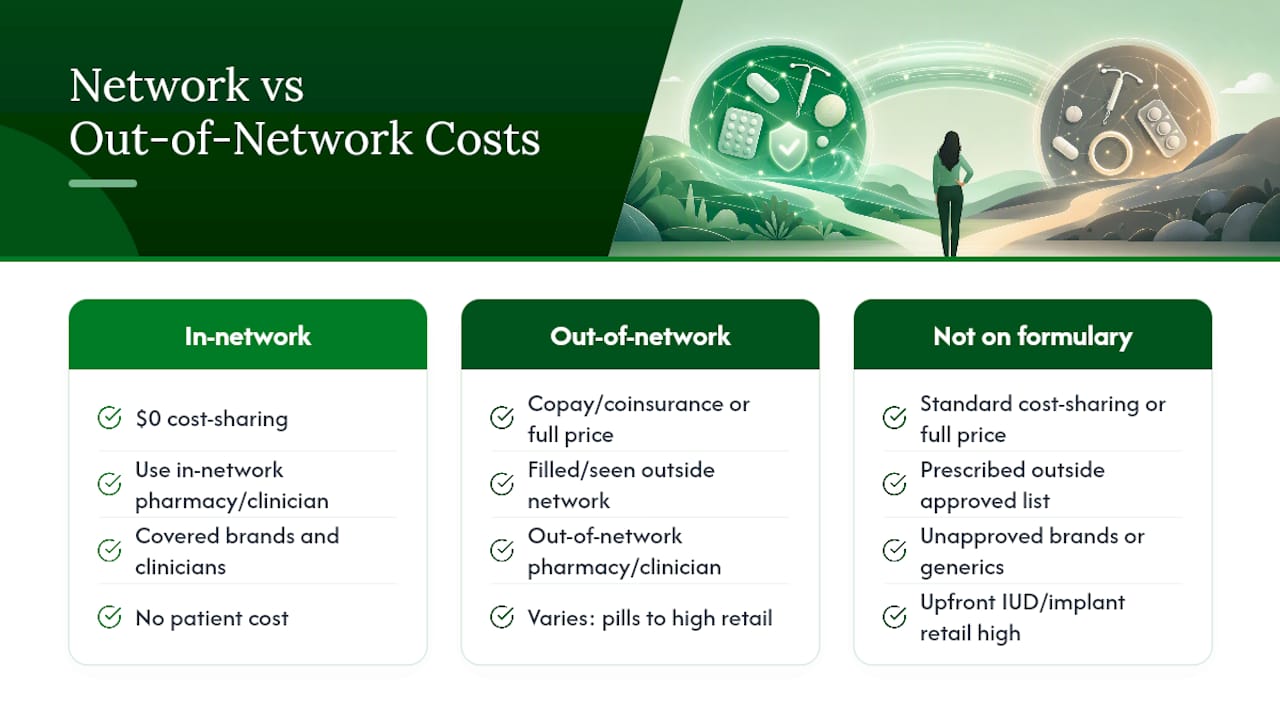
Cost-sharing rules only apply cleanly when you stay inside your plan’s network, and that’s where a lot of unexpected bills come from. If you fill a prescription at an out-of-network pharmacy or see a clinician who isn’t contracted with your insurer, your plan can legally apply a copay, coinsurance, or the full cash price, even for a method that would have been free in-network.
The same logic applies to methods your plan simply doesn’t cover as part of its formulary. If your insurer’s approved list includes only certain IUD brands or a specific generic pill, and your clinician prescribes something outside that list without a documented medical necessity exception, you’re likely looking at standard cost-sharing rates or the full retail price.
Retail pricing for contraception varies widely depending on the method. Birth control pills without insurance often run somewhere in the range of a modest monthly cost up to a higher figure depending on brand, while IUDs and implants carry a much larger upfront cost, offset over years of use. Clinics like Planned Parenthood publish typical price ranges for people paying without insurance, which is worth checking before assuming a method is out of reach.
The fix, when possible, is asking your clinician for an in-network alternative in the same category before paying out of pocket. If a specific brand is medically necessary, an exception request backed by documentation can sometimes convert an out-of-network charge into a covered claim after the fact, though this isn’t guaranteed and depends on your plan’s exception process.
Can Minors Get Birth Control Through Their Parents’ Insurance Privately?
This is one of the most common and least discussed friction points in the entire system. Many states allow minors to consent to their own contraceptive care without parental permission, but insurance billing doesn’t always respect that same boundary.
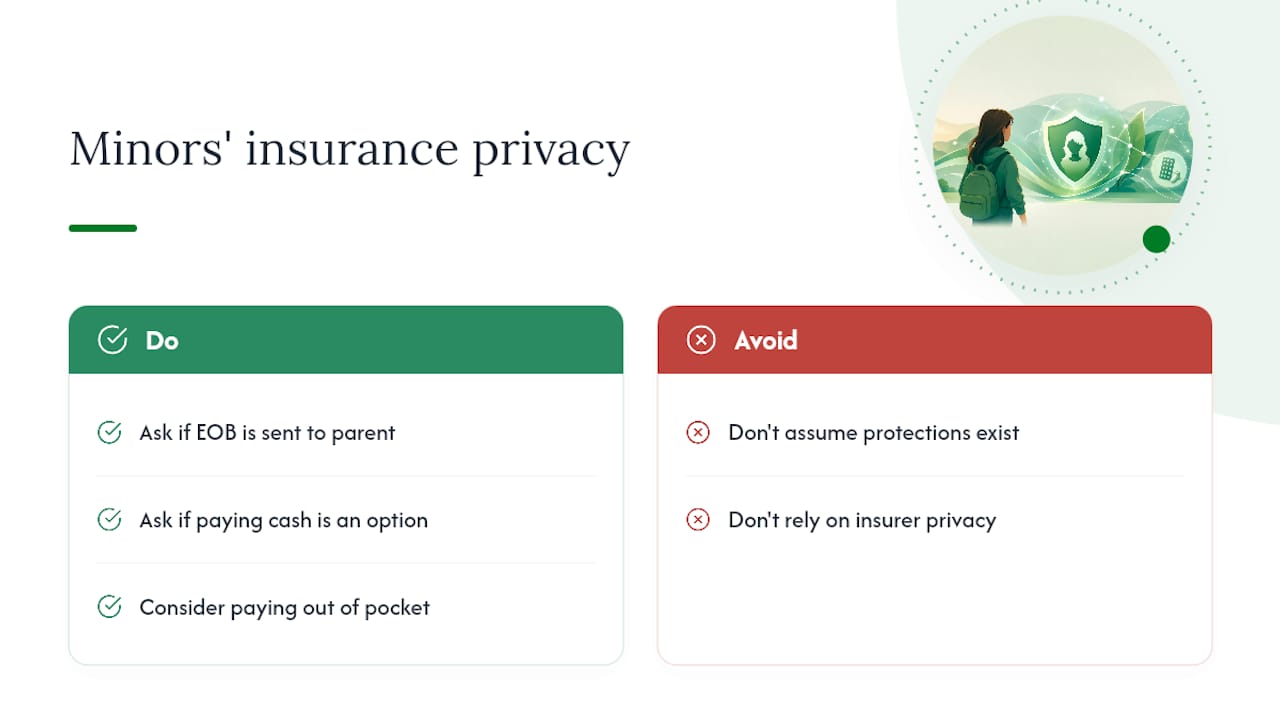
When a minor is covered under a parent’s health plan, the insurer typically sends an Explanation of Benefits (EOB) statement to the policyholder, meaning the parent, every time a claim is processed. That EOB can list the type of service received, which can inadvertently disclose a confidential visit even when the minor legally had the right to seek care privately.
Some states have passed “confidentiality laws” that restrict what insurers can show on an EOB for sensitive services, sometimes allowing the EOB to be suppressed or sent directly to the minor patient instead of the policyholder. But this protection is inconsistent nationwide, and many states offer no such safeguard at all.
If confidentiality is a concern, it’s worth asking the clinic or telehealth provider directly whether the visit will generate a billing statement visible to a parent, and whether paying out of pocket instead of billing insurance is an option to avoid that entirely. For many young patients, particularly those in states without strong confidentiality protections, paying cash for a single visit or prescription can be the more private route, even when insurance would otherwise cover it.
How to Read an EOB for Birth Control Charges
An Explanation of Benefits is not a bill, even though it looks like one, and misreading it is one of the most common reasons people panic over a charge they never actually owe. It’s a summary your insurer sends after processing a claim, showing what was billed, what the plan covered, and what portion (if any) you’re responsible for.
For birth control specifically, look for three numbers: the billed amount, the plan’s allowed amount, and your cost-sharing responsibility, which should read $0 if the method falls under the ACA’s preventive-services mandate and was provided in-network. If that last number isn’t zero, that’s your signal something went wrong, whether it’s a network error, a formulary mismatch, or a coding issue on the provider’s end.
The EOB will also list a claim number and a brief description of the service, which is exactly what you’ll need if you have to call your insurer to dispute the charge or file an appeal. Keep every EOB related to a contraceptive claim, even ones that look fine, since a pattern of correct $0 statements can help prove your case if a single claim later gets billed incorrectly.
If you’re on a family plan and confidentiality matters to you, remember that the EOB is typically mailed or emailed to whoever holds the policy, not necessarily to the person who received care.
A Clinician’s View on What Actually Gets Coverage Approved
Denials rarely come down to whether contraception is covered in general. They come down to documentation gaps: a formulary mismatch, a missing prior authorization, or a note that doesn’t explicitly state medical necessity. In practice, the language a clinician uses in a chart note or an appeal letter matters more than most patients realize.
The most effective appeals I’ve seen described in policy research name the specific condition, note any prior method that failed or caused side effects, and state plainly why the requested method is medically necessary rather than merely preferred. That level of detail is what separates a fast reversal from a denial that drags on for weeks.
Telehealth has a real role here, not as a replacement for insurance coverage, but as a bridge. A same-day virtual visit can get you an active prescription today while your appeal or benefits question gets sorted out, which matters when a gap in access is the actual problem rather than a philosophical one about who should pay. Use it to stay covered in the meantime, not as a reason to stop pushing your insurer for what you’re owed.
— Bryan
Getting Birth Control Fast When Insurance Is Unclear
If you’re stuck untangling a prior authorization or waiting on an appeal, you still need a method that works today, and that’s a reasonable reason to look at telehealth as a bridge, not a replacement for pursuing your coverage. You can connect with a licensed clinician online and, if a prescription makes sense for your situation, it can be sent for pickup or delivered to your door.

This matters most in two situations: you need a method now while your insurance question gets sorted out, or your plan’s barriers (a slow prior authorization, a formulary gap, an in-network provider who’s booked out for weeks) are creating a real delay in care you can’t afford to wait through. A visit through Zealthy’s birth control service doesn’t require you to abandon an appeal or give up on getting your insurer to pay what it owes. It just means you’re not left without options while that process plays out.
Zealthy also handles primary care visits, so ongoing contraceptive management, refills, and related health questions can stay in one place instead of scattered across separate appointments. If you want a straightforward next step, start a visit through Zealthy and get a clinician’s take on your options today.
Where to Verify Coverage Rules and File a Complaint
For anything beyond what your insurer tells you over the phone, these are the sources worth going straight to:
- HealthCare.gov for the official Marketplace rules on what preventive contraceptive coverage must include.
- CMS tri-agency guidance for what enforcement agencies expect plans to do, and what counts as an impermissible barrier.
- KFF’s state policy tracker for a state-by-state breakdown of contraceptive mandates and cost-sharing rules.
- The FDA for confirmation on which contraceptive methods and OTC products currently hold approval.
- Your state insurance department for filing a complaint against a fully insured plan that isn’t following state or federal rules.
Match the question to the source: verify your specific benefits with your insurer’s SBC, file a formal complaint with HHS, CMS, or the DOL, check state-specific mandates through KFF, and confirm FDA status directly before assuming a method isn’t approved.
This article is general information, not a substitute for advice from a qualified doctor. Consult a qualified healthcare professional about your own circumstances before acting on anything here.
Sources
- Healthcare
- HHS, DOL, and Treasury Issue Guidance Regarding Birth Control Coverage | CMS
- Policy landscape of private insurance coverage of contraception in the U.S. | KFF
- FDA media/document on Opill and contraceptive approvals
- How to get birth control pills and how much they cost | Planned Parenthood
FAQ
Is birth control 100% covered by insurance?
Most FDA-approved methods are covered with no copay or deductible when you use an in-network provider under a non-grandfathered plan, but grandfathered plans, some self-insured employer plans, and certain religious exemptions can mean coverage isn’t complete or automatic.
Is birth control covered under my insurance if I have a large national carrier?
Coverage depends on your specific plan design, not just which insurance company issues the card, since the same carrier can administer both ACA-compliant plans and grandfathered or self-insured plans with different rules. Check your SBC or call member services to confirm which category your plan falls into.
Why is my birth control no longer covered by insurance?
The most common causes are a formulary change dropping your specific brand, a new prior authorization requirement, a switch to an out-of-network pharmacy or provider, or your employer moving to a different plan type. Comparing this year’s EOB against a previous one that showed $0 cost-sharing usually reveals exactly what changed.
How do I tell if my insurance covers birth control?
Check your plan’s Summary of Benefits and Coverage for the preventive services section, then confirm with your insurer or HR whether your plan is grandfathered or self-insured, since those categories follow different rules. If you’re still unsure, a same-day visit through Zealthy can get you a prescription while you sort out the coverage question.
What should I do if my insurance denies coverage for a specific method?
Ask your clinician to document medical necessity in writing, including any prior method that failed, then file an internal appeal with your insurer before escalating to HHS, CMS, or the Department of Labor if the denial stands.




.svg)
.svg)
.svg)
.svg)

