TL;DR
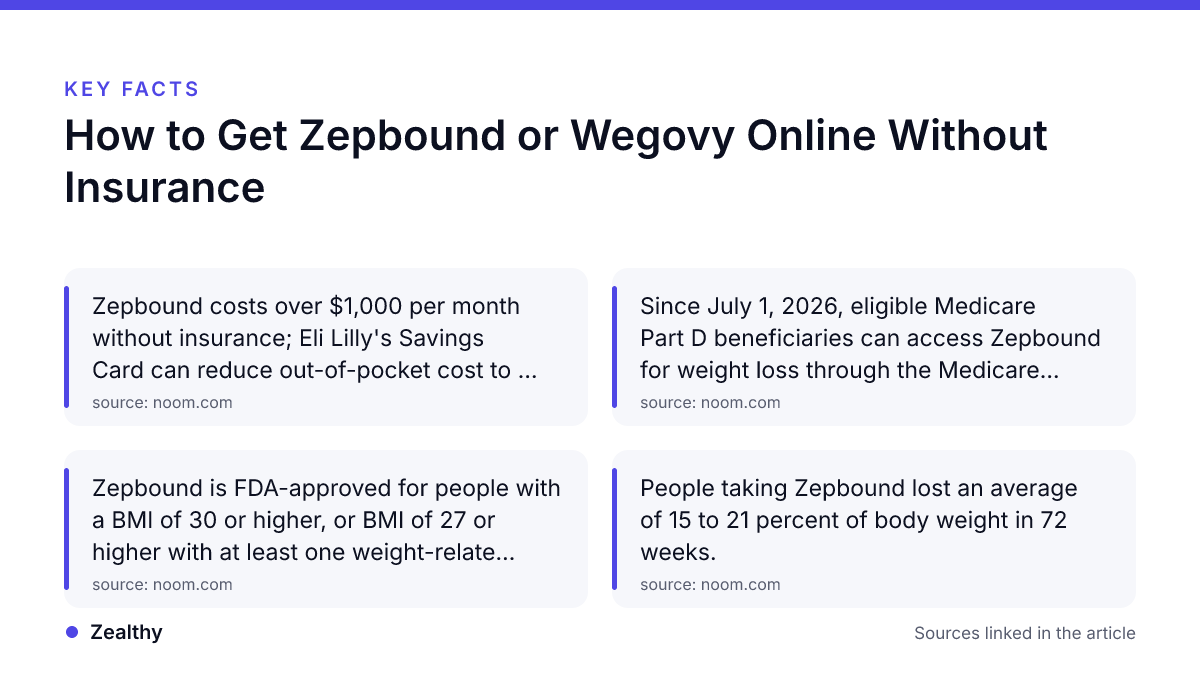
- Zepbound without insurance runs over $1,000 a month at list price, but Eli Lilly's Savings Card can bring eligible patients' out-of-pocket cost down to as low as $25 a month, per Noom's cost breakdown.
- You generally qualify for Zepbound if your BMI is 30 or higher, or 27 or higher with a weight-related condition like high blood pressure.
- Eligible Medicare Part D beneficiaries can get Zepbound for weight loss at a flat $50-a-month copay through the Medicare GLP-1 Bridge program, which opened July 1, 2026.
- A telehealth visit replaces the in-office exam. Providers confirm BMI and medical necessity through a video visit, your reported vitals, and your health history, not a scale in a waiting room.
- In clinical trials, people on Zepbound lost 15 to 21 percent of their body weight over 72 weeks, which gives you a real benchmark for what "working" should look like.
Dana is 38, self-employed, has no insurance through her business, and has spent two years watching her BMI creep from 28 to 32. Her doctor mentioned Zepbound at her last physical. Then she looked up the price at her local CVS and nearly closed the tab: just over $1,000 for a single month's supply. No insurance card to hand over. No employer HR line to call.
She assumed that was the end of it.
It wasn't. The affordable path to a GLP-1 prescription without insurance runs through three things most people never get explained: a telehealth visit that actually checks eligibility, a manufacturer savings program nobody tells you to ask about, and a Medicare pathway that didn't exist two years ago. Here's how each one works.
Table of Contents
- What does it actually take to get Zepbound or Wegovy online without insurance?
- Who qualifies for Zepbound or Wegovy, and how do telehealth providers check?
- What's the cheapest way to get Zepbound without insurance?
- How does the Medicare GLP-1 Bridge program work, and who's eligible?
- How do telehealth platforms compare on cost and process?
- What happens after your prescription is approved?
- Frequently asked questions
What does it actually take to get Zepbound or Wegovy online without insurance?
Three things. A BMI of 30 or higher (or 27+ with a condition like hypertension), a telehealth visit with a US-licensed provider who reviews your history and confirms medical necessity, and a plan for paying for the drug itself. Zepbound costs over $1,000 a month at list price, but the manufacturer's Savings Card can drop that to as low as $25 a month for eligible patients, according to Noom.
You don't need a referral. You don't need an existing primary care doctor. The intake, the visit, and the prescription can all happen online inside of a few days.
That last part matters more than people expect. The old sequence (see a doctor in person, carry a paper script to a pharmacy counter, hope they're stocked) adds days of dead time to a process that doesn't require any of it. We mapped out exactly how much time it costs in our breakdown of why CVS pharmacy waits cost you refill days. Short version: the pharmacy counter is a bottleneck, not a requirement.
Who qualifies for Zepbound or Wegovy, and how do telehealth providers check?
Zepbound is FDA-approved for adults with a BMI of 30 or higher, or a BMI of 27 or higher paired with at least one weight-related health condition such as high blood pressure, per Noom's eligibility criteria. Wegovy's criteria sit in the same territory.
The question most articles skip: how does a provider confirm any of that when you're sitting on your couch?
- Self-reported height and weight, cross-checked against your intake information and any recent labs or primary care records you can share.
- A structured health history intake that flags qualifying conditions (hypertension, prediabetes, sleep apnea, weight-driven joint pain) before the visit starts.
- A live video visit where a licensed provider asks the things a form can't catch: prior GLP-1 use, thyroid history, pregnancy status, gallbladder issues, and family history of medullary thyroid carcinoma, which is a hard contraindication for this drug class.
- Ongoing check-ins after the first prescription, where your dose gets adjusted based on tolerance and results rather than a fixed schedule.
This is the same clinical logic an in-person visit uses, minus the commute. Forbes' guide to getting Zepbound covers eligibility from a similar angle if you want a second source.
Pro tip: Have a blood pressure reading from the last few months and any lab work from the last year ready before you log on. The single most common reason a GLP-1 request stalls isn't ineligibility. It's a provider waiting on documentation of the qualifying condition you already have. Screenshots of a patient portal lab page are fine. So is a photo of a home BP cuff reading with the date visible.
If your BMI doesn't clear the threshold, that isn't a dead end for your broader goals. Men focused on metabolic health, energy, and hormone optimization rather than a GLP-1 specifically may get more out of a physician-led longevity practice like YOURx Health, which works the metabolic and hormonal side of the problem.
What's the cheapest way to get Zepbound without insurance?
For most people it's the manufacturer's savings card, which can cut the monthly cost from over $1,000 to as low as $25. For Medicare patients, it's the GLP-1 Bridge program at a flat $50. Here's the math so you can run it on your own numbers.
Full retail, no discount: over $1,000 a month. At $1,000, a year costs $1,000 × 12 = $12,000.
With the Lilly Savings Card: as low as $25 a month. $25 × 12 = $300 a year.
The spread: $12,000 − $300 = $11,700 a year for the identical medication.
Now put results against that. In clinical trials, people taking Zepbound lost 15 to 21 percent of their body weight over 72 weeks, which is roughly a year and a half, per Noom. Take a 220-pound patient at the 17 percent midpoint: 220 × 0.17 = 37 pounds.
At $300 a year, that's roughly $8 per pound lost. At list price, it's about $324 per pound. Same drug, same 37 pounds. The only variable is whether you spent ten minutes checking your savings card eligibility first.
A few other levers if the card doesn't apply to you:
- Ask about pricing across dose strengths. Pricing isn't always flat across the whole titration schedule, so ask your provider what each step actually costs before you assume it's fixed.
- Compare cash-pay telehealth bundles against standalone pharmacy pricing. Some platforms fold the visit, coaching, and medication coordination into one predictable monthly number instead of three separate bills. We broke down what that looks like in Quick Fix or Full Job: What Telehealth Costs You.
- Don't assume a compounded alternative is automatically cheaper or safer. Sourcing and quality vary between compounding pharmacies. Ask your provider exactly what they're prescribing and where it comes from.
Pro tip: Manufacturer savings cards almost always exclude Medicare and Medicaid patients. That's standard across pharma copay programs, not a Zepbound quirk. If you're on Medicare, skip the commercial card entirely and go straight to the Bridge program.
How does the Medicare GLP-1 Bridge program work, and who's eligible?
The Medicare GLP-1 Bridge program gives eligible Medicare Part D beneficiaries access to Zepbound for weight loss at a flat $50-a-month copay, effective July 1, 2026, per Noom's coverage of the program. That's a meaningful shift. Medicare has historically excluded weight-loss drugs outright, which pushed seniors with genuine obesity-related conditions into paying full retail or chasing a different diagnosis to get any coverage at all.
If you're on Medicare and considering Zepbound:
- Confirm your specific Part D plan participates. Plans don't all behave identically here. Call the number on the back of your card and ask about Bridge program participation for tirzepatide, by name.
- Get your BMI and qualifying conditions documented in writing. A clean paper trail of the diagnosis moves enrollment along much faster than a verbal history.
- Ask how the $50 copay interacts with your deductible. Part D plans vary on whether specialty tiers sit behind the deductible, and GLP-1s land in the top tier nearly every time.
The arithmetic: $50 × 12 = $600 a year, against $12,000 at full retail. That's $11,400 saved annually, landing in roughly the same place commercially insured patients get with the savings card, just through a different door.
How do telehealth platforms compare on cost and process?
They differ in two places: how they price the visit versus the medication, and how much ongoing support is baked into that price instead of sold as an add-on.
| Pathway | Monthly cost | Who it's for |
|---|---|---|
| Retail pharmacy, no insurance, no discount | Over $1,000 | Anyone, and it's the most expensive route by a wide margin |
| Lilly Savings Card | As low as $25 | Patients with commercial insurance that covers Zepbound |
| Medicare GLP-1 Bridge | Flat $50 copay | Eligible Medicare Part D beneficiaries |
| Compounded GLP-1 alternatives | Varies by compounding pharmacy | Uninsured patients seeking lower cost; verify sourcing first |
| Cash-pay telehealth with ongoing care | Visit fee plus medication, no insurance needed | Patients who want dose titration and check-ins included, not a one-time script |
Price is half the comparison. Speed is the other half, and it's the half people underestimate until they're living it. The traditional route looks like this: book a primary care appointment that's one to three weeks out, get a referral, wait for the specialist slot, collect a prescription, then start calling pharmacies to find one that has your dose. GLP-1 supply has been genuinely unpredictable at chain pharmacies, and in our experience the dose you need is often the one that's backordered while the strength above and below it sit on the shelf.
Telehealth collapses that chain into a same-week process for most patients. See how online prescription services actually work for the mechanics of how an e-prescription moves from your visit to your door.
Pro tip: If your script goes to a retail counter instead of mail order, call before you drive. Ask specifically whether they have your strength in stock, not just "Zepbound," because those are two different answers. No 24 hour pharmacy nearby? 6 faster options covers what to do when the answer is no.
What happens after your prescription is approved?
The medication ships to your door, refills get set up so you're not re-ordering every month, and check-ins are scheduled to track progress and adjust your dose. This is the part generic listicles skip, and it's the part that decides whether you land in that 15 to 21 percent range or quietly stall at month three.
What a follow-up process should actually include:
- Scheduled dose escalations. GLP-1s are titrated up gradually to limit nausea and GI side effects. Nobody starts at full strength, and rushing the ladder is the fastest way to end up abandoning the drug entirely.
- Coaching on protein and resistance training. Appetite suppression this strong means people under-eat protein without noticing, and a meaningful share of the weight lost can be lean mass. Get specific targets from your care team, not just "eat healthy."
- Side effect triage without a new appointment. A message to your care team when constipation or an injection-site reaction shows up, answered in hours, not at your next visit three weeks out.
- Refill automation. Missing a week mid-titration often means stepping back down a dose, which costs you more time than the gap itself did.
If you're juggling this alongside other things you've been putting off, a single telehealth visit usually covers more ground than people expect. Here's what an online primary care visit actually covers.
Frequently asked questions
Does Zealthy prescribe the new Wegovy pill, or only the injection?
Wegovy's pill form was FDA-approved in late 2025, giving patients wary of self-injecting a needle-free alternative to the weekly shot, per Everyday Health. Ask your provider during the visit which formulation fits you. It usually comes down to preference and how your body tolerates each one.
What if my pharmacy says Zepbound or Wegovy is out of stock?
Shortages still crop up regionally, and usually at specific dose strengths rather than across the whole product. Call before you drive over, and ask your telehealth provider to reroute the prescription to another pharmacy or to mail order.
Can I use the Lilly Savings Card and the Medicare GLP-1 Bridge program together?
No. The savings card is built for patients with commercial insurance, and federal rules generally bar Medicare and Medicaid beneficiaries from stacking manufacturer copay cards on top of government coverage. On Medicare, the Bridge program's flat $50 copay is your pathway.
If Dana's situation sounds like yours (BMI in range, no coverage through work, tired of guessing what a prescription will actually cost), the next move is a visit that checks eligibility honestly and lays out every pricing path open to you. Get started with Zealthy and you'll know within days, not weeks, whether $25 or $50 a month is the number you're working with.


