TL;DR
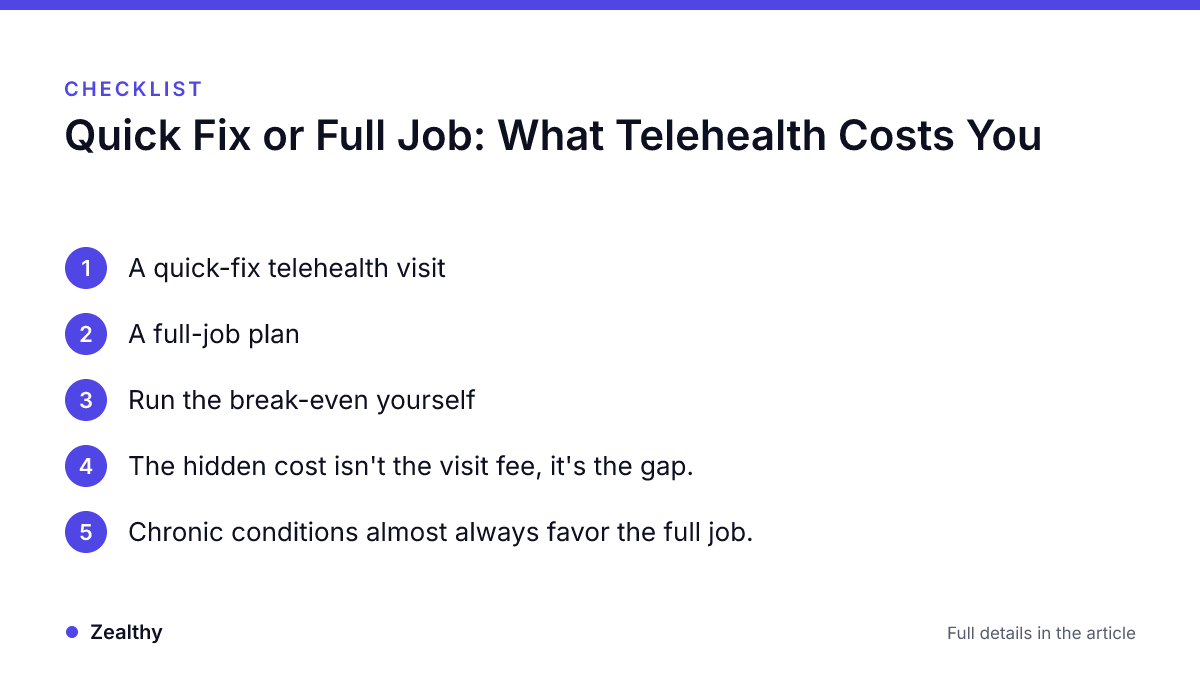
- A quick-fix telehealth visit solves one problem once (a refill, a single prescription, an urgent script) and you pay per visit with nothing carrying forward.
- A full-job plan bundles recurring visits, dose adjustments, and refills into one membership fee, which wins on total cost once your care stops being occasional.
- Run the break-even yourself: annual membership cost ÷ price per one-off visit = the number of visits where the plan starts paying for itself. In our experience that lands somewhere around five visits a year.
- The hidden cost isn't the visit fee, it's the gap. Days without medication while you wait on a backordered pharmacy don't show up on any invoice, but you feel them.
- Chronic conditions almost always favor the full job. Weight management, birth control, anxiety, and skin conditions need adjustment over time, and one-off visits can't do that.
Maria hit refill on her birth control app at 6:40 on a Friday evening and got the little red exclamation point: "Pharmacy needs 3-5 business days to process." Her CVS counter closed at 7. She had eleven minutes. When she called ahead, the pharmacist told her they were out of her generic anyway and would have to order it. Saturday morning she called a Walgreens two towns over, got put on hold twice, and gave up.
That's how most people meet telehealth. Not out of curiosity. Because they're stuck.
The question Maria actually faced wasn't whether to use telehealth. It was whether to pay for one visit to patch this, or sign up for something ongoing so it never happens again. Same fork in the road whether you're dealing with birth control, GLP-1 weight loss care, ED treatment, hair loss, skincare, or anxiety.

Table of Contents
- What's the difference between a quick-fix visit and a full-job telehealth plan?
- How much does each option actually cost, and where does the money go?
- When does the quick fix actually make sense?
- When does skipping the full job end up costing you more?
- How did Maria decide, and what did her month look like?
- How do you decide which one is right for you?
- Frequently asked questions
What's the difference between a quick-fix visit and a full-job telehealth plan?
A quick fix is one transaction. You describe a problem, a licensed provider evaluates it, you get a prescription, and the relationship goes dormant until you need something again. A full job is a standing care relationship: recurring visits, medication management, dose changes, and refills that fire automatically instead of making you restart the whole process.
Think of it like your car. A quick fix is driving to a shop because the check-engine light came on. A full job is a maintenance plan where somebody's tracking your mileage and calling you before the belt snaps. Both are legitimate. They solve different problems.
- Quick fix fits one-time or rare needs: a single ED prescription before a trip, a UTI antibiotic, a bridge script while you're between providers.
- Full job fits anything that recurs: GLP-1 weight loss with medications like Zepbound, Wegovy, or Ozempic; birth control that needs refilling every month; anxiety or depression treatment; acne and rosacea that flare back the moment you stop.
- The provider relationship changes too. Quick-fix visits usually route you to whoever's available that day. Full-job plans keep you with a provider who already knows your history and adjusts the plan as your labs, weight, or symptoms move.
Pro tip: not sure which bucket you're in? Ask yourself whether you'll need this again within 90 days. If you honestly would, it's a full-job situation even when it feels like a one-off today.
How much does each option actually cost, and where does the money go?
Quick fixes have the lower sticker price per visit. Full-job plans win on total cost once you need care more than a couple of times a year. The figures below are a working example based on what we typically see, not a quote, since real pricing swings with condition, medication, and insurance.
| Factor | Quick fix visit | Full-job plan |
|---|---|---|
| Cost structure | Pay per visit, roughly $50–$90 each time | Flat monthly membership, lower per visit once averaged out |
| What's included | One evaluation, one prescription | Recurring visits, dose adjustments, refill coordination, provider messaging |
| Best for | Isolated needs that won't recur | Weight loss, birth control, mental health, skin, hair |
| Refill process | You restart intake and evaluation each time | Refills ship on a set schedule |
| Time cost | Low once, brutal if repeated four times a year | Front-loaded: intake and first visit, then almost nothing |
| Risk of gaps in care | High; easy to run out waiting on the next visit | Low; the model exists to prevent lapses |
Show the math
Take a quick-fix visit at $80. You need three this year for unrelated things: a UTI, a skin flare, and a one-off refill because your pharmacy was backordered. That's 3 × $80 = $240. A membership would have been a waste of money. Stay on quick fixes.
Now flip it. You're managing anxiety that needs monthly check-ins plus refills, and rosacea that needs an initial visit plus follow-ups every few months. Realistically that's five to six touchpoints a year. At $80 each, you're at $400 to $480, and that's before you count the days you spend without medication waiting for each new visit to get on the calendar.
A membership at $35/month runs $35 × 12 = $420 a year, covering all of it with no gaps and no re-explaining your history to a stranger every time.
Here's the formula worth memorizing: annual membership cost ÷ price per one-off visit = your break-even visit count. At $420 and $80, that's 420 ÷ 80 = 5.25 visits. Cross roughly five visits a year for the same condition and the plan is the cheaper option, not the indulgent one.
Plug in your own numbers. If your quick-fix visits run $60 and the plan is $29/month, break-even is (29 × 12) ÷ 60 = 5.8 visits. The threshold barely moves. That's the point.
When does the quick fix actually make sense?
When the need is genuinely isolated. One prescription for something that won't come back, or a stopgap while you sort out longer-term care somewhere else. Traveling and forgot your ED prescription? One visit. Need a single round of antibiotics? One visit. Don't buy a membership you won't use just because it sounds more organized.
It's also the smarter call when:
- You're testing the waters. First time using telehealth, and you want to see how a provider communicates before you commit to anything recurring. Our guide on how online prescription services actually work covers what to expect.
- Your pharmacy is just having a bad week. You need a bridge, not a new system. Anyone who's hunted for a 24-hour pharmacy nearby at 11pm knows a single fast visit often ends the whole ordeal.
- The condition has a clear endpoint. Sleep trouble from a two-week work crunch or a time-zone change isn't a chronic condition. Treat it like what it is.
When does skipping the full job end up costing you more?
The minute your "one-time" need turns out to be recurring and you keep paying the one-time price. That's the trap Maria nearly walked into. She'd filed her birth control lapse as a pharmacy problem, when in fact it was the third time in a year her pharmacy had run short or stalled a refill.
Chronic conditions are where continuity earns its cost:
- GLP-1 weight loss treatment needs regular check-ins to titrate the dose, catch side effects early, and keep the nutrition and activity side moving. A single visit can get you a starting prescription. It can't get you through the month your nausea spikes or your progress stalls at dose three.
- Birth control needs refills landing before the pack runs out, every time, with no negotiation.
- Anxiety and depression care depends on the same provider watching whether a medication is working across weeks. Starting over with a new evaluation every time resets that clock, and you end up re-litigating decisions you already made.
- Hair loss and skincare for acne, rosacea, or hyperpigmentation take a couple of months before you know whether the plan is working. Most people need at least one adjustment in that window. Isolated visits can't make that call because nobody's watching the trend line.
Pro tip: if you've paid for the same kind of quick-fix visit twice in six months, that's your signal. You're not dodging a membership fee at that point. You're paying twice for the privilege of starting from scratch.
How did Maria decide, and what did her month look like?
She ran the numbers the way we just did and found something she hadn't tallied before: this was her fourth pharmacy scramble in fourteen months. She'd also been treating a stubborn rosacea flare with drugstore creams that weren't doing anything, and had been putting off a dermatology appointment because the next opening was weeks out.
She did a five-minute intake that night and had a visit with a licensed provider a couple of days later. Birth control moved to autoship, so a Friday-night pharmacy counter no longer decides whether she gets her medication. And because the visit wasn't a single-issue transaction, she raised the rosacea in the same appointment instead of booking a separate one.
Her total ongoing time investment now: opening the mailbox. Compare that to the old pattern of a scramble every few months, a drive across town, a hold with a pharmacist, and a day or two off her medication in between.
How do you decide which one is right for you?
Match the option to how often you actually need care, not to how urgent the problem feels today. A flare feels urgent whether it's the first time or the fifth. The feeling tells you nothing. Your history tells you everything.
- Count your visits over the last 12 months for the same condition. Two or more and you're already living the full-job life without any of the full-job convenience.
- Check whether the condition is chronic by nature. Weight management, hormonal birth control, anxiety, depression, hair loss, and most skin conditions are, even when any single flare looks temporary.
- Price the gap, not just the visit. A week without anxiety medication is a different event than a week without a one-time antibiotic. Weight that accordingly.
- Still unsure? A broader comparison of telehealth providers shows how different platforms structure their one-off versus ongoing options, and our breakdown of what you save versus Walgreens is useful if pharmacy pricing is part of your math.
One more thing worth knowing. If your need is narrow, say male hormone optimization rather than general care, telehealth-only brands like yourxhealth.com specialize in that lane. You're not stuck choosing between a generalist and nothing.
Frequently asked questions
Can I switch from a quick-fix visit to an ongoing plan later without starting over?
Yes. Your visit history and prescription information carry forward, so moving to ongoing care means adding a plan, not repeating intake from zero.
Does insurance change which option makes more financial sense?
It can. If your insurance covers the medication itself, your real cost becomes the visit and coordination fee instead of the drug price. That usually tips the math further toward the full job, because what you're buying is continuity rather than pills.
What happens if I only need a full-job plan seasonally, like allergy-related skin flares?
You can generally pause or cancel and restart later. Run the full-job model during your flare window, then drop back to one-off visits or nothing at all once it settles. Seasonal doesn't mean permanent commitment.
If you're looking at a lapsed prescription right now the way Maria was, don't spend Saturday morning on hold with a pharmacy counter. Start a five-minute intake and let a licensed provider tell you whether one visit closes this out or whether it's time to put the whole thing on autopilot.


.svg)
.svg)
.svg)
.svg)

