

TL;DR:
- Virtual counseling options like teletherapy, message-based psychotherapy, and app programs are effective for mild-to-moderate anxiety and depression, often matching or exceeding in-person care. The best format depends on individual needs, with hybrid models and licensed providers offering comprehensive, accessible support. Careful evaluation of credentials, privacy, and insurance coverage ensures a safe and suitable virtual therapy experience.
Video teletherapy, message-based psychotherapy, evidence-based app programs, group teletherapy, asynchronous coaching, and hybrid models are all realistic virtual counseling alternatives to traditional therapy for mild-to-moderate anxiety and depression. A systematic review and meta-analysis found that virtual interventions produced higher remission rates compared to waitlist or treatment-as-usual controls, with no consistent evidence that in-person care is superior for mild-to-moderate depression. The American Psychological Association similarly frames many digital mental health tools as effective components of care, particularly within hybrid models.
| Format | Best fits |
|---|---|
| Synchronous video teletherapy | Most conditions; prefers face-to-face interaction |
| Message-based psychotherapy | Flexible schedules; mild-to-moderate depression |
| App-based CBT programs | Self-guided learners; mild symptoms |
| Group teletherapy | Social support needs; cost-conscious patients |
| Asynchronous coaching | Skill-building between sessions |
| Hybrid models | Complex needs; wants both remote and in-person access |
How do the main virtual counseling formats actually work?
Virtual care is not one thing. Each format delivers therapy differently, and understanding those differences helps you choose what fits your life.
Synchronous video teletherapy mirrors a traditional session most closely. You meet a licensed therapist face-to-face over a secure video platform, typically for 45–55 minutes. Phone therapy follows the same structure without the visual component, which some patients actually prefer for reducing self-consciousness.
Message-based psychotherapy (MBP) is asynchronous: you and your therapist exchange written messages on a secure platform, usually with a guaranteed response window. A randomized clinical trial published in JAMA Network Open found MBP produced outcomes comparable to video-based psychotherapy for depression, with lower disengagement in some analyses. One underappreciated benefit: the written record of exchanges can help you track symptoms and implement action plans between sessions.
App-based digital therapeutics (DTx) are clinically distinct from general wellness apps. The APA distinguishes regulated DTx as evidence-based interventions, sometimes requiring a prescription, from consumer apps that lack clinical validation. If you’re evaluating an app, look for peer-reviewed trial data, not just app store ratings.
Group teletherapy delivers structured therapy to multiple participants over video. It costs less per session than individual care and adds a peer-support dimension that some patients find motivating.
Tele-medication management pairs a prescribing clinician with a patient for psychiatric medication evaluation and follow-up, fully remotely. Hybrid models combine any of the above with periodic in-person visits, which the APA often recommends for patients with more complex needs.
When evaluating any service, confirm that providers hold active state licenses, that the platform uses HIPAA-compliant infrastructure, and that a crisis protocol exists before you need it.
Pro Tip: Set up a dedicated, private space before your first session. Use noise-canceling headphones, close unnecessary browser tabs, and place a “do not disturb” sign on the door. Clinicians recommend treating this space the way you would a private office to protect confidentiality and reduce distractions.
What does the research say about virtual versus in-person therapy?
The evidence base for virtual care has grown substantially, and the headline finding is reassuring. A PMC systematic review and meta-analysis covering virtual interventions for depressive disorders found:
UCLA Health’s summary of more than 60 studies concludes that online therapy is comparable to in-person care for anxiety, depression, and PTSD, and that cognitive behavioral therapy (CBT) adapts particularly well to virtual delivery. A PMC review on virtual CBT describes eCBT as a cost-efficient alternative that improves access and patient autonomy.
Gaps remain. Head-to-head trials comparing every virtual modality are still limited. Patients without reliable broadband or private space face real access barriers. And the evidence base for severe or acute conditions, including active psychosis or high-acuity suicidality, does not yet support virtual-only care as a substitute for in-person treatment.
Who benefits most, and when should you prefer in-person care?
Virtual care works well for many people, but it is not the right fit for every situation.
Strong candidates for virtual-first care:
- Mild-to-moderate depression or anxiety
- Geographic or mobility barriers to clinic access
- Social anxiety that makes in-person visits difficult
- Busy schedules requiring flexible appointment times
- Patients who prefer the comfort of their own environment
Situations where in-person care is preferable or required:
- Active suicidality or recent self-harm
- Severe manic episodes or active psychosis
- Severe substance withdrawal requiring medical monitoring
- Conditions requiring physical examination or lab work
- Crisis situations needing immediate intervention
Multiple studies and reviews note that teletherapy generally improves attendance and reduces stigma for patients who avoid clinics. That said, reduced nonverbal cues, data privacy risks, and technology requirements are real limitations. If your internet connection is unreliable or you lack a private space, those barriers can undermine the quality of care regardless of the platform’s clinical credentials.
How do you choose the right virtual counseling option?
Use this checklist before committing to any service.
| Criterion | What to confirm |
|---|---|
| Provider licensing | Active state license; therapist vs. coach distinction |
| Treatment model | CBT, ACT, psychodynamic — matches your goals |
| Crisis availability | 24/7 crisis line or clear escalation protocol |
| Medication management | Available if needed; prescribing clinician on staff |
| HIPAA compliance | Encrypted platform; clear data-use policy |
| Insurance coverage | In-network status; reimbursement for your plan |
| Cost structure | Per-session, subscription, or employer-sponsored |
| Provider experience | Average years of clinical practice |
| Continuity of care | Same provider over time; referral process if needs change |
Questions worth asking before you sign up: What is the guaranteed response time for messages? How does the platform handle a mental health emergency? What is the provider turnover rate? How do you request an in-person referral if your needs escalate?
On cost, Forbes Health’s review of online therapy platforms notes that pricing, provider network size, and insurance acceptance vary widely across services. Check with your insurer whether video sessions, phone sessions, and message-based therapy are reimbursed at the same rate, since coverage policies differ. Many employers also offer mental health benefits through Employee Assistance Programs that cover several free sessions. For a step-by-step guide to accessible online therapy, including how to navigate insurance and find a licensed provider, that resource walks through the process clearly.
Key Takeaways
Virtual counseling is a clinically supported alternative to in-person therapy for mild-to-moderate depression and anxiety, with the right format depending on your symptoms, schedule, and access needs.
| Point | Details |
|---|---|
| Evidence supports virtual care | Meta-analyses show no consistent evidence that in-person care is superior for mild-to-moderate depression. |
| Format matters | Video, MBP, CBT apps, and hybrid models each suit different needs and schedules. |
| Know the red flags | Suicidality, active psychosis, and severe withdrawal require in-person or higher-acuity care. |
| Verify credentials and privacy | Confirm state licensure, HIPAA compliance, and a crisis protocol before enrolling. |
| Zealthy as an integrated option | Zealthy offers licensed mental health care, same-day access, and medication management in one virtual platform. |
The gap between what virtual therapy promises and what actually matters
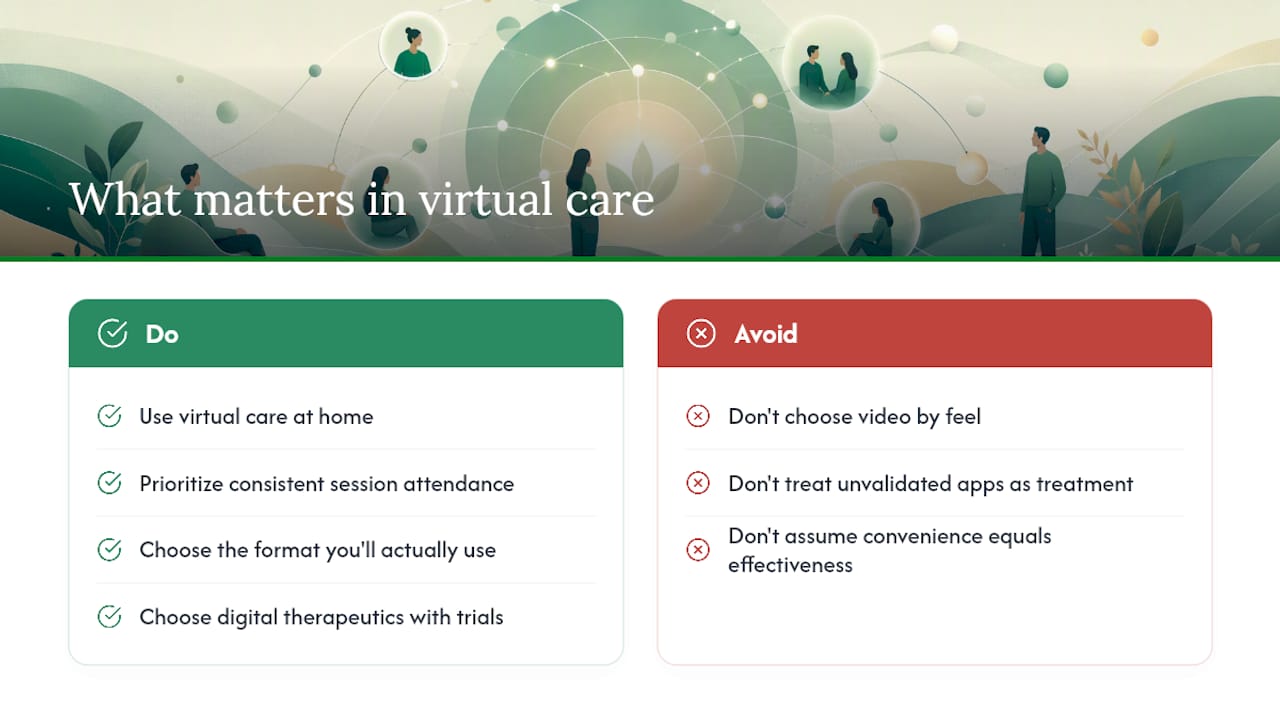
Virtual therapy’s biggest selling point is usually convenience. That framing undersells what the research actually shows. The more meaningful advantage is that virtual care meets patients in their own environments, which changes the therapeutic dynamic in ways that often improve engagement and follow-through. When someone attends a session from their living room rather than a clinical waiting room, the barrier to showing up consistently drops, and consistency is what drives outcomes in CBT and most evidence-based modalities.
What people underestimate is the importance of format matching. Choosing video therapy because it feels most like “real” therapy, when your schedule or anxiety level would make message-based care more sustainable, is a common mistake. The JAMA Network Open trial showing comparable outcomes for MBP and video-based care is a signal worth taking seriously: the best format is the one you will actually use.
The one area where caution is warranted is the wellness app category. Many apps marketed as mental health tools are not clinically validated. The APA’s distinction between regulated digital therapeutics and consumer wellness apps is not a technicality. It reflects a real difference in the evidence behind the product. If an app cannot point to a peer-reviewed trial, treat it as a supplement, not a treatment.
Zealthy brings licensed mental health care and primary care together
If you’re ready to move from research to care, Zealthy’s mental health services connect you with licensed clinicians who average over ten years of clinical experience, with same-day appointment availability and HIPAA-compliant messaging built into the platform. Zealthy integrates mental health care, primary care, and medication management in one place, so you are not coordinating between separate providers when your needs overlap.
Review Zealthy’s telehealth consent and privacy details before your first session, then complete a brief intake to get matched with a provider. Same-day scheduling means you do not have to wait weeks for a first appointment. Visit Zealthy to start your intake today.
This article provides general health information and is not a substitute for professional medical or mental health advice. Confirm current guidelines and your specific clinical needs with a licensed provider.
Useful sources and further reading
| Source | What it contributes |
|---|---|
| PMC: Efficacy of Virtual Care for Depressive Disorders | Systematic review and meta-analysis; remission and response data for virtual interventions |
| PMC: Virtual vs. In-Person CBT | Evidence for eCBT as a cost-efficient, accessible alternative to in-person CBT |
| JAMA Network Open: MBP vs. VBP RCT | Randomized trial comparing message-based and video-based psychotherapy outcomes |
| APA: Digital Therapeutics and Mobile Health | APA guidance distinguishing regulated DTx from consumer wellness apps |
| UCLA Health: Is Online Therapy Right for You? | Summary of 60+ studies on online therapy efficacy for anxiety, depression, and PTSD |
| Psychology.org: Online vs. In-Person Therapy | Pros, cons, attendance data, and practical environment recommendations |
| Forbes Health: Best Online Therapy Platforms | Consumer guide covering pricing, provider networks, and insurance acceptance |
| Zealthy Telehealth Consent | Zealthy’s privacy and consent policies for telehealth patients |
| Why use virtual therapists? | Partner resource on evidence and accessibility benefits of virtual therapists |
FAQ
Can virtual therapy fully replace traditional in-person therapy?
For mild-to-moderate depression and anxiety, virtual therapy often produces comparable outcomes to in-person care, according to multiple meta-analyses. For acute conditions like active psychosis or high-acuity suicidality, in-person or higher-acuity care remains necessary.
Is message-based therapy as effective as video therapy?
A randomized clinical trial in JAMA Network Open found no significant differences in depression outcomes between message-based and video-based psychotherapy, with message-based care showing lower disengagement in some analyses.
How do I know if a mental health app is clinically valid?
Look for peer-reviewed trial data and check whether the app is classified as a regulated digital therapeutic by the FDA. The APA distinguishes evidence-based DTx from general wellness apps, which often lack clinical validation.
Does insurance cover virtual counseling?
Coverage varies by plan and modality. Many insurers reimburse video teletherapy at the same rate as in-person visits, but message-based therapy reimbursement is less consistent. Confirm your specific benefits with your insurer before enrolling.
How does Zealthy handle mental health care virtually?
Zealthy connects patients with licensed mental health clinicians through same-day video and messaging appointments, with integrated medication management and HIPAA-compliant privacy safeguards available through its mental health care platform.




.svg)
.svg)
.svg)
.svg)

