TL;DR
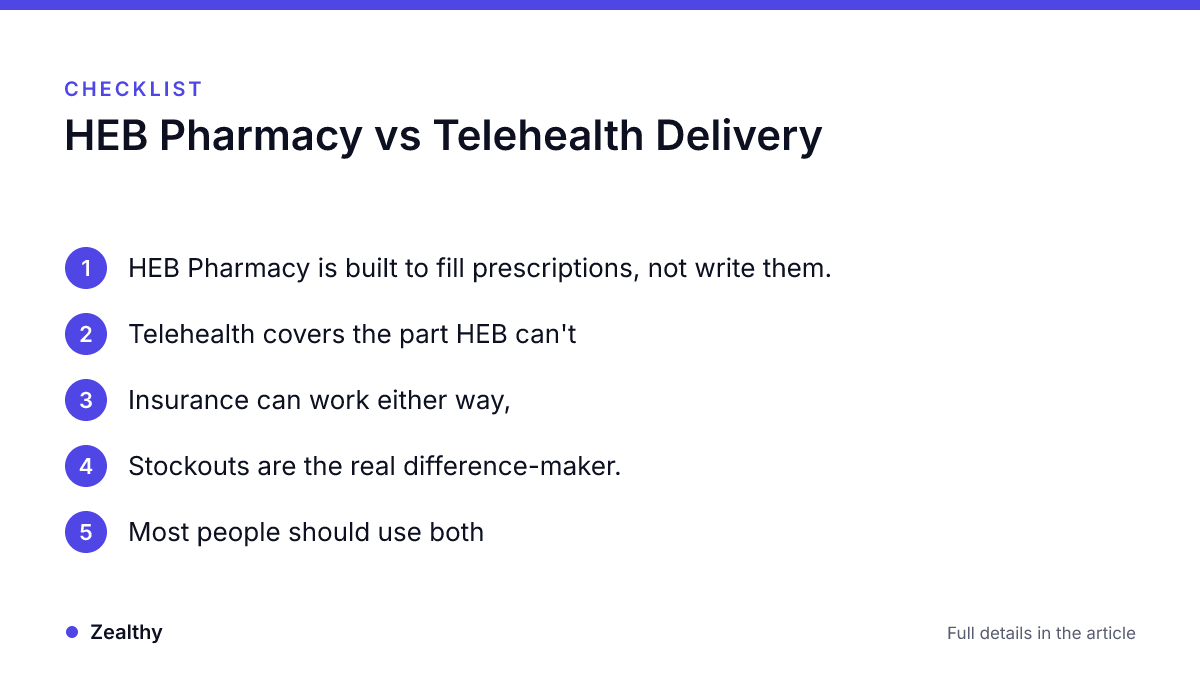
- HEB Pharmacy is built to fill prescriptions, not write them. It's a good fit for refills, antibiotics, kids' meds, and anything you're fine picking up in person.
- Telehealth covers the part HEB can't: the provider visit itself, plus plain-packaged delivery with automatic refills for things people would rather not discuss at a counter.
- Insurance can work either way, but at HEB you need an active prescription in hand first; a telehealth service bundles the visit and the medication into one flow.
- Stockouts are the real difference-maker. A same-day refill turns into a three-day wait the moment your drug isn't on the shelf, and that happens at every chain, not just HEB.
- Most people should use both — HEB for routine, local, insured fills; telehealth for weight loss, mental health, sexual health, and hair loss.
Here's the short version: if you already have the prescription, HEB will fill it faster than almost anyone. If you need someone to actually evaluate you and write the prescription — for a GLP-1, for escitalopram, for finasteride — HEB can't help you until a provider somewhere else does. That's the whole decision in one sentence.

Table of Contents
- What does HEB Pharmacy actually offer?
- How does HEB Pharmacy's refill process work?
- How do you decide between HEB Pharmacy and telehealth delivery?
- How much does HEB Pharmacy cost compared to telehealth?
- Is telehealth prescription delivery actually faster?
- What should you do next?
- Frequently asked questions
What does HEB Pharmacy actually offer?
It works like any grocery-chain pharmacy. Fills prescriptions written elsewhere, stocks common generics and brand names, gives vaccines, and lets you manage refills through the H-E-B app or your pharmacy login online. You can pull up store hours, find the nearest location, or grab a store's direct phone number — which is the move worth making before you drive, especially in dense markets like San Antonio or Corpus Christi where the next location is ten minutes away and might have what the first one doesn't.
Call the store line, not the general number, and ask for the pharmacy directly. A tech can tell you in thirty seconds whether your exact drug and dose are physically in the building. That one call has saved me more wasted trips than any app notification ever has.
What HEB doesn't do: diagnose you or write the script. New medication for weight loss, hair loss, or anxiety? You need a provider appointment first. That gap is what most people searching for an HEB pharmacy are actually bumping into — they either want a fill to go faster, or they're annoyed that getting the prescription required a separate visit at all.
How does HEB Pharmacy's refill process work?
Through the app, the online pharmacy portal, or a call to the store. Routine refills are usually ready within a few hours when the drug is on the shelf. Auto-refill is available for maintenance medications, and you'll get a text or call when the bag is ready. HEB's help center walks through tracking prescription status from your account, which is genuinely useful if you're splitting fills between a store near work and one near home.
The catch sits inside that phrase "when the drug is on the shelf."
GLP-1s, several ADHD medications, and a rotating cast of generics have gone in and out of supply at chain pharmacies for stretches at a time. When that happens, your same-day refill becomes a transfer request to another store and a wait of a day or three. That's physical inventory math, not a knock on HEB — CVS, Walgreens, and Safeway all live with the same constraint. If you've ever confirmed a store's hours, driven over, and learned at the window that your one medication is backordered, you've met the problem.
Pro tip: ask the pharmacy to check the dose, not just the drug. Stores routinely have the 0.25 mg pen and not the 1 mg, or the 20 mg tablet and not the 10 mg. "We have it" and "we have yours" are different answers.
How do you decide between HEB Pharmacy and telehealth delivery?
Run through these seven questions in order. The first one usually settles it.
- Is this a new prescription or a refill? Active prescription, just needs filling — HEB handles it, often same day. Need a provider to evaluate you first for weight loss medication, birth control, or anxiety? You need a visit, and a telehealth slot is typically open sooner than a new-patient appointment locally.
- What does your insurance actually do at each? Coverage often behaves the same either way, but copay tiers vary by drug and pharmacy network. Check your formulary through your plan's member portal — pharmacy benefit managers like MedImpact let members look up coverage before they fill anything.
- How much does discretion matter? Picking up ED medication, PrEP, or a hair loss prescription at a busy counter isn't everyone's idea of a good Saturday. Telehealth ships in plain packaging. People switch for this reason alone, even when the price is a wash.
- Will you remember to go get it? Auto-refill at HEB is solid, but you still have to show up. A telehealth subscription ships on a schedule whether or not you thought about it that week.
- Do you want support beyond the pill? This matters most for weight loss. A pharmacy hands you the box. A program built around GLP-1 care, like Zealthy's weight loss program, pairs the medication with provider check-ins and coaching — which is the part that tends to determine whether the weight stays off.
- What's the total time cost? A $0 copay isn't free if it costs you a 20-minute drive, a 15-minute wait, and a second trip because the store was short. Price the trip, not just the receipt.
- What category is the medication? Antibiotics, long-standing blood pressure meds, a kid's ear infection — fine at HEB. Weight loss, mental health, sexual health, hair loss — telehealth usually wins on speed, privacy, and follow-up.
Pro tip: if you're on a medication with a spotty supply history, ask whichever pharmacy or telehealth service you're using how often they've actually been able to fill that specific dose lately. A straight answer tells you a lot. A vague one tells you more.
What most people miss
They treat "doctor's visit" and "pharmacy" as two separate errands, and that's where the days disappear. See a provider. Wait for the script to route. Wait for the fill. Drive over. Telehealth folds all of it into one system — visit, prescription, fulfillment — which is why it often beats a local pharmacy on total timeline even though the medication arrives by mail instead of over a counter. We dug into exactly where those gaps come from in our guide to pharmacy refill delays, and the logic holds whether the store is CVS, Walgreens, or HEB.
The second thing people miss: "automatic refill" at a physical pharmacy means the pharmacy prepares it without being asked. It does not mean it comes to your house.
How much does HEB Pharmacy cost compared to telehealth?
Depends on your insurance and the specific drug, but the structure of the costs differs in ways worth seeing side by side.
| Cost factor | HEB Pharmacy | Telehealth (Zealthy) |
|---|---|---|
| Insured generic maintenance med | Typically a low copay, set by your plan's tier | Comparable when insurance is billed through the service |
| New-patient provider visit | Not offered; requires an outside appointment | Included in the visit or subscription cost |
| Cash-pay GLP-1 | Full list price, no visit or coaching included | Flat monthly plan; medication, visits, and coaching bundled |
| Home delivery | In-store or curbside pickup only | Standard, shipped on a refill schedule |
| Refill handling | App and text alerts, pickup still required | Ships automatically, no action needed |
| Stockout risk | Tied to one store's physical shelf | Routed through fulfillment, not a single storefront |
Run the math on your own numbers. The formula is simple: monthly out-of-pocket × 12, then compare that to a bundled monthly plan × 12.
An illustrative case — not a quoted price, just a scenario to copy: say your plan excludes weight loss drugs, so you're paying cash at a retail counter at $1,100 a month. That's $1,100 × 12 = $13,200 a year, and the provider visits that keep the prescription active aren't in that number. Now say a bundled telehealth plan runs $300 a month: $300 × 12 = $3,600, a $9,600 swing before you count the visits you didn't pay for separately.
Your real figures will land somewhere else depending on dose, drug, and coverage. The threshold to watch is this: once your cash-pay monthly cost clears roughly three times a bundled plan, the pharmacy counter has stopped being the cheap option, no matter how convenient it feels. You can compare the medications themselves in our breakdown of semaglutide for weight loss and our Ozempic vs. Mounjaro comparison.
Is telehealth prescription delivery actually faster?
For a new prescription, usually yes — by days, sometimes weeks.
Count the steps on the local path: book with a provider (new-patient slots are rarely next-week), attend the visit, wait for the script to route electronically, wait for the fill, drive over. If the drug is short, add another trip. A telehealth visit typically happens in the same week you sign up, and an approved prescription goes straight to fulfillment with no pickup leg at all.
For a refill of something you've taken for years, a well-stocked HEB can match or beat that. Same day, in and out. The gap only opens up around three things: stockouts, prior authorizations, and anything requiring a fresh diagnosis.
One detail people learn the hard way — prior auth is where weeks go to die, and it doesn't care which channel you use. If your plan requires one, start it the day you're prescribed, get the provider's office or the telehealth team to confirm it's been submitted, and follow up in 48 hours rather than assuming silence means progress.
Pro tip: starting something new for weight loss, anxiety, or hair loss and not in a same-day rush? Book the telehealth visit first and let the service route the prescription into delivery. You skip the pharmacy trip entirely.
What should you do next?
If your prescriptions are stable, covered, and easy to grab on the way home, keep using HEB. No reason to change a system that works.
But if you're starting something new, want the package to arrive unmarked, or you're done with stockouts turning a five-minute pickup into a three-day chase, compare what a telehealth visit looks like for your specific condition. Zealthy's care spans weight loss to mental health support like fluoxetine for anxiety — the Zealthy homepage lays out the full range, and the FAQ page answers the practical stuff about signup, insurance, and shipping. Smaller specialized brands like yourxhealth.com are worth a look too; the space is crowded enough now that checking two options before you subscribe is just sensible.
Frequently asked questions
Can I get vaccines at HEB Pharmacy, and does that affect my prescription pickup?
Yes. Most HEB Pharmacy locations give flu shots, COVID boosters, and other routine vaccines, and you can book a slot through HEB's vaccine scheduler. Vaccine appointments and prescription pickups run on separate queues, so booking one won't slow down the other.
Can I switch a prescription from HEB to a telehealth pharmacy mid-month?
Usually, yes. A telehealth service can either issue a new prescription to its own fulfillment pharmacy or help coordinate a transfer, though timing depends on how many refills are left on the original. Confirm the specifics through the service's customer service page rather than assuming the switch happens overnight.
What happens if I want to cancel a telehealth subscription after trying it?
Any service worth using has a written cancellation and refund process instead of a quiet recurring charge. Read Zealthy's subscription cancellation policy and returns and refunds page before you sign up, so you know the terms before your treatment plan changes rather than after.


