Yes, many patients can receive evidence-based obesity medicine through telehealth, including prescription anti-obesity medications, when care comes from licensed clinicians paired with nutrition and behavioral support. Telehealth works best for adults who meet guideline-based BMI or comorbidity thresholds and do not need urgent in-person evaluation. If that sounds like you, the next step is a telehealth intake or a scheduled evaluation with a licensed clinician.
TL;DR:
- Eligibility generally starts at a BMI of 30, or 27 with a related condition; clinicians review medications, medical history, labs, and reproductive health.
- Clinical reports suggest telehealth weight management can produce outcomes comparable to in person care over the short to medium term, though monitoring differs by program.
- Medication should accompany nutrition and behavior support, while clinicians choose treatments based on comorbidities, prior medication response, preferences, and safety concerns.
- Before enrolling, confirm licensed prescribers, lab monitoring, scheduled visits, side effect support, and clear pricing; a quick prescription without ongoing care leaves treatment incomplete.
- Patients whose history signals a need for closer supervision should expect an in person evaluation or specialist referral instead of an automatic prescription.
Table of Contents
- What obesity medicine telehealth includes: services and medications
- What the evidence and guidelines say about telehealth obesity care
- Who qualifies for telehealth obesity treatment and how clinicians screen for safety
- How a telehealth obesity visit actually works
- How to choose a telehealth obesity medicine program
- How Zealthy delivers telehealth obesity medicine
- Integrating mental health support with obesity telehealth treatment
- Personalized care plan development and patient engagement strategies
- Prescription delivery and medication adherence support in the telehealth model
- Technology requirements and user experience tips for telehealth visits
- Why telehealth changes the math on obesity care
- Ready to start: check your eligibility with Zealthy
- FAQ
- Sources
What obesity medicine telehealth includes: services and medications
A telehealth obesity program typically bundles several pieces of care into one visit cadence rather than treating medication as a standalone transaction. We build our own weight loss approach around the same core components that guide most reputable programs:
- Medical evaluation, including history, current medications, and relevant labs
- Medication management for FDA-approved anti-obesity drugs
- Nutrition therapy tailored to the patient’s eating patterns and goals
- Behavior change support to address habits tied to weight
- Routine monitoring of weight, side effects, and dosing adjustments
On the medication side, clinicians commonly manage GLP-1 receptor agonists like semaglutide, GLP-1/GIP combination agents like tirzepatide, naltrexone-bupropion, and phentermine-based options, with the specific choice guided by clinical judgment rather than a one-size-fits-all protocol. Our semaglutide and tirzepatide resources walk through how each works and what results tend to look like.
Medication alone rarely carries the full weight of treatment. Current guidance pairs pharmacotherapy with lifestyle interventions, meaning a prescription is one piece of a plan that also addresses diet quality, activity, and the behavioral patterns that make weight loss durable.
What the evidence and guidelines say about telehealth obesity care
Clinical guidance is fairly consistent on one point: pharmacotherapy belongs in the treatment plan for adults who meet specific thresholds, not just those who have already failed every other option. The joint TOS/OMA/OAC expert guidance statement recommends combining pharmacotherapy with lifestyle interventions for eligible adults and frames obesity as a chronic disease requiring comprehensive, person-centered care. That guidance also flags access barriers and equity concerns, which is part of why telehealth delivery matters so much for reaching patients who cannot easily see a specialist in person.
The American Gastroenterological Association’s clinical practice guideline reinforces this, recommending that adults with overweight or obesity add pharmacotherapy to lifestyle measures when those measures alone have not produced an adequate response, and naming agents including semaglutide and phentermine-topiramate ER as options.
Telehealth-delivered weight management programs can produce short- to medium-term outcomes comparable to in-person care, according to clinical reports on obesity management during and after the COVID-19 pandemic. That matters for anyone weighing convenience against results: the delivery channel itself doesn’t appear to be the limiting factor, though individual programs vary in rigor.
Medication selection still needs to be individualized. High-efficacy agents like semaglutide and tirzepatide have strong evidence behind them, but comorbidities, prior medication response, and patient preference all factor into what a clinician actually prescribes.

Who qualifies for telehealth obesity treatment and how clinicians screen for safety
Eligibility generally follows the same thresholds used in any obesity medicine setting: a body mass index of 30 or higher, or 27 or higher with a weight-related comorbidity such as type 2 diabetes or hypertension, consistent with BMI cutoffs many IVF clinics require. From there, screening becomes individualized rather than purely numbers-based.
Before starting treatment, most telehealth programs ask for:
- A full medical history, including prior weight loss attempts and relevant conditions
- A current medication list to check for interactions
- Available labs or vitals, which may be requested from a recent visit or ordered as part of intake
- Pregnancy status and reproductive health history where relevant to medication choice
- Cardiovascular and psychiatric history, since some anti-obesity medications carry precautions in these areas
When something in that history suggests a need for closer supervision, an in-person evaluation or specialist referral, a responsible telehealth clinician will say so rather than prescribing anyway.
How a telehealth obesity visit actually works
The path from first contact to an active treatment plan usually follows a predictable sequence. Intake forms collect your history and goals, a clinician conducts a tele-visit assessment, the two of you land on a shared plan, and if medication is appropriate, an electronic prescription routes to home delivery or a local pharmacy.
- Intake: history, current medications, and goals collected before the visit
- Assessment: a live or asynchronous evaluation with a licensed clinician
- Plan: a shared decision on medication, nutrition, and behavioral support
- Prescription: sent electronically, often with delivery options
- Follow-up: scheduled check-ins to track weight, side effects, and dosing
Monitoring continues after that first prescription. Clinicians track weight trends, side effects, and lab values where needed, adjusting dosing or switching medications if the response isn’t what was expected.
Pro Tip: Have your current medication list and any recent labs ready before your first visit. It speeds up the assessment and gets you to a plan faster.
How to choose a telehealth obesity medicine program
Not every telehealth program offers the same depth of care, so it helps to evaluate a few specifics before committing.
- Check that clinicians are licensed and have direct experience managing anti-obesity medications.
- Confirm the program integrates nutrition and behavioral support rather than offering medication alone.
- Ask about follow-up frequency and how dosing adjustments are handled.
- Review whether labs and monitoring are built into the plan or left to you to arrange.
- Look for transparent pricing and clarity on whether insurance is accepted.
On your first contact, a few direct questions tend to surface the answers that matter:
- How much experience does the clinician have prescribing GLP-1s or similar medications?
- What happens if I experience side effects between visits?
- How often will we check in, and through what format?
- Does the program accept my insurance, or what does self-pay look like?
Same-day access is appealing, but it shouldn’t come at the cost of follow-up rigor. A program that gets you a prescription quickly but has no plan for monitoring is solving only half the problem.
How Zealthy delivers telehealth obesity medicine
Some weight loss programs are built around same-day appointments with licensed clinicians, personalized care plans, and prescription delivery, so patients can move from intake to an active plan without long waits. A typical start includes an intake questionnaire, a consult with a clinician, a tailored plan, and prescription fulfillment when medication is appropriate. You can review eligibility and next steps on our weight loss page or learn more about tirzepatide consultations.
Integrating mental health support with obesity telehealth treatment
Weight and mental health are tangled together often enough that treating one in isolation leaves gaps. Anxiety, depression, and disordered eating patterns can all affect adherence to a weight management plan, and stress itself has a documented relationship with eating behavior and metabolic health. A telehealth model that only addresses the physical side of obesity misses a piece that frequently determines whether a plan sticks.
Integrated platforms are positioned to screen for mental health concerns during intake and route patients toward counseling or psychiatric support alongside their weight management care. That might mean a clinician flags signs of binge eating or emotional eating during an initial visit and brings in behavioral health support rather than treating the conversation as off-topic. It might also mean someone already managing anxiety or depression finds it easier to address weight when the same platform handles both, rather than juggling separate providers and separate records.
Some providers offer mental health care alongside weight loss support, which can help patients managing both concerns avoid coordinating between two disconnected systems. The practical benefit is continuity: a clinician who understands your mental health history can factor that into medication choices, since some anti-obesity medications carry psychiatric precautions, and a counselor working from the same care plan can reinforce behavioral strategies tied to your weight goals. For patients, that coordination often matters more than either service would on its own.
Personalized care plan development and patient engagement strategies
A generic protocol rarely works for long. Two patients with the same BMI can have entirely different drivers behind their weight, different comorbidities, different relationships with food, and different capacity for behavior change, which is why a personalized plan starts with a detailed intake rather than a standard checklist.
Building that plan typically means a clinician reviews your medical history, prior weight loss attempts, current medications, and lifestyle factors before recommending a medication class or lifestyle intervention. From there, engagement strategies keep the plan alive between visits: regular check-ins, clear goals for the next follow-up, and a channel for messaging a clinician when something changes.
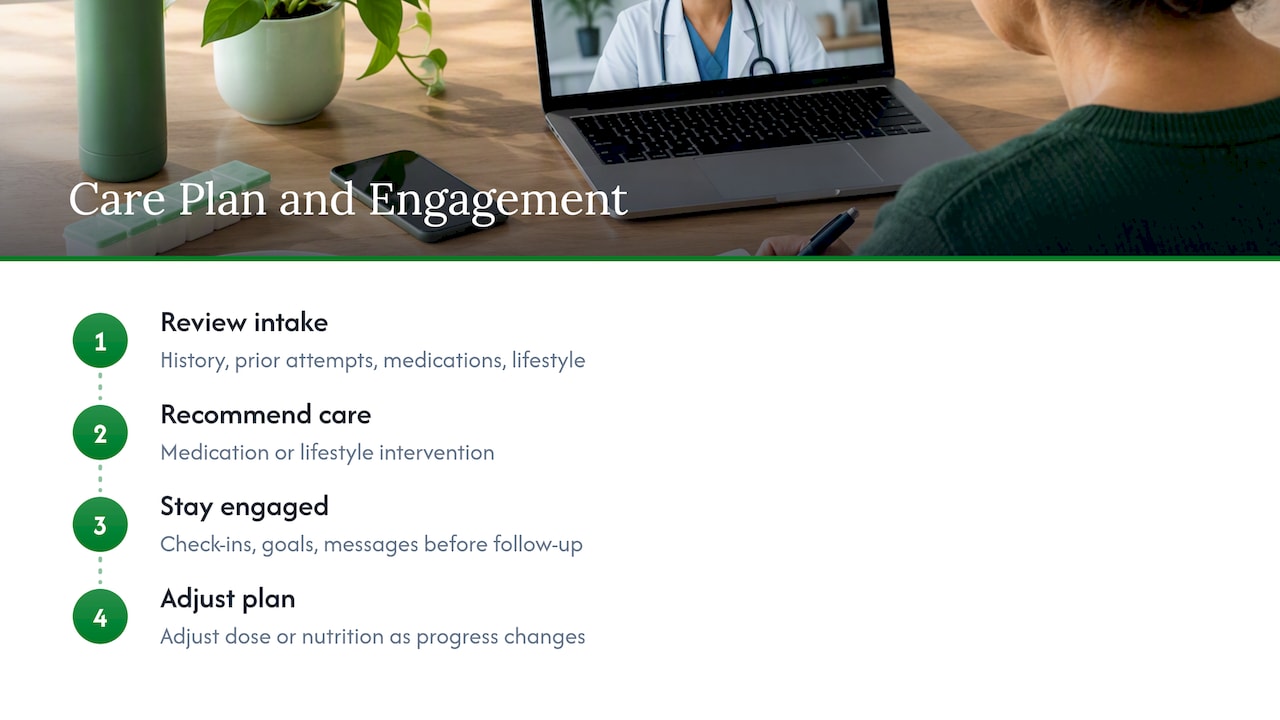
Personalized care plans can be created based on each patient’s specific health concerns, which means the medication, nutrition guidance, and follow-up cadence are set around an individual’s actual history rather than a default protocol. Patients tend to stay engaged when they can see a clinician adjust a plan in response to their real progress, whether that means changing a dose, addressing a side effect, or shifting nutrition guidance as weight loss progresses. That responsiveness is part of what separates an integrated program from a one-time prescription.
Prescription delivery and medication adherence support in the telehealth model
Getting a prescription is only the first step. Adherence, actually taking the medication as directed and staying on a consistent schedule, is where many weight management plans quietly fail, often because refills lapse or side effects go unaddressed between visits.
Telehealth models that build in home delivery remove one common point of friction: a trip to the pharmacy that can delay a dose or lead to a missed refill. Pairing that delivery with scheduled follow-ups gives a clinician a chance to catch adherence problems early, whether that’s a patient skipping doses due to nausea or simply forgetting amid a busy week.
Prescription delivery can be included as part of some weight loss services, with follow-up visits built into the plan so a clinician can address side effects or dosing questions before they turn into a missed refill. That structure matters for medications like GLP-1 receptor agonists, where dosing is typically titrated up gradually, since consistent follow-up makes it easier to adjust the schedule if side effects appear. Our guide to semaglutide’s safety and efficacy covers what that titration process and side-effect management typically look like.
Technology requirements and user experience tips for telehealth visits
Most telehealth obesity visits need little more than a smartphone, tablet, or computer with a camera, a stable internet connection, and a quiet space for a confidential conversation. Platforms generally run through a web browser or a dedicated app, and most don’t require downloading specialized software beyond what the provider’s app or portal provides.
A few habits make the visit itself go more smoothly. Testing your camera and microphone a few minutes before the appointment avoids a scramble at the start. Having your medication list, recent labs, and any specific questions written down ahead of time keeps the conversation focused. If your visit involves uploading documents or photos, doing that before the appointment rather than during it saves time for the actual clinical discussion.
For anyone who has never done a telehealth visit before, the format tends to feel more natural after the first one. Most of the adjustment is logistical, figuring out the platform and what to have on hand, rather than anything about the quality of the conversation itself.
Why telehealth changes the math on obesity care
The biggest barrier to obesity treatment has rarely been a lack of effective medication. It’s been access: finding a clinician who treats obesity as a chronic disease rather than a willpower problem, getting an appointment within a reasonable window, and staying engaged long enough for a plan to work. Telehealth doesn’t replace clinical judgment, but it removes a lot of the friction that used to keep patients from ever reaching that judgment in the first place. The programs that will matter most over the next few years are the ones that treat medication as one piece of ongoing care rather than a single transaction.
— Bryan
Ready to start: check your eligibility with Zealthy
Some telehealth visits for weight loss are built around licensed clinicians, personalized care plans, and prescription delivery, allowing patients to move from a first conversation to an active plan without waiting weeks for an appointment.

If you’re wondering whether a GLP-1 or another anti-obesity medication fits your situation, our team can walk through your history and goals and build a plan around them. Find out if weight loss injections could be right for you and take the first step toward a plan built for your specific case.
This article is general information, not a substitute for advice from a qualified doctor. Consult a qualified healthcare professional about your own circumstances before acting on anything here.
FAQ
Can a telehealth doctor prescribe weight loss medication?
Yes, licensed clinicians delivering care through telehealth can prescribe FDA-approved weight loss medications when a patient meets clinical criteria after an evaluation. This typically follows guideline-based thresholds around BMI and comorbidities, the same standards used in joint TOS/OMA/OAC guidance.
Can I get Zepbound through telehealth?
Zepbound and similar GLP-1/GIP medications can be prescribed through telehealth when a clinician determines they’re appropriate based on your medical history and eligibility. Coverage details continue to shift, and the Medicare GLP-1 Bridge program running from July 2026 through the end of 2027 expands access to certain GLP-1 drugs for eligible Medicare Part D beneficiaries with a $50 copay.
Can I get a GLP-1 prescription online?
Yes, a licensed clinician can prescribe a GLP-1 medication after a telehealth evaluation that reviews your medical history, current medications, and eligibility. Clinical guidelines support pairing these medications with lifestyle interventions rather than prescribing them as a standalone treatment.
What is the best telehealth for weight loss?
The right program depends on your history and goals, but a strong telehealth option combines licensed clinicians, integrated nutrition and behavioral support, routine monitoring, and prescription delivery rather than medication alone. We built our weight loss service around that integrated model, with same-day appointments and personalized care plans for each patient.
How does telehealth help with obesity treatment compared to in-person visits?
Telehealth can expand access to obesity medicine by removing travel and scheduling barriers that keep many patients from seeing a specialist. Reports on telehealth-delivered weight management programs suggest they can produce weight-loss outcomes comparable to in-person care in the short to medium term, though individual results depend on the program’s structure and follow-up.
Sources
- Medicare GLP-1 Bridge | CMS
- Joint TOS/OMA/OAC expert guidance statement on the pharmacological management of United States adults with overweight or obesity
- AGA clinical practice guideline on pharmacological interventions for adults with obesity


.svg)
.svg)
.svg)
.svg)

