

Yes, Medicare and most U.S. insurers cover telehealth today, and that isn’t changing anytime soon. Medicare’s expanded flexibilities run through December 31, 2027, and many states plus D.C. require some form of private-insurance telehealth coverage. Expect the Part B deductible followed by 20% coinsurance if you’re on Medicare, and state law shaping what you owe if you’re on a private plan. Before you book, call your insurer’s member services line and ask directly whether the visit is covered.
TL;DR:
- Medicare covers a broad range of telehealth services with 80% cost coverage after the Part B deductible, guaranteed through December 2027.
- Many states and D.C. require private insurers to offer the same telehealth coverage as in-person care, but fewer enforce payment parity, which affects provider reimbursement rates.
- Medicare Advantage plans often enhance benefits by including additional telehealth services like audio-only visits and lower copays, though provider networks can influence costs.
- Medicaid’s telehealth coverage varies significantly by state, with live video universally reimbursed but other modalities like remote monitoring and audio-only visits subject to state-specific rules.
- Patients should verify insurance coverage, provider licensure, and billing codes before appointments to avoid surprise bills or claim denials.
What Telehealth Insurance Coverage Looks Like by Payer
Coverage rules shift depending on who’s paying the bill, and knowing your payer’s baseline saves you from a surprise invoice later.
- Original Medicare: Covers office visits, mental health care, and remote monitoring nationwide, with the Part B deductible and typically 20% coinsurance applying, guaranteed through 2027.
- Medicare Advantage: Often adds extra telehealth perks, including audio-only options and home-based services, funded through the plan’s supplemental design (KFF/PMC analysis).
- Private insurance: Governed by state law, not federal rule, with wide variation in what’s reimbursed and at what rate.
- Medicaid: Live video is reimbursed everywhere, but audio-only and remote monitoring coverage depends on your state’s program.
By the numbers: 41 states and D.C. require insurers to cover telehealth the same way they cover in-person care, a rule called coverage parity. Only 24 states go further and mandate payment parity, meaning the provider gets paid the same amount whether the visit happens on video or in an exam room.
That gap between coverage parity and payment parity matters more than most patients realize. Your visit might be “covered,” but the provider could still get reimbursed less for delivering it virtually, which occasionally affects which providers even offer a telehealth option in your area.
Medicare Telehealth Coverage: Services, Costs, and the 2027 Deadline
Medicare pays for a genuinely broad slate of virtual care, and the list runs well past the basic video checkup most people picture. Covered services include office visits, psychotherapy, diabetes self-management training, cardiac and pulmonary rehabilitation, and certain screenings, all deliverable to a beneficiary sitting at home anywhere in the country. Remote patient monitoring, where a device tracks readings like blood pressure or glucose and sends them to a clinician, also falls under this umbrella and has become one of the fastest-growing categories in Medicare telehealth policy.
The cost structure mirrors in-person Medicare care almost exactly. You pay your annual Part B deductible first, then Medicare typically covers 80% of the approved amount for the visit, leaving you responsible for the remaining 20% coinsurance. There’s no separate, higher “telehealth fee” bolted on. If you have a Medigap policy, it may pick up some or all of that coinsurance, the same way it would for an office visit.
What’s currently guaranteed through Dec. 31, 2027:
- Telehealth visits from home, not just a clinic or hospital “originating site”
- Coverage regardless of whether you live in a rural or urban area
- A broadened list of eligible distant-site providers, including many specialists
- Audio-only visits for specific services when video isn’t accessible or practical
That end date isn’t arbitrary. Congress set it through legislation extending pandemic-era flexibilities, and Congress show these deadlines have already been pushed back multiple times as lawmakers debate a permanent fix. Nobody can promise what happens on January 1, 2028, but the pattern so far favors extension over expiration.
Separately from that legislative deadline, the Centers for Medicare & Medicaid Services runs its own annual process: the Physician Fee Schedule rulemaking. Each year, CMS proposes adding or removing specific services from the Medicare telehealth list, usually effective the following January 1, with a public comment period along the way. This is a separate lever from the Dec. 31, 2027 deadline. A service can vanish from the covered list at the start of any year even while the broader flexibilities remain intact, so it’s worth a quick check before you assume last year’s coverage still applies.
Behavioral health carries its own carve-outs worth flagging. Medicare permanently removed the in-person visit requirement for mental telehealth services delivered from a beneficiary’s home, a change that predates and outlasts the current temporary flexibilities. Audio-only coverage for mental health counseling also has more durable protection than most other telehealth categories, reflecting how many rural and elderly beneficiaries rely on a phone rather than a video app.
Pro Tip: Ask your provider’s office directly whether they bill your visit as telehealth or as an in-person equivalent. The billing code matters more than what the visit felt like to you, and it drives whether your coinsurance calculation matches what you expect.
If you’re enrolled in Medicare Advantage rather than Original Medicare, your specific benefits can differ meaningfully from everything above. The next section breaks down exactly how.
Medicare Advantage and Private Plans: Where Benefits Expand and Contract
Medicare Advantage plans build on Original Medicare’s telehealth baseline rather than replacing it, and insurers frequently use that flexibility to compete for enrollees. Many MA plans offer supplemental telehealth benefits that go beyond what Original Medicare guarantees, such as broader access to home-based virtual urgent care, expanded audio-only options, and in some cases lower copays for virtual visits than in-person ones. This flexibility comes from how CMS structures Medicare Advantage plan design, letting insurers fund extra virtual services through rebates or supplemental premiums rather than standard Part B rules.
That flexibility cuts both ways. Some MA plans steer enrollees toward a specific telehealth vendor network, meaning your out-of-pocket cost depends heavily on whether the provider you choose sits inside that network. A visit that would be free through the plan’s preferred vendor might carry a real copay if you go elsewhere.
Private insurance, whether through an employer or purchased individually, answers to state law rather than federal Medicare rules. This is where the coverage parity versus payment parity distinction really bites.
- Coverage parity means your insurer must cover telehealth for services it would cover in person, but says nothing about the payment amount.
- Payment parity requires the insurer to pay the provider the same rate for a virtual visit as an in-person one, which exists in fewer states and often applies only to specific specialties like mental health or primary care.
- Where payment parity doesn’t exist, some providers limit which virtual services they offer, since lower reimbursement makes certain visit types less financially viable to schedule.
- Your employer’s specific plan design, negotiated separately from state minimums, can add its own copay structure or preferred vendor list on top of the baseline state law.
Before you assume anything about your private coverage, pull up your Summary of Benefits and Coverage document. Search it for the terms “virtual visit,” “telemedicine,” or “telehealth,” since insurers use different labels for the same category, and the copay listed there is the number you should plan around, not a generic estimate from a search result.
Medicaid Telehealth Coverage: Why It Varies So Much by State
Medicaid runs as 50 separate state programs layered under federal guidelines, and telehealth reimbursement reflects that patchwork more than almost any other coverage category. Live video visits are reimbursed in every state Medicaid program, which makes it the one modality you can count on regardless of where you live. Everything past that baseline gets inconsistent fast.
- Live video: Reimbursed nationwide, the one modality with universal Medicaid coverage.
- Store-and-forward (sending images or data for a clinician to review later, common in dermatology and radiology): Covered in many states but excluded or restricted in others.
- Remote patient monitoring: Increasingly reimbursed, but eligibility rules, covered conditions, and payment rates differ sharply by state.
- Audio-only visits: Some states reimburse phone-only care at the same rate as video; others pay less or restrict it to specific service types.
A scoping review of telehealth payment policy found this state-by-state unevenness runs deep enough that two Medicaid enrollees living a short drive apart, across a state line, can face genuinely different coverage for the identical virtual visit.
If you’re on Medicaid, don’t rely on a generic search result to tell you what’s covered. Your state Medicaid agency publishes its own telehealth policy manual, usually on the agency’s official website under a heading like “provider billing” or “telehealth policy.” Calling the Medicaid member services number listed on your card is the fastest way to get a definitive answer for your specific plan and state, since these rules change often enough that even provider offices sometimes work from outdated information.
How Do You Verify Your Telehealth Insurance Coverage?
Confirming coverage before your appointment takes about ten minutes on the phone, and it’s the single best way to avoid an unexpected bill.
- Read your Summary of Benefits first. Look specifically for “virtual visit,” “telemedicine,” or “telehealth,” note any listed copay, and check whether it differs from your in-person copay for the same service type.
- Call member services and ask direct questions. Confirm whether your provider is in-network for telehealth specifically, what your exact copay or coinsurance will be, whether prior authorization is required, which CPT codes and modifiers apply, and whether audio-only visits are covered under your plan.
- Confirm the provider’s state licensure. Telehealth providers must generally be licensed in the state where you’re physically located during the visit, not just where the practice is based, so mismatches can cause denied claims.
- Get a written cost estimate and save your documentation. Ask for the visit’s expected cost, then keep your Explanation of Benefits and any authorization number on file in case a claim needs to be disputed later. Many telehealth visits, copays, and coinsurance amounts qualify as eligible expenses under an HSA or FSA, so check your plan documents before assuming you’ll pay entirely out of pocket.
Pro Tip: If you’re traveling when you need a virtual visit, confirm your provider is licensed in the state you’re physically sitting in, not your home state. This single detail causes more denied telehealth claims than almost anything else on this list.
Resources like Sobal Nationwide Health’s insurance FAQ and cost tools can help you decode unfamiliar plan language if your Summary of Benefits reads more like a legal document than a helpful guide.
What to Do If Your Telehealth Claim Gets Denied
Denials usually trace back to one of a handful of causes, and most are fixable once you know where to look.
- Out-of-network provider: The clinician wasn’t in your plan’s telehealth network, even if they take your insurance for in-person visits.
- Coding or modifier errors: The claim was submitted without the correct telehealth modifier, causing the insurer’s system to treat it as an ineligible service.
- Licensure mismatch: The provider wasn’t licensed in the state where you were located during the visit.
- Plan exclusions: Some plans still carve out specific telehealth service types, particularly for certain specialties.
Start by reading your Explanation of Benefits line by line to identify the stated denial reason, then request an itemized bill from the provider if it’s unclear. If a coding error is the culprit, ask the provider’s billing department to resubmit with the corrected code or modifier, since this resolves a meaningful share of denials without any formal appeal. If the insurer still denies it, file a formal appeal through your plan, and if that fails, contact your state insurance commissioner’s consumer assistance office, which can intervene on disputes involving state-regulated private plans. Appeals typically take several weeks to resolve, so keep every document from the original visit forward.
How Telehealth Platforms Handle Insurance Behind the Scenes
Every telehealth visit that gets billed to insurance runs through the same basic checkpoints on the provider’s side: confirming the clinician is licensed in your state, verifying your plan considers the visit in-network, and selecting the correct billing code before the claim ever reaches your insurer. Getting any one of those wrong is what produces the denials covered above.
Platforms built around this workflow structure their process specifically to catch these issues before a claim goes out the door.
- Licensure verification happens automatically before a visit is scheduled, matching the clinician’s credentials to the patient’s physical location.
- Same-day appointment availability means patients don’t have to choose between fast access and getting matched with an in-network provider.
- Prescription delivery is coordinated directly with the visit, so medication access doesn’t depend on a separate pharmacy trip.
- Licensed clinicians average over a decade of clinical experience, which shapes how care plans get built for concerns like weight management, anxiety, and other ongoing treatment needs.
Patients considering a virtual visit through any platform should review the provider’s consent-to-telehealth terms before their first appointment, since this document typically spells out how billing, licensure, and cost transparency work in practice.
What This Policy Moment Means for Patients
Telehealth access has stopped being an emergency stopgap and become a permanent fixture of how Americans get care, but the rules underneath it are still shifting every year. That’s the uncomfortable truth nobody likes to sit with: the coverage that applied to your last virtual visit isn’t guaranteed to apply identically to your next one, especially with CMS revisiting its telehealth service list annually and Congress treating the 2027 deadline as a recurring negotiation rather than a settled policy.
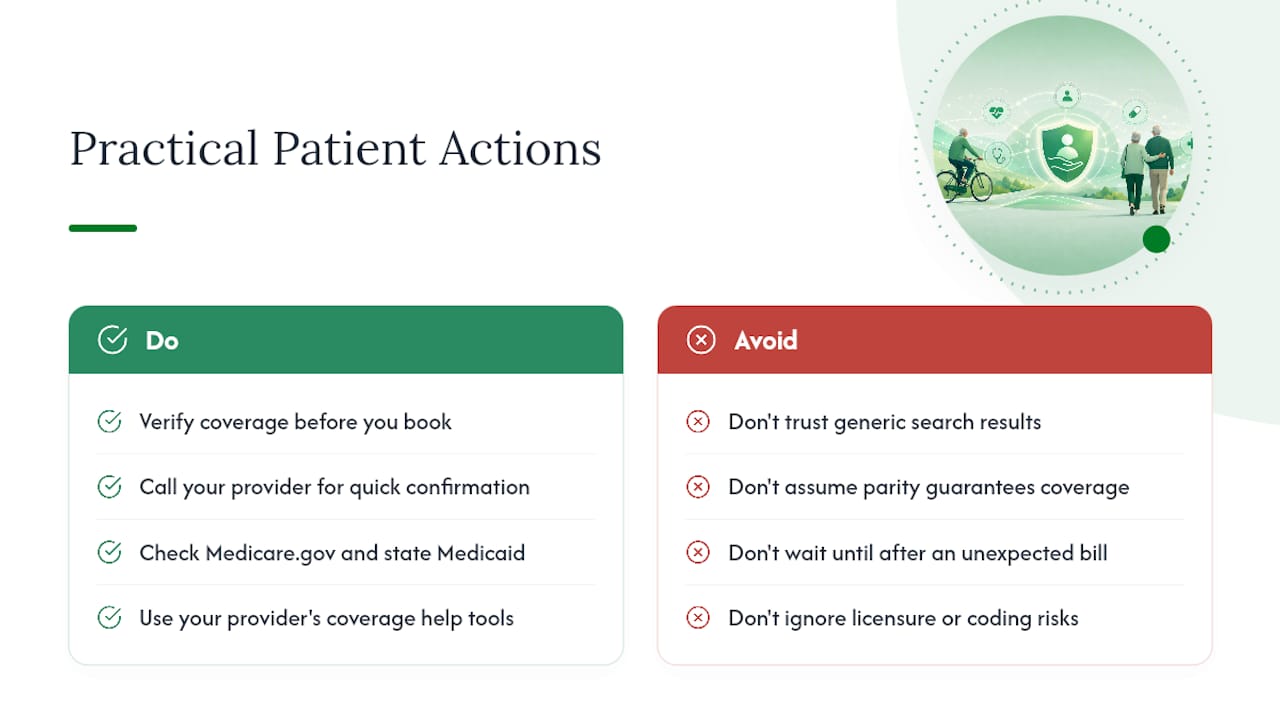
My honest read is that patients spend too much energy worrying about whether telehealth “counts” as real coverage and not enough energy on the ten-minute phone call that actually confirms it. Coverage parity laws in 41 states plus D.C. have done real work closing the gap between virtual and in-person benefits, but parity on paper doesn’t protect you from a licensure mismatch or a coding error on a specific claim. The single most useful habit you can build is verifying before you book, not after you get a bill you weren’t expecting.
Check Medicare.gov or your state’s Medicaid page directly rather than trusting a search result that might be describing last year’s rules. When your provider’s platform offers help navigating coverage, use it. That assistance exists precisely because these rules are too fragmented for most patients to track alone.
— Bryan
Getting Insured Telehealth Care Through Zealthy
If you’ve confirmed your plan covers virtual visits, the next question is finding a provider that makes the process simple rather than another hurdle. Some telehealth platforms offer virtual appointments across primary care, mental health, weight management, and several other treatment areas, all handled through online visits, messaging, and prescription delivery.

The platform is built to check licensure and provider network status before your visit is scheduled, which helps you avoid the exact billing surprises covered above. Whether you need a primary care visit, ongoing mental health support, or a specialty treatment plan, the process starts with a quick consultation to match you with the right clinician.
Before your first appointment, review Zealthy’s telehealth consent details to understand exactly how your visit will work. Ready to see what a same-day virtual visit looks like? Get started with Zealthy and book your consultation today.
Where to Check for the Latest Telehealth Coverage Rules
Policy details change often enough that a bookmark beats a memory. These sources publish the actual rules, not secondhand summaries:
- Medicare: The definitive source for what Medicare covers, current cost-sharing, and the 2027 flexibility deadline.
- Telehealth: Federal policy updates and patient-facing guidance on paying for virtual visits.
- CMS’s telehealth page: Details on the annual Physician Fee Schedule rulemaking that adds or removes covered services.
- NCSL’s telehealth private insurance law explainer: State-by-state breakdown of coverage parity and payment parity laws.
- Your state Medicaid agency’s website: Search for “telehealth policy” or “provider billing manual” to find your state’s specific modality coverage.
Check these directly before assuming last year’s coverage still applies, particularly early in the calendar year when CMS rule changes typically take effect.
This article is general information, not a substitute for advice from a qualified doctor. Consult a qualified healthcare professional about your own circumstances before acting on anything here.
Sources
- Telehealth Insurance Coverage
- Telehealth Private Insurance Laws
- Medicare Advantage telehealth flexibility (KFF/PMC analysis)
FAQ
Will Telehealth Visits Still Be Covered in 2026?
Yes. Medicare’s expanded telehealth flexibilities remain in effect through December 31, 2027, and most private insurers continue covering virtual visits under state coverage parity laws.
Are Insurance Companies Still Paying for Telehealth?
Yes, both Medicare and the large majority of private insurers continue reimbursing telehealth visits, though the amount they pay depends on whether your state has a payment parity law in addition to coverage parity.
What Are the Current Rules for Medicare Telehealth Coverage?
Medicare covers telehealth visits from anywhere in the U.S., including home, with the Part B deductible followed by 20% coinsurance applying, and this framework is guaranteed through the end of 2027.
Is Congress Going to Extend Telehealth Coverage Again?
Congress has extended Medicare’s telehealth flexibilities multiple times already, and current legislation sets the next deadline at December 31, 2027, though no permanent extension has been enacted yet.
Does Medicare Advantage Cover More Telehealth Than Original Medicare?
Often, yes. Many Medicare Advantage plans add supplemental telehealth benefits, such as expanded audio-only options or lower virtual-visit copays, funded through the plan’s own benefit design.
How Do I Know if My State Requires Telehealth Coverage Parity?
Check the NCSL private insurance law database, since 41 states and D.C. currently mandate coverage parity, though far fewer require equal payment rates.




.svg)
.svg)
.svg)
.svg)

