

Telehealth can be as secure as an in-person visit, but only when it runs on a legitimate, HIPAA-aware platform and both sides follow basic privacy habits. Encryption and HIPAA compliance set the baseline protection for your health information. Security is a shared job: the platform builds the walls, and you decide who’s in the room when you log on.
TL;DR:
- Telehealth privacy relies heavily on HIPAA compliance, platform encryption, and users following basic privacy practices during visits.
- Most telehealth platforms should have signed BAAs, use encryption in transit and at rest, and enforce strict access controls for patient data.
- Common privacy risks stem from environmental factors like lack of privacy, unsecured devices, and inconsistent staff training, not necessarily the technology itself.
- Patients should verify that their provider’s platform uses signed BAAs, clear consent procedures, and has an incident response plan for data breaches.
- Recording of telehealth visits generally requires explicit patient consent and secure storage; unconsented recordings are a privacy red flag.
Are Telehealth Visits Private Compared With In-Person Care?
A telehealth visit carries the same legal privacy protections as sitting in an exam room at least on paper. HIPAA doesn’t have a separate rulebook for video visits. It applies the same standards for protected health information whether your doctor is across the desk or across a screen.
“HIPAA-compliant” is a phrase you’ll see on almost every telehealth site, but it has a specific meaning. It means the platform has signed a business associate agreement (BAA) with your provider, encrypts your data, and restricts who inside the organization can view your records. A platform without a BAA in place isn’t legally allowed to handle your protected health information, no matter how polished its app looks.
The technical baseline that reputable platforms should meet includes:
- Encryption in transit and at rest. Your video, audio, and messages get scrambled while traveling between your device and the server, and again while sitting in storage.
- Authentication controls. You log in with a password (ideally paired with a second verification step), so a stranger can’t just open your patient portal.
- Patient portals instead of open links. HHS guidance recommends checking for a secure site lock icon and using an actual patient portal rather than a random video link texted to you.
- Access restrictions on the back end. Only staff involved in your care should be able to open your chart, not the entire clinic roster.
What should you actually expect from a provider? A signed BAA with its video and messaging vendors, a written notice of privacy practices you can read before your first appointment, and a portal that requires your own login rather than a shared or guest link. If a provider can’t answer basic questions about any of these, that’s a signal to look elsewhere.
How Telehealth Platforms Secure Data: Technical and Operational Controls
Encryption isn’t a single feature. It’s a layered system, and the layers matter more than the marketing language.
Transport encryption protects data while it moves between your device and the platform’s servers, similar to what a banking app uses. End-to-end encryption goes further: only you and your provider can decode the content, even the platform operator can’t read it in the middle. Most mainstream telehealth video tools use transport encryption, not end-to-end. That’s usually fine for a routine visit, but it’s a fair question to ask directly: “Does this platform use end-to-end encryption, or standard transport encryption?”
Beyond encryption, the controls that separate a mature telehealth operation from a rushed one include:
- Multi-factor authentication (MFA) on both patient and clinician logins, so a stolen password alone isn’t enough to get in.
- Session timeouts and automatic logouts that close an unattended visit window after a period of inactivity.
- Role-based permissions, meaning a billing staffer sees payment data, not your therapy notes.
- Access logging, which records who viewed a chart and when, so unusual activity gets flagged rather than buried.
- Defined data retention and encrypted storage policies, so old records don’t sit unprotected indefinitely.
- Vendor risk management, including BAAs with every third-party tool that touches patient data, from the video engine to the pharmacy integration.
HHS’s provider guidance calls for a periodic risk analysis covering authentication policies, consent processes, secure transmission, and staff training, not a one-time setup that never gets revisited. Providers that treat this as ongoing maintenance, rather than a checkbox, tend to catch problems before they become breaches.
Pro Tip: Ask your provider one direct question: “What happens if there’s a data breach, and how would I be notified?” A provider with a real incident response plan will have a specific answer, not a shrug.
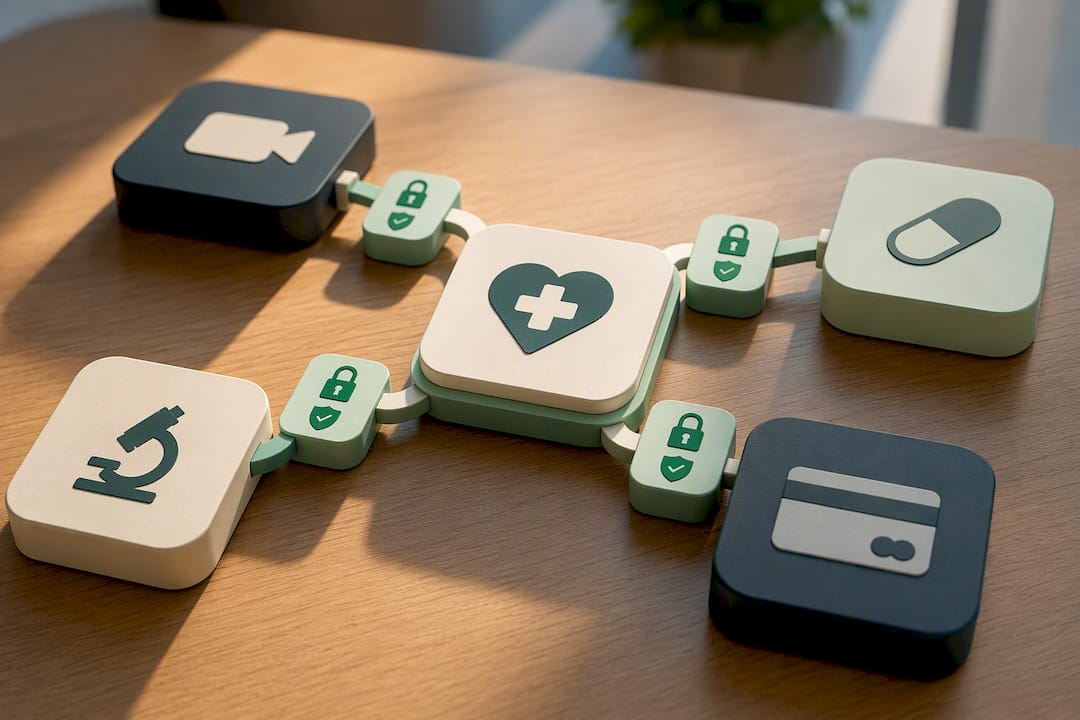
Third-party integrations deserve their own scrutiny. Modern telehealth platforms often connect video vendors, e-prescribing tools, lab integrations, and payment processors into one experience. Each connection is a potential weak point if the vendor behind it isn’t held to the same BAA standard as the primary platform.
What Are the Biggest Telehealth Privacy Risks?
The technology usually isn’t the weak link. The environment around it often is.
- Environmental exposure. A systematic review of telehealth privacy and security risk factors found that a lack of private physical space is one of the most common vulnerabilities, whether that’s a roommate walking through the frame or a smart speaker sitting within earshot, capable of capturing audio it was never meant to hear.
- Unsecured devices and networks. Logging into a visit over open public Wi-Fi, on a phone that hasn’t been updated in months, or with a reused password all widen the door for interception or malware.
- Operational gaps. Inconsistent staff training, unclear consent procedures, and ambiguous recording policies create openings that have nothing to do with encryption strength.
Research on primary care telemedicine backs this up from the provider side too. Studies on clinician work-from-home setups note that patients report feeling less secure when a visit is clearly happening from a kitchen table instead of a professional-feeling space, even when nothing about the actual data handling changed.
None of this means telehealth is inherently riskier than a waiting room full of strangers who can hear the front desk call your name. It means the risks shift location, from the clinic’s walls to your living room and your phone’s settings menu.
A Checklist to Protect Your Telehealth Visit
Security on your end doesn’t require technical expertise. It requires a short routine, repeated every time.
Before the visit:
- Confirm you’re using your provider’s official app or portal link, not a forwarded text or email link you can’t verify.
- Update your phone, laptop, or tablet software before logging in. Old software is where most known exploits still work.
- Connect over your home Wi-Fi rather than a public network at a coffee shop or airport.
- Turn on multi-factor authentication if your provider’s portal offers it.
During the visit:
- Find a room with a door you can close. If that’s genuinely not available, headphones cut down on what a smart speaker or a roommate can pick up.
- Move or mute nearby smart devices, voice assistants included, before the call starts.
- Confirm your provider’s identity if anything feels off, especially at a new practice. A licensed clinician should be able to state their name and credentials without hesitation.
After the visit:
- Log out fully rather than just closing the browser tab or app.
- If the session generated any local recording or screenshot, delete it unless you intend to keep it and understand where it’s going.
- Ask how long your visit record will be retained and who can access it later.
Pro Tip: Before your first appointment with any new telehealth provider, spend two minutes reading their notice of privacy practices. It will tell you exactly who can see your data, which is worth more than any security badge on their homepage.
If you want to verify a platform’s claims rather than take them on faith, ask three questions: Do you sign a BAA with every vendor that touches my data? What’s your policy on recording visits? How would you notify me of a breach? Guides on HIPAA-compliant app features outline the technical standards worth checking against, if you want a fuller list before you commit to a provider.
Can Telehealth Visits Be Recorded?
Generally, no, not without your explicit say. HHS guidance is direct on this point: telehealth visits generally should not be recorded, and if a recording does happen for a clinical reason, it requires advance, documented consent from the patient.
There are legitimate reasons a recording might happen, usually tied to training, quality review, or a specific clinical need like reviewing a movement disorder over time. In those cases, the consent should be specific (not buried in a general terms-of-service click-through), and the recording should live in an encrypted, access-restricted system, not a shared drive or a clinician’s personal device.
You’re entitled to ask, plainly: “Is this visit being recorded, and if so, where will that recording be stored and who can access it?” A provider with solid practices will answer without hesitation and document your response. If you get a vague answer, that’s worth noting before your next visit.
- Recording without consent is not standard practice and should raise a flag.
- Clinically justified recordings need documented, specific consent, not a blanket agreement.
- Stored recordings should sit in encrypted systems with limited staff access.
- You can request details on retention length and deletion timelines.
How Zealthy Approaches Telehealth Privacy and Consent
Zealthy offers primary care, mental health, and specialty prescription visits on a platform that includes documented consent as part of the process. Before any visit, patients can review Zealthy’s consent to telehealth terms, which spell out how visits are conducted and what patients are agreeing to.
That transparency matters because it gives you something to check against. A provider willing to publish its consent process and privacy notice in plain language, rather than only in dense legal text, gives you a way to verify claims instead of just trusting a badge on a homepage. Zealthy’s primary care team includes licensed clinicians, and the same consent and privacy framework applies whether you’re booking a routine checkup or a specialty consultation.
Before booking with any telehealth provider, including Zealthy, it’s worth reading the notice of privacy practices and consent forms directly rather than skimming past them. That’s the single best way to know what you’re agreeing to before the camera turns on.
Balancing Convenience and Privacy in Telehealth
Telehealth solved a real problem. It got care to people who couldn’t easily reach a clinic, whether because of distance, mobility, work schedules, or just the plain difficulty of getting a same-day appointment anywhere else. That access benefit is real and shouldn’t get lost in a conversation about risk.
But convenience earns trust only when it comes with transparency. The research on this is consistent: patients do worse at protecting their own privacy than platforms do at protecting theirs, mostly because nobody explained what to watch for. A provider that hands you a consent form without a plain-language explanation, or that stays vague about recording and data retention, is asking for trust it hasn’t earned yet.
My take is simple: ask the uncomfortable questions before your first visit, not after something goes wrong. A good provider will answer them without flinching.
— Bryan
Want a Telehealth Provider That’s Upfront About Privacy?
Reading a privacy policy shouldn’t feel like decoding a legal puzzle, and choosing a telehealth provider shouldn’t mean guessing whether your data is actually protected. Zealthy publishes its consent to telehealth terms in plain language before you ever book, so you know what you’re agreeing to and how your information gets handled, whether you’re there for primary care, a mental health visit, or a specialty prescription.
If privacy and clear consent matter to you as much as convenience does, that’s exactly the standard worth holding every provider to. Review Zealthy’s privacy resources, then book a visit when you’re ready to see how a telehealth platform built around transparency actually feels from the patient side.
Sources
- Telehealth
- Privacy and Security Risk Factors Related to Telehealth Services – A Systematic Review
- Hhs
This article is general information, not a substitute for advice from a qualified doctor. Consult a qualified healthcare professional about your own circumstances before acting on anything here.
FAQ
Can You Trust Telehealth With Your Health Information?
Yes, when the platform is HIPAA-aware, encrypts data, and has signed BAAs with every vendor touching your records. Trust should be earned through transparent privacy policies and clear answers to direct questions, not assumed from a polished app.
Can Telehealth Visits Be Recorded?
Generally, no, not without your explicit advance consent. HHS guidance states that recordings require documented patient consent and must be stored securely if made.
What Are the Most Common Telehealth Security Risks?
The biggest risks are usually environmental (lack of private space, nearby smart devices), technical (public Wi-Fi, outdated software), and operational (unclear consent practices, inconsistent staff training), according to a peer-reviewed systematic review.
How Do Doctors Feel About Telehealth Security?
Clinicians generally support telehealth’s access benefits but emphasize that provider-side discipline, like completing risk analyses and enforcing MFA, matters as much as the platform’s technology. Providers who treat privacy as an ongoing process rather than a one-time setup report fewer procedural lapses.
Is Telehealth Secure Enough for Sensitive Conversations Like Mental Health?
It can be, provided you take the same environmental precautions, a private room, headphones, no lingering smart speakers, that you’d want for any confidential conversation. The platform’s encryption handles the data; your physical setting handles the rest.



.svg)
.svg)
.svg)
.svg)

