

TL;DR
- There's no universal "best" telehealth provider. The right one depends on what you're treating, whether you carry insurance, and how fast you need medication in hand.
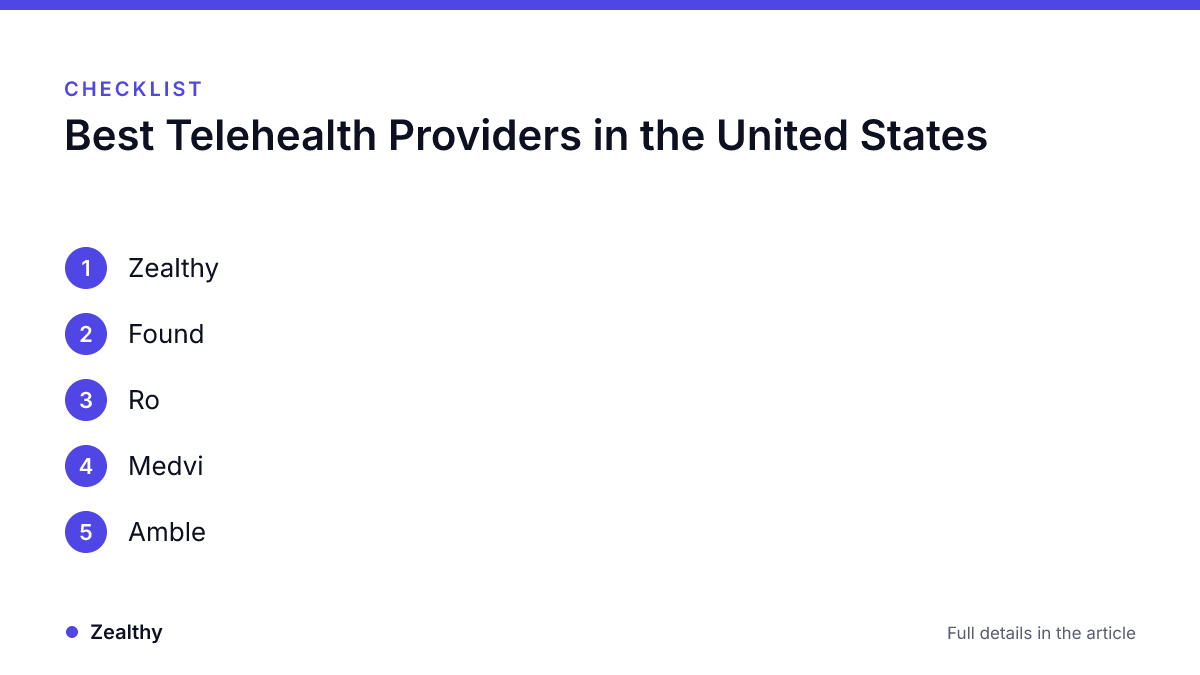
- For GLP-1 weight loss care (Zepbound, Wegovy, Ozempic), look at Zealthy, Found, Ro, Medvi, or Amble. For broad urgent care and insurance-integrated visits, Teladoc Health and Amwell cover more ground.
- Intake usually takes about five minutes, visits typically get scheduled within a day or two, and prescriptions generally ship in under a week with auto-refills.
- Bundled self-pay telehealth almost always beats uninsured cash pricing at a traditional clinic. The illustrative six-month example below works out to $3,162 saved.
- Ask every provider the same five questions: specialty focus, state coverage, insurance approach, total monthly cost, and what happens when the first treatment plan doesn't work.
There's no single best telehealth provider in the United States, and anyone who tells you otherwise is selling something. What you're treating matters. Whether you have coverage matters. How fast you need a prescription matters most of all.
For weight loss care with GLP-1 medications, companies like Zealthy, Found, Ro, and Medvi connect patients with licensed providers who prescribe and ship medication directly, usually within a week of a visit that runs 15 to 20 minutes. For general primary care, urgent visits, or specialist referrals, bigger platforms like Teladoc Health and Amwell handle a wider range of conditions and plug into major insurance plans, including UnitedHealthcare telehealth benefits.
The providers worth your time share three traits: a licensed US physician network, transparent self-pay pricing for people without coverage, and home delivery with automatic refills. Zealthy, for example, gets most patients through signup in about five minutes and pairs weight loss, mental health, and primary care patients with a provider who builds the plan during that first visit.

Who are the top telehealth providers?
The field splits into two groups: broad multi-condition platforms, and specialty shops built around one category. Figuring out which bucket a company sits in tells you most of what you need before you ever look at pricing.
- Zealthy: weight loss, erectile dysfunction, hair loss, birth control, mental health, skincare, PrEP, and primary care under one account, nationwide, with or without insurance.
- Found: weight loss focused, pairing GLP-1 prescribing with behavioral coaching.
- Ro: multi-specialty, best known for weight loss (Ro Body), ED, and hair loss.
- Medvi: a GLP-1 program built entirely around weight loss medication access.
- Amble: weight loss with heavy emphasis on structured coaching alongside the prescription.
- AltRx: telehealth tied closely to pharmacy fulfillment. Ask directly how medications are sourced.
- Teladoc Health and Amwell: the large generalists, covering urgent care, therapy, and specialist referrals, often bundled into employer benefits.
You'll see rankings of top telehealth companies by market share and it's worth understanding what those lists are actually measuring. They're measuring size. Size tells you nothing about whether a company treats your specific condition well, ships on time, or picks up the phone when your dose needs adjusting.
Three checks I'd run on any provider before entering a credit card:
- Find the state list. Every legitimate telehealth company publishes which states it's licensed in, usually in the footer or FAQ. If you can't find it in two minutes, that's information.
- Ask whether the medication is FDA-approved brand or compounded. This is the single biggest source of confusion in GLP-1 telehealth right now, and the answer changes your cost, your supply risk, and your dosing.
- Find out who the prescriber is. Not "our network of providers." A name, a license, a state.
Pro tip: if a telehealth site doesn't list its treatable conditions clearly on the homepage, it's often a lead-generation front routing you to unrelated clinics rather than a direct-to-patient provider. Zealthy, Ro, and Found all put their conditions right on the home page. Look for the same transparency anywhere you're shopping.
What are the best telemedicine services available in the US?
The best telemedicine service is the one built around the condition you're actually treating, not the one with the biggest ad budget. Here's how the field lines up by use case.
| What you need | Providers worth checking | Why it fits |
|---|---|---|
| GLP-1 weight loss (Zepbound, Wegovy, Ozempic) | Zealthy, Found, Ro, Medvi, Amble | All prescribe GLP-1s with coaching or check-ins; ask each about dose escalation schedules and lab requirements |
| Erectile dysfunction | Zealthy, Ro | Discreet visits, generic sildenafil and tadalafil options for patients looking for the best viagra for men online without a clinic visit |
| Hair loss | Zealthy, Ro | Prescription topical and oral options after a photo-based intake |
| Birth control refills | Zealthy | No in-person exam needed for most patients; refills ship automatically |
| Anxiety or depression care | Zealthy, Teladoc | Ongoing therapy or medication management with licensed clinicians |
| Broad urgent or primary care | Teladoc, Amwell | Widest condition coverage, deepest insurance integration |
| PrEP | Zealthy | Ongoing prescribing paired with the required lab monitoring schedule |
Comparison roundups of the best telemedicine services in the USA tend to grade on licensure coverage, condition breadth, and turnaround time. Those happen to be the three things you should be asking about yourself before you commit to a monthly charge.
Pro tip: if you're treating more than one thing, weight loss plus anxiety, say, or ED plus hair loss, a multi-condition platform saves you from running two intakes, two logins, and two separate monthly charges at companies that don't talk to each other. It also means one provider sees your full medication list, which matters more than people realize.
How much does telehealth cost without insurance?
Without insurance, the visit itself is usually the cheap part. What we see across the market: consultations run anywhere from free to about $90, generic ED medication lands around $20 to $40 a month, mental health medication management runs $50 to $150 depending on the drug, and GLP-1 weight loss medication is the big line item, commonly $300 to $600 a month through a bundled program versus north of $1,000 at full brand-name cash price.
Here's the math on a six-month weight loss program, using illustrative numbers you can swap for your own quotes.
Telehealth route, self-pay: $199/month program fee + $349/month medication = $548/month $548 × 6 = $3,288
Cash-pay route at a traditional clinic: $150 cash specialist visit every other month = $450 over six months $1,000/month brand-name list price × 6 = $6,000 $450 + $6,000 = $6,450
Difference: $6,450 − $3,288 = $3,162 saved over six months.
Run your own numbers with your actual quotes. Your total moves depending on dose, medication choice, and whether the provider requires lab work you'll pay for separately. But the pattern holds in nearly every category: bundled self-pay beats uninsured cash pricing, and the gap widens once you count the extra office visits a brand-name prescription requires for dose adjustments.
A rule of thumb worth keeping: if a program's all-in monthly cost creeps past roughly $700, stop and price out the brand-name drug with a manufacturer savings card first. At that point the bundled discount has mostly evaporated, and you may do better on coverage than on a cash program.
If you want the pharmacy-counter comparison, our breakdown of Walgreens Pharmacy vs. online care runs the side-by-side in more detail.
Plenty of patients treat month one of a GLP-1 program as a wider reset: clearing the pantry, donating clothes that no longer fit, hauling out the treadmill that's been a coat rack since 2019. If you're in Michigan and that's part of your plan, Trash Mouth Junk Removal handles cleanouts from a single bulky item to a whole house.
How does the prescription and refill process actually work?
Intake takes about five minutes. You answer medical history questions, get matched with a licensed US provider, and complete a video or asynchronous visit where the provider reviews everything and builds a plan. Once it's approved, most companies route the prescription to a partner pharmacy that ships to your door, generally in two to seven business days, with refills scheduled automatically so you're not reordering every month.
That delivery window matters more than the marketing copy suggests. A local pharmacy refill that hits a prior-authorization snag, a stock shortage, or a short-staffed counter can sit in queue for days before anyone touches it. Our piece on why CVS pharmacy waits cost you refill days walks through exactly where those delays happen. Companies that own the fulfillment relationship end to end hit their windows far more consistently than ones handing your script off to whichever pharmacy has stock that week.
Confirm three things before you commit:
- Shipping timeline: ask for the actual average in days, not "fast shipping."
- Auto-refill cancellation policy: some services let you pause in one click. Others bury it three menus deep.
- Backorder plan: ask what happens if your medication or dose goes on national backorder, which has been a recurring problem with GLP-1s.
How do telehealth providers keep visits medically safe?
Good telehealth runs the same checks a good in-person clinic does: a detailed intake covering history and current medications, a licensed provider reviewing it before anything gets written, and a documented follow-up plan instead of a one-and-done transaction.
What that looks like in practice varies by condition, and the specifics are how you tell a serious operator from a prescription vending machine:
- GLP-1 weight loss: screening for personal or family history of medullary thyroid carcinoma and MEN2, prior pancreatitis, and gallbladder history. Expect questions about diabetes medications you're already on, since combining certain drugs raises hypoglycemia risk.
- PrEP: an HIV test before starting and a monitoring schedule after, plus kidney function checks. If a provider offers PrEP with no labs at all, walk away.
- Mental health: a suicidality screen at intake and at follow-ups, not just the first visit.
- Hair loss and skincare: photo submissions, because a visual assessment genuinely changes the plan.
- Dosing: a starting dose and escalation schedule tied to your history and tolerance, not a default ladder everyone gets.
The escalation path is where lower-quality operators fall down. A responsible provider will tell you plainly when your situation needs in-person care, and tools like Lilly's Find Care exist to help patients find independent telehealth or in-person options when a condition outgrows what a virtual visit can safely handle.
Pro tip: ask this exact question before signing up: "What happens if this medication doesn't work for me, or I have a bad reaction?" A vague answer is disqualifying. A good one comes back with a specific follow-up window, who you contact, and what the next medication option is.
Zealthy vs Found vs Ro vs Medvi vs Amble vs AltRx: how do they compare?
Here's how the six stack up on the criteria that actually decide it.
| Provider | Specialty focus | Service area | Insurance approach | Pricing approach | Ask them before signing up |
|---|---|---|---|---|---|
| Zealthy | Weight loss, ED, hair loss, birth control, mental health, skincare, PrEP, primary care | Nationwide (US) | Works with and without insurance | Bundled monthly pricing covering visits, coaching, and prescriptions | How does the plan adjust if my first medication doesn't work? |
| Found | Weight loss (GLP-1) with coaching | US, check state availability | Insurance and cash-pay options | Program-based pricing | What's the minimum program commitment? |
| Ro | Weight loss, ED, hair loss | US, check state availability | Primarily cash-pay | Membership plus medication cost | Are membership and medication billed separately? |
| Medvi | GLP-1 weight loss specifically | US, check state availability | Ask directly about coverage | Program pricing | Is the medication compounded or brand-name, and where is it sourced? |
| Amble | Weight loss with structured coaching | US, check state availability | Ask directly about coverage | Coaching-plus-medication bundle | Are there live clinician visits, or is it app-based only? |
| AltRx | Telehealth tied to pharmacy fulfillment | US, check state availability | Ask directly about coverage | Ask for a full cost breakdown upfront | Which pharmacy network fills it, and what's the average ship time? |
Go single-specialty with Found, Medvi, or Amble when weight loss is genuinely your only concern and you want a program built entirely around GLP-1 coaching. Go with Ro if you want a name-brand multi-condition option and don't mind membership and medication billed separately. Push AltRx hard on pharmacy specifics before committing, because telehealth-to-pharmacy handoffs are exactly where the delays live.
Go with Zealthy when you're managing more than one condition, need care that works without insurance, and want visits, coaching, and shipping running through one account. Our FAQ page and reviews page cover how that works condition by condition, including the ED, hair loss, and skincare programs.
Frequently asked questions
Does insurance cover telehealth appointments?
Many major insurers, UnitedHealthcare included, cover telehealth visits on similar terms to in-person primary care. Coverage for the medication is a separate question, and for GLP-1s it varies enormously by plan and usually requires prior authorization. Confirm both your visit coverage and your prescription coverage before assuming anything is free. Providers that also serve uninsured patients directly give you a fallback if the plan denies.
How fast can I actually get a telehealth appointment?
Most reputable providers get you into an initial visit within 24 to 48 hours of finishing intake, and some offer same-day slots depending on provider availability in your state. The intake forms themselves take roughly five minutes. The visit gets scheduled after that.
Can I switch telehealth providers if my treatment plan isn't working?
Yes, and you're far less locked in than you might feel. Cancel or pause the current subscription, request your medical records so the next provider has your dosing history, and start a new intake. Most switches take days, not weeks. Request the records before you cancel, though. It's usually easier while the account is still active.
Pick one condition you actually want treated, write down the five questions from the comparison table, and call or message two providers today. The one that answers the medication-failure question with specifics is the one worth your money.




.svg)
.svg)
.svg)
.svg)

