A nocturnal panic attack is a sudden surge of fear that jolts you awake with a racing heart, sweating, and shortness of breath, even though nothing dangerous is happening. These episodes usually peak within minutes and pass on their own, so they are rarely dangerous by themselves, though certain symptoms deserve a same-day medical check. If one wakes you tonight, sit up, slow your exhale, and focus on the room around you. If attacks keep happening, it is worth arranging an evaluation to rule out other causes and start treatment.
TL;DR:
- Nighttime panic attacks often peak within ten minutes and are triggered by psychological or medical factors such as anxiety disorders, sleep apnea, or reflux.
- Differentiating panic from night terrors involves memory, response to stimuli, and physical clues like snoring or movements, making accurate diagnosis crucial for targeted treatment.
- Active response techniques like calming breathing, grounding exercises, and having a familiar object ready can shorten episodes and reduce disorientation during attacks.
- Cognitive behavioral therapy, antidepressants, and management of underlying sleep issues are effective treatments, with lifestyle changes supporting long-term prevention.
- Telehealth evaluations can provide rapid access to diagnosis, therapy, or medication, with detailed episode logs aiding clinicians in identifying causes and appropriate interventions.
Table of Contents
- What does panic feel like when it wakes you up?
- Why do panic attacks happen at night?
- How do you tell panic apart from night terrors or sleep apnea?
- When should a nighttime panic attack prompt a doctor visit?
- What should you do during and after an attack?
- What treatments actually reduce nighttime panic?
- Can better sleep habits actually prevent nighttime panic?
- What does a telehealth evaluation for nighttime panic look like?
- Beyond sleep hygiene: managing panic for the long haul
- Do relaxation and mindfulness techniques help at night specifically?
- Are nighttime panic triggers different from daytime ones?
- How do you talk to a partner or roommate about nighttime panic?
- A clinician’s honest take on nighttime panic
- Zealthy: a telehealth route to evaluation and treatment
- Sources
- FAQ
What does panic feel like when it wakes you up?
A nighttime panic attack tends to announce itself through the body before the mind catches up. You might sit up gasping, heart pounding, convinced something is seriously wrong, only to realize a few minutes later that you are safe.
Common symptoms include:
- A racing or pounding heartbeat
- Sweating or chills
- Trembling or shaking
- Shortness of breath or a choking sensation
- Chest pain or tightness
- Tingling in the hands or face
- A wave of nausea or dread
Symptoms typically peak within minutes, usually less than ten, according to Cleveland Clinic, though the leftover adrenaline can leave you shaky or exhausted well after the fear itself fades. Most people remember the episode clearly afterward, and breathing symptoms often feel more intense at night than during a daytime attack.
Why do panic attacks happen at night?
Nighttime panic rarely has a single cause. It usually reflects some mix of psychological patterns and physical health factors, and sometimes both at once.
On the psychiatric side, contributors include:
- Panic disorder or generalized anxiety disorder
- Post-traumatic stress, especially with sleep-related triggers
- A learned fear response to bedtime itself after a prior attack
On the medical side, Mayo Clinic points to contributors such as sleep apnea, asthma, thyroid dysfunction, reflux, cardiac arrhythmia, and certain medications or substances that can mimic or provoke panic symptoms.
Genetics and changes in brain function also play a role, and an attack can strike with no obvious trigger at all. That unpredictability is not a sign the fear is imaginary. It is a reason to get evaluated rather than assume you know the cause.
How do you tell panic apart from night terrors or sleep apnea?
Several nighttime conditions can look alike from the outside but feel completely different from the inside, and the distinctions matter for treatment.
- Memory. Panic attacks are usually remembered clearly; night terrors typically involve amnesia for the event.
- Content. Nightmares wake you with dream content still vivid in your mind, while panic often has no dream attached.
- Timing and responsiveness. Night terrors tend to happen early in the sleep cycle with the person hard to wake or comfort, while panic attacks can strike at any point and leave you fully alert.
- Physical clues. Snoring, gasping, or witnessed breathing pauses point toward sleep apnea; unusual repetitive movements or confusion afterward can suggest a seizure rather than panic.
A clinical review of frightening nighttime spells notes that diagnosis depends on sleep stage, memory, autonomic arousal, dreaming, and responsiveness, not just how frightening the moment felt.
Pro Tip: Keep a simple log of the time of night, how long the episode lasted, whether you were breathing normally, and anything a partner noticed. That record often tells a clinician more than a description of the fear itself.
When should a nighttime panic attack prompt a doctor visit?
A clinician evaluating nocturnal panic will usually ask about the timing of episodes, what happens during them, your medical history, and any medications or substances you use. That history often shapes which tests make sense.
Reasonable next steps can include:
- An ECG to check heart rhythm
- Thyroid blood tests
- Pulse oximetry or a sleep study if apnea is suspected
- An EEG if the pattern suggests possible seizure activity
Cleveland Clinic recommends arranging a visit when attacks recur, disrupt sleep, or cause you to dread going to bed. Certain symptoms need emergency care instead of a scheduled appointment: severe or persistent chest pain, fainting, breathing difficulty that does not ease, or any new neurological signs such as slurred speech or weakness.
What should you do during and after an attack?
The instinct to fight the panic often makes it worse. A calmer, more mechanical response tends to shorten the episode.
- Sit up and turn on a soft light so your eyes can orient to the room.
- Loosen tight clothing or bedding that might heighten the sense of restriction.
- Avoid forcing one big breath. Instead, breathe normally and make your exhale a little longer and slower than your inhale.
- Ground yourself: name five things you can see, four you can touch, three you can hear, two you can smell, one you can taste.
- Remind yourself the surge will pass, usually within minutes.
Do not drive until you feel steady, and never take someone else’s sedative to manage the moment. Call emergency services if you have severe chest pain, fainting, or breathing trouble that will not ease.
Pro Tip: Keep a glass of water and a dim lamp within reach before bed. Having something familiar to focus on can shorten the disorientation that follows a nighttime episode.
What treatments actually reduce nighttime panic?
Nocturnal panic responds to the same core treatments as daytime panic, and treating both together tends to work better than addressing nighttime symptoms alone.
- Cognitive behavioral therapy targets the catastrophic thoughts and avoidance behaviors that keep panic going, and Mayo Clinic lists it alongside medication as a standard treatment.
- Antidepressants, including SSRIs like sertraline or citalopram, are commonly used, though Mayo Clinic notes some can take six to eight weeks to reach full effect.
- Benzodiazepines can ease acute symptoms but carry dependence risks, so they are typically reserved for short-term use under close supervision.
- Beta-blockers such as propranolol can blunt physical symptoms like a racing heart, offering relief while other treatments take hold.
- Underlying sleep disorders deserve their own evaluation, since correcting a physical contributor can reduce how often panic strikes at night.
Starting this process usually means a conversation with a primary care provider or mental health clinician who can arrange a CBT referral or discuss medication options suited to your history.
Can better sleep habits actually prevent nighttime panic?
Consistent habits will not eliminate every episode, but they lower the odds of your nervous system being on edge when your head hits the pillow.
- Keep a consistent sleep and wake schedule, even on weekends.
- Cut off caffeine and alcohol several hours before bed.
- Set a screen curfew, since scrolling in bed keeps the mind alert rather than winding down.
- Build a short wind-down routine: dim lights, light stretching, or a few minutes of journaling worries out of your head.
- Exercise earlier in the day rather than right before bed.
Addressing a medical contributor matters too. Treating obstructive sleep apnea, sometimes with weight loss or a CPAP machine, has been associated with fewer panic episodes in some patients in small clinical observations, which makes it worth raising with a clinician if snoring or gasping is part of your pattern.
What does a telehealth evaluation for nighttime panic look like?
A virtual visit can cover your history, review current medications, and start therapy or a medication plan, with referrals for tests like an ECG or sleep study when needed. Before the visit, gather an episode log, any partner observations, your current medications, substance use, and prior mental health history. That preparation helps a clinician sort panic from a medical mimic faster.
Beyond sleep hygiene: managing panic for the long haul
Sleep hygiene helps, but lasting control over nighttime panic usually comes from treating the underlying anxiety pattern, not just the bedtime routine around it. Ongoing CBT, continued after the first few sessions resolve the acute crisis, teaches you to catch catastrophic interpretations before they spiral, which matters at 3 a.m. when your judgment is foggiest.
Regular medication review matters too. If you are on an SSRI or another daily medication, periodic check-ins with your prescriber help confirm the dose still fits, especially if your sleep pattern, weight, or stress level has shifted since you started.
Tracking patterns over months, not just nights, can reveal triggers a single log misses. Some people notice clusters around menstrual cycles, high-stress work periods, or seasonal changes in daylight. That kind of pattern recognition turns a string of scary nights into useful clinical information.
Addressing daytime anxiety management, through exercise, structured worry time, or ongoing therapy, tends to lower the baseline arousal that makes nighttime attacks more likely in the first place. Panic disorder rarely stays confined to nighttime hours forever, so treating it as a daytime condition with nighttime symptoms, rather than a separate nighttime problem, usually produces steadier results.
Finally, revisit your plan periodically. What worked in the first month of treatment might need adjusting six months in, particularly if life circumstances or sleep needs change.

Do relaxation and mindfulness techniques help at night specifically?
Standard relaxation advice often assumes you are calm and trying to prevent stress, not already jolted awake in a state of fear. Nighttime-specific versions work a little differently.
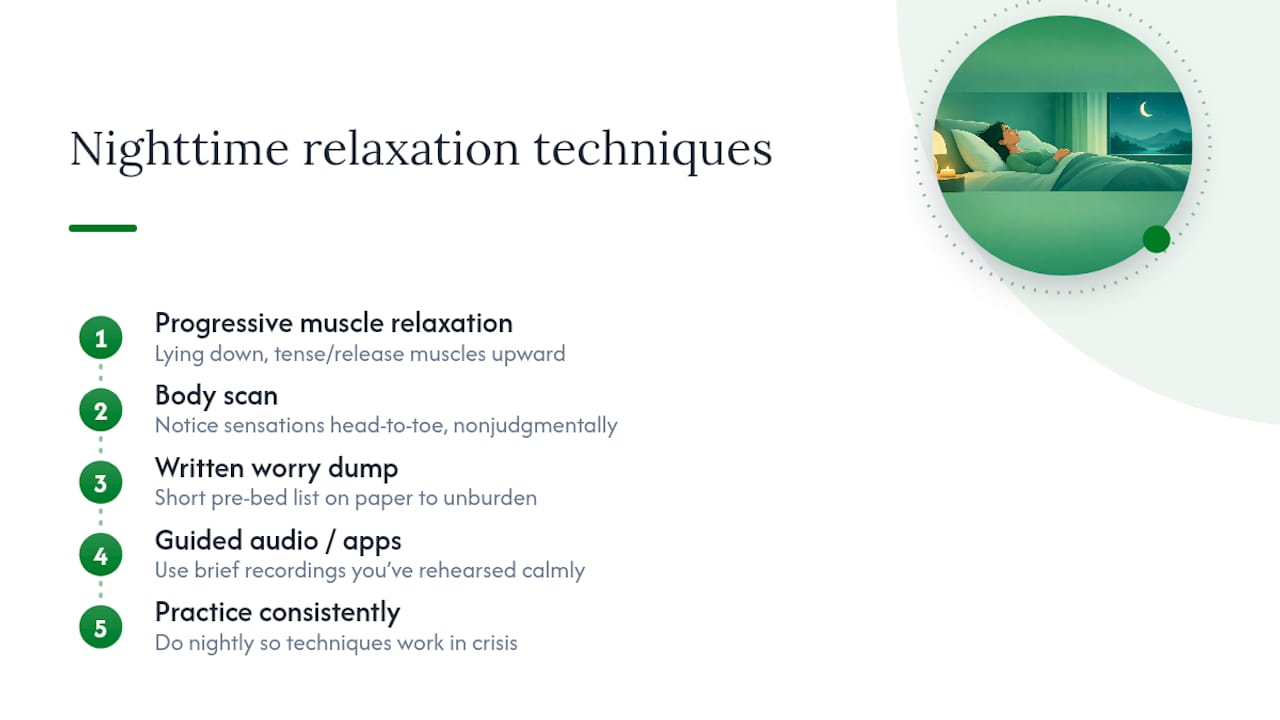
Progressive muscle relaxation, done lying down, tensing and releasing muscle groups from your feet upward, can redirect attention away from racing thoughts without requiring you to fully wake up or turn on lights. Some people find it easier than breathing exercises because it gives the mind a physical task to follow.
A brief body scan, noticing sensation from head to toe without judgment, can also interrupt the spiral of catastrophic thinking that keeps a panic attack going. The goal is not to force calm immediately but to give your attention somewhere steady to land.
For recurring nighttime worry that precedes an attack rather than following one, a short written worry dump before bed, listing concerns on paper so they are not circling in your head, can reduce the mental load that sometimes tips into a full episode.
Mindfulness apps and guided audio work for some people, though the specific tool matters less than the consistency of practice. A technique used only during a crisis is harder to access than one practiced nightly as part of a wind-down routine, so the exercises that help most during an attack are usually ones you have already rehearsed calmly beforehand.
Are nighttime panic triggers different from daytime ones?
Daytime panic often has an identifiable trigger: a stressful meeting, a crowded space, a reminder of past trauma. Nighttime panic frequently lacks that clear antecedent, which is part of what makes it so unsettling.
Some contributors are unique to the sleep environment itself. Sleep apnea can trigger a panic-like surge through oxygen drops during breathing pauses, with the fear response arriving before the person is even fully conscious of why. Reflux that worsens when lying flat can create chest discomfort that the brain interprets as a cardiac emergency, sparking a fear cascade. Nightmares with intense emotional content can blur into a panic attack on waking, even after the dream content itself fades.
The absence of an external trigger also means the brain has more room to misattribute bodily sensations, a slightly elevated heart rate from normal sleep cycling, for instance, as evidence of danger. This is part of why genetics, stress, and changes in brain function are cited as contributors even when no obvious daytime-style trigger exists.
Understanding this distinction matters practically: someone whose panic is largely trigger-driven during the day may need different coping tools at night, when there is no situation to avoid or exposure therapy target, just a body that woke up already in distress.
How do you talk to a partner or roommate about nighttime panic?
Waking someone else up gasping for air is unsettling for them too, and a little advance conversation prevents confusion in the moment.
Explain what a panic attack looks like for you specifically: the racing heart, the sense of doom, how long it typically lasts. Let them know what helps and what does not. Some people want quiet company and a hand to hold; others want space and a calm voice reminding them it will pass.
Give clear, simple instructions for red flags. If you have chest pain that does not ease, fainting, or breathing trouble that persists past a few minutes, tell them explicitly to call emergency services rather than wait it out with you.
It also helps to mention this if you share a bed regularly, since a partner who has witnessed an episode can offer useful details, whether you seemed responsive, whether there were unusual movements, how long it actually lasted, that you might not remember clearly yourself. That information is exactly what a clinician asks for during an evaluation.
A clinician’s honest take on nighttime panic
Nocturnal panic attacks are frightening, but they respond well to treatment, and getting evaluated is rarely a wasted trip. Expect some trial and error: the right combination of therapy, medication, and sleep assessment varies by person, and ruling out medical mimics is worth the appointment even when the answer turns out to be anxiety after all.
— Bryan
Zealthy: a telehealth route to evaluation and treatment
Getting evaluated for nighttime panic should not require weeks of waiting for an appointment. Some telehealth providers offer same-day virtual visits for mental health and primary care, enabling patients to discuss symptoms, review medications, and obtain referrals for testing without long delays.

An initial visit typically covers:
- A discussion of your symptoms, timing, and history
- A review of current medications and substance use
- A path toward CBT referral or a medication conversation if appropriate
- Prescription delivery when a treatment plan calls for it
If nighttime panic has been disrupting your sleep, you can book an evaluation through Zealthy’s mental health care page or start with primary care if you suspect a medical contributor like thyroid or heart rhythm issues. Insurance may apply depending on your plan.
This article is general information, not a substitute for advice from a qualified doctor. Consult a qualified healthcare professional about your own circumstances before acting on anything here.
Sources
- Nocturnal Panic Attack: Anxiety, Panic Disorder & Night …
- Panic attacks - Symptoms and causes - Mayo Clinic
- Panic attacks - Diagnosis and treatment - Mayo Clinic
- Frightening spells at night - PMC
FAQ
How to stop a panic attack in the night?
Sit up, loosen tight clothing, and breathe normally with a slightly longer exhale rather than forcing a deep breath in. Grounding yourself by naming things you can see, touch, and hear also helps shorten the episode, according to Mayo Clinic’s guidance.
What is the 3-3-3 rule for panic attacks?
The 3-3-3 rule is a grounding technique where you name three things you see, three sounds you hear, and move three parts of your body. It is a simplified version of the broader grounding approach used to redirect attention during panic, though definitions of the exact steps vary slightly by source.
How can I stop waking up in a panic?
Consistent sleep and wake times, cutting late caffeine and alcohol, and a wind-down routine before bed can reduce how often you wake in panic. If episodes keep recurring despite these habits, an evaluation can check for contributors like sleep apnea, thyroid issues, or medication effects.
How to stop bedtime anxiety?
A short wind-down routine, writing down worries before bed, and avoiding screens in the hour before sleep can ease the anticipatory anxiety that sometimes precedes a nighttime attack. Ongoing anxiety despite these steps is often better addressed with cognitive behavioral therapy or medication rather than sleep habits alone.


.svg)
.svg)
.svg)
.svg)

