

Compounded semaglutide carries safety risks that FDA-approved semaglutide does not, and the FDA has repeatedly discouraged its use outside narrow circumstances. Adverse event reports now number in the thousands, and many trace back to dosing errors, impurities, or unapproved additives. If you’re using or considering a compounded product, talk to your clinician about switching to an FDA-approved alternative.
TL;DR:
- Over 1,700 adverse event reports have been linked to compounded semaglutide, with many stemming from dosing errors, impurities, or untested ingredients.
- Compounded semaglutide often contains different salts, added unapproved ingredients, or is formulated into untested dosage forms, increasing safety risks.
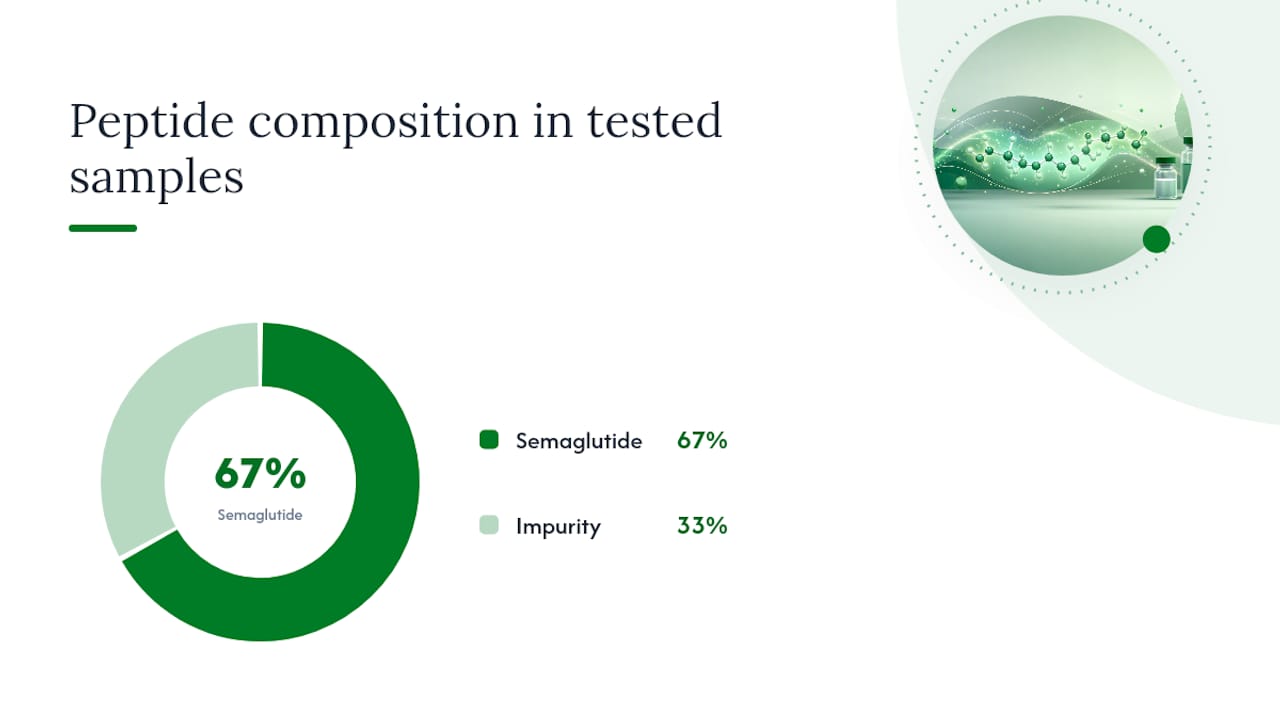
- The majority of harms are caused by human errors in dosing, with lab tests revealing impurities as high as 33% and underdosed samples at risk of reduced effectiveness.
- The FDA has proposed removing semaglutide from the 503B bulks list, which would limit large-scale compounding and improve safety controls.
- Proper verification, prescription requirements, and choosing FDA-approved products through licensed clinicians greatly reduce risks compared to unregulated compounded formulations.
Compounded Semaglutide Safety: What the FDA Says Now
The FDA’s core objection is simple: compounded semaglutide has never gone through the agency’s premarket review process, so nobody outside the compounding pharmacy has verified what’s actually in the vial. That gap matters more than it might sound. It means the drug could contain the wrong ingredient, the wrong concentration, or contaminants that would normally get flagged before a product ever reaches a patient.
The scale of the problem is no longer theoretical. As of May 31, 2026, the FDA had logged 990 adverse event reports tied specifically to compounded semaglutide, and more than 1,700 when combined with reports for compounded tirzepatide. The agency is explicit that this number likely understates the real total, since not every state-licensed compounding pharmacy is required to submit adverse event data at all.
990 reports. That’s the FDA’s current adverse event count for compounded semaglutide alone, as of May 2026, and it doesn’t include the pharmacies that never had to report in the first place.
Regulatory action has followed the data. Once semaglutide came off the FDA’s drug shortage list in February 2025 (tirzepatide had come off in December 2024), the legal justification for mass compounding weakened considerably. The FDA has since proposed excluding semaglutide, tirzepatide, and liraglutide from the 503B bulks list entirely, a move that would sharply limit which pharmacies can legally compound these drugs going forward. Warning letters to compounding companies have accompanied this shift, signaling that enforcement is not slowing down.
None of this means every compounded product on the market today is dangerous. It means the regulatory floor under these products is thinner than most patients assume, and the agency’s own numbers back that up.
How Compounded Semaglutide Differs From FDA-Approved Semaglutide
FDA-approved semaglutide products go through clinical trials, manufacturing inspections, and batch-level quality testing before they ever reach a pharmacy shelf. Compounded versions skip that entire process. The FDA does not review compounded drugs for safety, effectiveness, or quality before they’re sold, according to analysis from Stanford Medicine, which means the burden of quality control shifts almost entirely onto the individual compounding pharmacy.
That shift shows up in several concrete ways:
- Different salt forms. Some compounders use semaglutide sodium or semaglutide acetate instead of the base compound used in approved products, forms that haven’t been proven equivalent in safety or effect.
- Added ingredients. Vitamin B12, amino acid blends, or other peptides sometimes get mixed in, creating combinations that have never been studied together.
- Untested dosage forms. Sublingual drops and orally disintegrating tablets have shown up on the market despite no clinical data on how well the body absorbs semaglutide that way.
- Multi-dose vials instead of pens. Patients often have to draw their own dose with a syringe, rather than using a pre-measured, FDA-approved pen.
- Inconsistent storage and shipping. Compounded peptides are temperature-sensitive, and supply chain gaps can degrade potency before the product ever reaches you.
Pro Tip: If your compounded product requires you to draw a dose from a vial using unit markings on an insulin syringe, ask your pharmacist to walk you through the math out loud before your first injection. Unit-to-milligram conversion errors are one of the most common ways patients accidentally overdose.
Mixing matters more than most patients realize. Stanford’s review notes that combining tirzepatide with B12 has, in some tests, produced entirely new bonded molecules with unknown clinical effects, not a semaglutide-plus-vitamin cocktail, but a different chemical compound altogether.
Documented Harms: Dosing Errors, Impurities, and Administration Mistakes
The most consistent failure mode reported to the FDA isn’t an allergic reaction to the drug itself. It’s dosing. The FDA has documented cases where patients or providers administered doses far beyond what was intended, sometimes 10 to 20 times the intended amount, leading to hospitalization.
Lab testing has confirmed why quality is such a persistent concern. Independent analyses of compounded semaglutide samples found peptide-related impurities as high as 33%, with some samples showing a 19% reduction in labeled strength. That means a patient could be injecting a drug that’s simultaneously contaminated and underdosed, a combination that undermines both safety and effectiveness at once.
One-third of the peptide content in some tested samples wasn’t semaglutide at all. It was impurity.
Common harms reported include:
- Severe nausea and vomiting beyond what’s typical with approved semaglutide, often tied to accidental overdosing
- Pancreatitis and gallbladder complications, consistent with known semaglutide risk categories but sometimes intensified by potency errors
- Kidney injury following dehydration from uncontrolled vomiting
- Anaphylaxis-type reactions linked to added, unstudied ingredients
- Hospitalization following self-administered overdoses from multi-dose vials
Poison control centers have tracked a steep rise in calls related to injectable weight-loss drugs since 2019, a trend Stanford researchers link largely to dosing and administration mistakes rather than the drug’s underlying safety profile. The molecule itself isn’t the primary danger. Inconsistent manufacturing and human error around dosing are.
Red Flags That Signal an Unsafe or Fraudulent Supplier
Spotting a bad actor before you inject anything is far easier than dealing with the aftermath. Watch for these warning signs:
- No prescription required. Legitimate semaglutide, compounded or not, requires a valid prescription from a licensed clinician who has evaluated you.
- Vague or foreign pharmacy labeling. If the label doesn’t clearly name a U.S.-licensed pharmacy, or lists no lot number and no expiration date, don’t use it.
- Unusual dosage forms. Sublingual drops, lozenges, or dissolvable tablets marketed as semaglutide are a strong signal the product hasn’t been tested the way it’s being sold.
- Added peptides you didn’t ask for. Products bundled with BPC-157 or similar unregulated peptides raise the risk of unknown drug interactions.
- Suspiciously low pricing or pressure tactics. Aggressive discounts, countdown timers, or urgency-driven sales language are more common with unreliable sellers than legitimate pharmacies.
- Being asked to self-draw from a multi-dose vial with no instruction. A responsible provider walks you through exact measurement, every time.
Pro Tip: Ask any compounding pharmacy for a Certificate of Analysis (COA) and confirm whether they operate as a registered 503B outsourcing facility. Both are quick checks, and a legitimate pharmacy will produce them without hesitation.
You can also cross-check a pharmacy against your state board of pharmacy and the FDA’s own warning letter archive before committing to a purchase.
What to Do If You Have Side Effects or a Suspicious Product
Seek emergency care immediately if you notice severe abdominal pain radiating to your back (a hallmark of pancreatitis), signs of anaphylaxis like facial swelling or trouble breathing, severe dehydration, or sudden vision changes. These aren’t symptoms to monitor at home.
Once you’re safe, take these steps:
- Report the adverse event to the FDA’s MedWatch program online or by phone.
- Contact your prescriber and the dispensing pharmacy directly so they can investigate the specific batch.
- File a complaint with your state board of pharmacy if the seller wasn’t licensed or acted suspiciously.
- Preserve everything: the original packaging, lot numbers, shipping confirmation emails, and photos of the product itself.
That documentation does more than support your own case. It gives investigators the specific batch and supplier information they need to act on a pattern, not just a single complaint.
When Compounding Might Make Sense, and How to Make It Safer
Compounding has a legitimate place in medicine, but the bar is narrow: it’s meant to fill gaps when an FDA-approved product genuinely can’t meet a documented medical need, not to serve as a cheaper or more convenient default.
If your clinician determines compounding is appropriate, a few safeguards make a real difference:
- Favor 503B outsourcing facilities, which follow stricter sterility and quality standards than smaller 503A compounding pharmacies.
- Ask for a Certificate of Analysis and evidence of cGMP (current good manufacturing practice) compliance where the pharmacy can provide it.
- Start with conservative, clearly documented dosing, with a specific titration schedule rather than an open-ended “increase as needed” instruction.
- Schedule frequent follow-up visits and lab monitoring, especially in the first few months.
Pro Tip: Keep a written log of every dose, date, and injection site, even for a compounded product your clinician is actively supervising. That record becomes essential if you ever need to switch to an FDA-approved formulation, since your prescriber can match your titration history instead of restarting from scratch.
The goal should always be a bridge, not a permanent arrangement. As soon as an FDA-approved product becomes accessible for your situation, that’s the safer long-term path.
How Zealthy Approaches Semaglutide Safety
The safest path with semaglutide isn’t about finding the cheapest source. It’s about having a clinician who evaluates your history, checks for contraindications, and stays involved after the prescription is written. An evaluation happens before any prescription goes out, with licensed clinicians reviewing your health history, screening for conditions that make semaglutide inappropriate, and following up as your treatment continues.
The model is built around FDA-approved prescribing, clear counseling on what to expect, and prescription delivery that removes the guesswork some patients turn to compounded products to solve in the first place. If you’re currently using a compounded product and want a supervised, approved alternative, a consultation for semaglutide through Zealthy is a reasonable next step, paired with your regular clinician’s guidance on how to transition safely.
— Bryan
Where to Verify These Facts Yourself
Start with the FDA’s own warning on unapproved GLP-1 drugs and its dosing error alert. MedlinePlus covers semaglutide’s clinical safety profile in plain language, and Stanford Medicine’s reporting breaks down why doctors remain cautious.
Getting FDA-Approved Semaglutide Through Zealthy
If reading through the FDA’s adverse event data has you rethinking a compounded product, you’re not alone, and you have a straightforward alternative. Telehealth providers can connect you with a licensed clinician who evaluates your health history, prescribes FDA-approved semaglutide when it’s appropriate, and coordinates delivery so you’re not sourcing medication from an unverified supplier on your own.

This approach differs from piecing together a compounded regimen yourself by continuity: the same clinician who prescribes your dose also monitors your progress, adjusts your titration schedule, and answers questions when side effects come up, often through messaging and video visits instead of a waiting room. That ongoing relationship is exactly what’s missing when patients order compounded semaglutide from an online seller with no follow-up built in.
If you’re ready to explore FDA-approved weight loss care with a clinician who stays involved after the prescription, start a consultation through Zealthy today and find out whether semaglutide is the right fit for your health history.
This article is general information, not a substitute for advice from a qualified doctor. Consult a qualified healthcare professional about your own circumstances before acting on anything here.
Sources
- FDA’s Concerns with Unapproved GLP-1 Drugs Used for Weight Loss
- Compounded GLP-1s: Why doctors worry and the FDA is cracking down
- MedlinePlus: Semaglutide drug information
FAQ
Can you still get compounded semaglutide in the U.S.?
Yes, compounded semaglutide is still available in some states through licensed 503A and 503B pharmacies, though the FDA’s proposed rule to exclude semaglutide from the 503B bulks list would significantly narrow legal access going forward.
Is the FDA going to stop compounded semaglutide?
The FDA has already removed semaglutide from the drug shortage list and proposed excluding it from the substances 503B pharmacies can compound, a move that would end most large-scale compounding once finalized, though it hasn’t banned compounding outright for documented medical necessity cases.
Why did some celebrities report stopping GLP-1 medications?
Public accounts of stopping GLP-1 drugs typically cite side effects like severe nausea, muscle loss concerns, or personal preference rather than a single universal reason, and individual experiences vary widely based on dose, formulation, and how the medication was sourced.
Is compounded semaglutide safer than FDA-approved Ozempic or Wegovy?
No. FDA-approved products go through premarket review, manufacturing oversight, and consistent quality testing that compounded versions skip entirely, and the FDA’s own adverse event data shows higher documented risks of impurities and dosing errors tied to compounded formulations.



.svg)
.svg)
.svg)
.svg)

