TL;DR
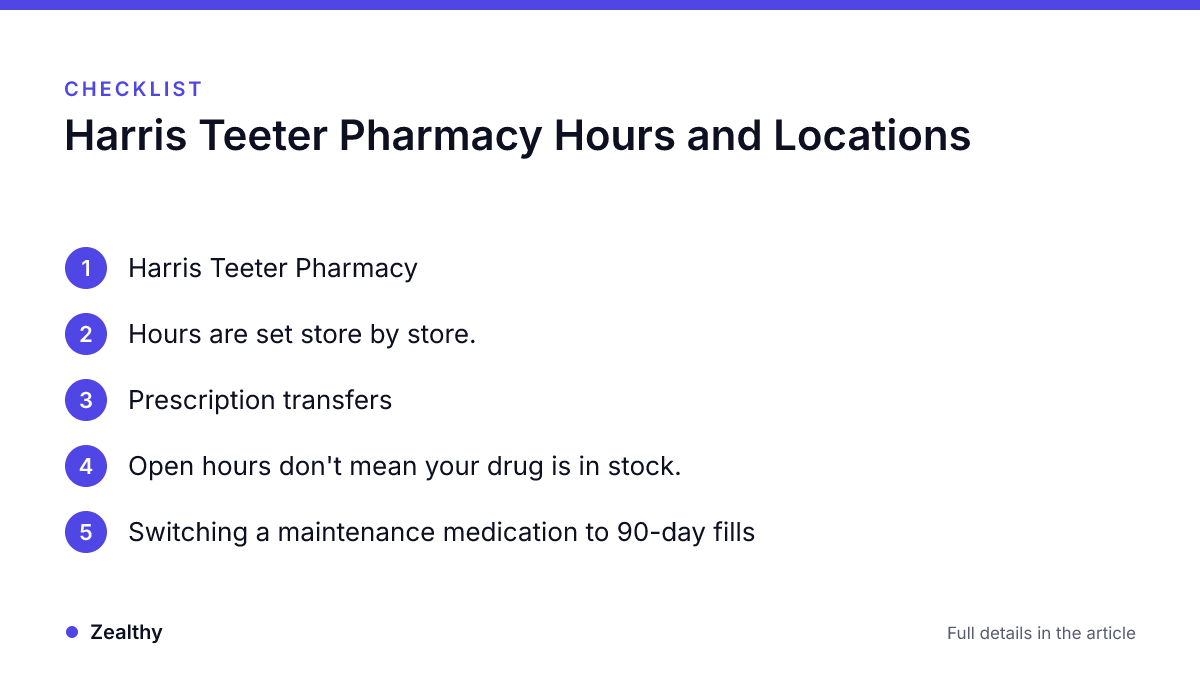
- Harris Teeter Pharmacy is the prescription counter inside Harris Teeter grocery stores, concentrated in North Carolina, South Carolina, Virginia, and Georgia, with most counters running a daytime schedule Monday through Saturday and shorter Sunday hours.
- Hours are set store by store. Two Charlotte locations a few miles apart can close at different times, and the pharmacy almost always closes before the grocery store does.
- Prescription transfers from CVS, Walgreens, or Safeway usually land the same day or within one business day. You need the old pharmacy's phone number and the medication name, nothing more.
- Open hours don't mean your drug is in stock. GLP-1s, ADHD medications, and some controlled substances get backordered at retail counters, which is why so many people have moved recurring prescriptions to telehealth.
- Switching a maintenance medication to 90-day fills cuts you from roughly 12 pharmacy trips a year to 4. At a 25-minute round trip, that's about 200 minutes back in your calendar.
Harris Teeter Pharmacy is the in-store prescription counter inside Harris Teeter grocery stores, the Kroger-owned chain with its heaviest footprint in North Carolina, South Carolina, Virginia, and Georgia. Most counters keep a standard daytime schedule, roughly mid-morning to evening, with a shorter Sunday. The exact closing time, lunch break, and drive-thru availability change from store to store. Call before you drive.
Table of Contents
- What are Harris Teeter Pharmacy's typical hours?
- How do I find a Harris Teeter Pharmacy near me?
- How do I get a prescription filled without wasting a trip?
- How does Harris Teeter compare to CVS, Walgreens, and Safeway?
- When does it make more sense to skip the pharmacy counter entirely?
- Frequently asked questions
What are Harris Teeter Pharmacy's typical hours?
In our experience helping patients move prescriptions around, Harris Teeter pharmacy counters follow the familiar grocery-pharmacy pattern: open around 9 a.m. on weekdays, closed by 8 or 9 p.m., with Saturday a little shorter and Sunday the shortest of all. Some smaller stores close the pharmacy entirely on Sunday.
What trips people up isn't the closing time. It's the middle of the day. Plenty of grocery pharmacies staff a single pharmacist, which means the counter shuts for a lunch break while the rest of the store stays open and lit. If you call at 1:45 p.m. and nobody picks up, the pharmacy isn't gone. It's at lunch. Try again after 2:30.
Holiday weeks compress everything. Thanksgiving, Christmas Eve, Christmas Day, and New Year's Day all run on reduced or closed schedules, and the reduction usually hits the pharmacy harder than the grocery floor.
If you're coming from a 24-hour CVS or an all-night Walgreens in a bigger metro, reset your expectations. Harris Teeter, like most Safeway pharmacy counters, runs on daylight hours and nothing else.
Pro tip: Call the pharmacy's direct line, not the main store number listed on Google. The hours on a map listing are almost always the grocery store's hours, and that gap between "store open until 11" and "pharmacy closed at 8" causes more wasted trips than any other single thing.
How do I find a Harris Teeter Pharmacy near me?
Search by cross-street or neighborhood, not just "near me." Charlotte alone has enough locations that shoppers look up specific ones by landmark: the Park Road store, South Blvd, Central Ave, the Rivertown store in Mount Holly, the Stonecrest counter on Rea Rd, the one off Highway 41. Each sets its own hours and staffing, so the map pin only gets you halfway. You still need to confirm that counter is open and has your medication on the shelf.
Two worth bookmarking if you're in the Charlotte area:
- Quail Corners on Park Road. The Quail Corners Pharmacy on Park Road is a go-to for transfers and routine refills on that side of town.
- Stonecrest on Rea Rd. The Stonecrest Pharmacy on Rea Rd covers south Charlotte and the Waxhaw-adjacent crowd. Saturday mornings there are the busiest window of the week.
How do I get a prescription filled without wasting a trip?
Here's the sequence that actually works, whether it's a brand new script or a transfer from another chain.
- Confirm that store's pharmacy hours and drive-thru status. Call the pharmacy line. Drive-thru windows frequently close an hour or more before the walk-in counter, and some locations never had one.
- Have your insurance card, photo ID, and medication name ready. For a transfer, add your old pharmacy's phone number. That's the piece people forget, and without it the pharmacist has to hunt it down while you stand there.
- Start the transfer or refill before you leave the house. Call it in or use the app. Most transfers from CVS, Walgreens, or Safeway finish same day. Controlled substances take longer because of the extra verification between pharmacists.
- Ask for a text when it's ready, and ask for a time window. Same day does not mean same hour. "Ready by 4" is a usable answer. "Later today" is not.
- Check stock separately from checking hours. Say the drug name on the phone and ask if it's physically on the shelf. GLP-1s like semaglutide and tirzepatide, plus a lot of ADHD and anxiety medications, have been unreliable at retail counters. A 90-second call beats finding out at the window.
- Use the counter, not the drive-thru, for anything new. First fills, dose changes, anything with real side effects. Two minutes of face-to-face counseling is worth more than the convenience of a speaker box.
- Move maintenance medications to 90-day fills. Birth control, blood pressure medication, an SSRI. Fewer trips, fewer chances to run out on a Sunday when the counter's closed.
Is a 90-day fill actually worth the switch?
Run the numbers on your own commute and it usually answers itself. Here's an illustrative scenario using a 25-minute round trip, which is about what a suburban grocery run costs you door to door.
The formula: fills per year × round-trip minutes = annual time spent at the pharmacy.
- 30-day fills: 12 × 25 = 300 minutes a year (5 hours)
- 90-day fills: 4 × 25 = 100 minutes a year (1 hour, 40 minutes)
- Difference: 200 minutes, roughly three and a half hours
Now add the failure rate. If one trip in six ends with "it's not ready yet" or "we're waiting on your insurance," the monthly schedule produces about two wasted trips a year and the 90-day schedule produces well under one. The rule of thumb we use: if you've been on a medication more than six months and the dose is stable, there's no good reason to still be filling it 30 days at a time.
What most people miss
The blind spot isn't hours. It's assuming an open pharmacy is a stocked pharmacy. A counter can be fully staffed and still be two weeks out on your dose. If your dose has been unavailable for weeks at more than one chain, that's usually a supply problem upstream rather than a local one — ask the pharmacist straight out whether the manufacturer has it on backorder, because that answer changes what you do next.
The other gap is prior authorization. Insurance approval for weight loss drugs and certain mental health medications can sit in a queue for days even after the medication is sitting on the shelf with your name on it. Those are two separate clocks, and the pharmacy only controls one of them.
How does Harris Teeter compare to CVS, Walgreens, and Safeway?
| Factor | Harris Teeter Pharmacy | CVS Pharmacy | Walgreens Pharmacy | Safeway Pharmacy |
|---|---|---|---|---|
| Typical weekday schedule | Daytime only, closes evening | Longer evenings, some 24-hour stores | Longer evenings, some 24-hour stores | Daytime, closes evening |
| Weekend coverage | Short Saturday, limited or closed Sunday | Usually open both days | Usually open both days | Usually open both days |
| Midday pharmacist lunch closure | Common | Less common | Less common | Common |
| Drive-thru | Varies by store, not guaranteed | Common in suburbs | Common | Less common |
| Geographic footprint | Southeast U.S. | Nationwide | Nationwide | West Coast and select states |
| Transfer turnaround | Same day to one business day | Same day to one business day | Same day to one business day | Same day to one business day |
The honest read: once you're standing at the counter, these chains are more alike than different. Footprint and hours are what separate them, not the quality of the fill. Pick the one closest to your actual daily route, because the pharmacy you can reach at 6:15 p.m. on a Tuesday beats the one with the better app.
When does it make more sense to skip the pharmacy counter entirely?
Skip the trip when the prescription is routine, recurring, and doesn't need an in-person exam. Birth control refills. Ongoing anxiety or depression medication. Hair loss treatment. GLP-1 weight loss medication. None of those require you to stand in a line next to the cough drops.
The real cost of a retail refill isn't the drive. It's the days you lose when a request gets stuck behind an insurance hold and nobody tells you. We've broken down how CVS pharmacy wait times can cost you refill days when that happens, and the pattern is identical at a grocery counter.
Telehealth collapses the prescriber visit and the fulfillment into one process that ships to your door. Zealthy's weight loss program pairs GLP-1 prescriptions, including semaglutide, with ongoing provider support. Still deciding between medications? Our breakdown of Ozempic vs. Mounjaro covers the practical differences. The same logic runs outside weight loss: men tracking low testosterone symptoms can read up on enclomiphene dosing, and anyone weighing anxiety treatment can compare fluoxetine for anxiety and depression or review bupropion's side effect profile before the visit.
Pro tip: Ask your telehealth provider to put refills on an automatic ship schedule timed to arrive about a week before you run out. That buffer is what protects you from a shipping delay. Without it, you're back on the phone with a pharmacy at 7 p.m. asking who has your dose in stock.
Frequently asked questions
Does Harris Teeter Pharmacy accept prescriptions without insurance?
Yes. Harris Teeter pharmacies fill prescriptions at cash price for uninsured patients, and most accept manufacturer coupons and discount cards. Before you pay that cash price, compare it against a telehealth plan that bundles the provider visit and the medication into one monthly cost. For recurring medications, the bundled number often comes in lower once you add the visit fee you'd otherwise pay separately.
Can I get a same-day prescription transfer to or from Harris Teeter?
Usually. Transfers between Harris Teeter and chains like CVS or Walgreens typically finish within a few hours to one business day. Controlled substances and specialty medications run longer because of the added verification between pharmacists. Call with your old pharmacy's name and phone number in hand and you'll cut the turnaround noticeably.
What happens if my medication is out of stock at my local Harris Teeter?
The pharmacist can check inventory at nearby sister stores or place an order, which generally adds one to three business days depending on the drug and the distributor. For anything you can't afford to run out of, keep a direct-ship telehealth provider as a backup so you're not dependent on one store's shelf. You can start that process through Zealthy's intake in about five minutes.
Before your next refill is due, do one thing: call your local Harris Teeter pharmacy line, confirm the closing time and whether they do a lunch closure, and ask if your medication can move to a 90-day fill. Those two questions eliminate most of the wasted trips. If the answer on either one isn't workable for your schedule, that's your signal to move the prescription somewhere that ships.


