

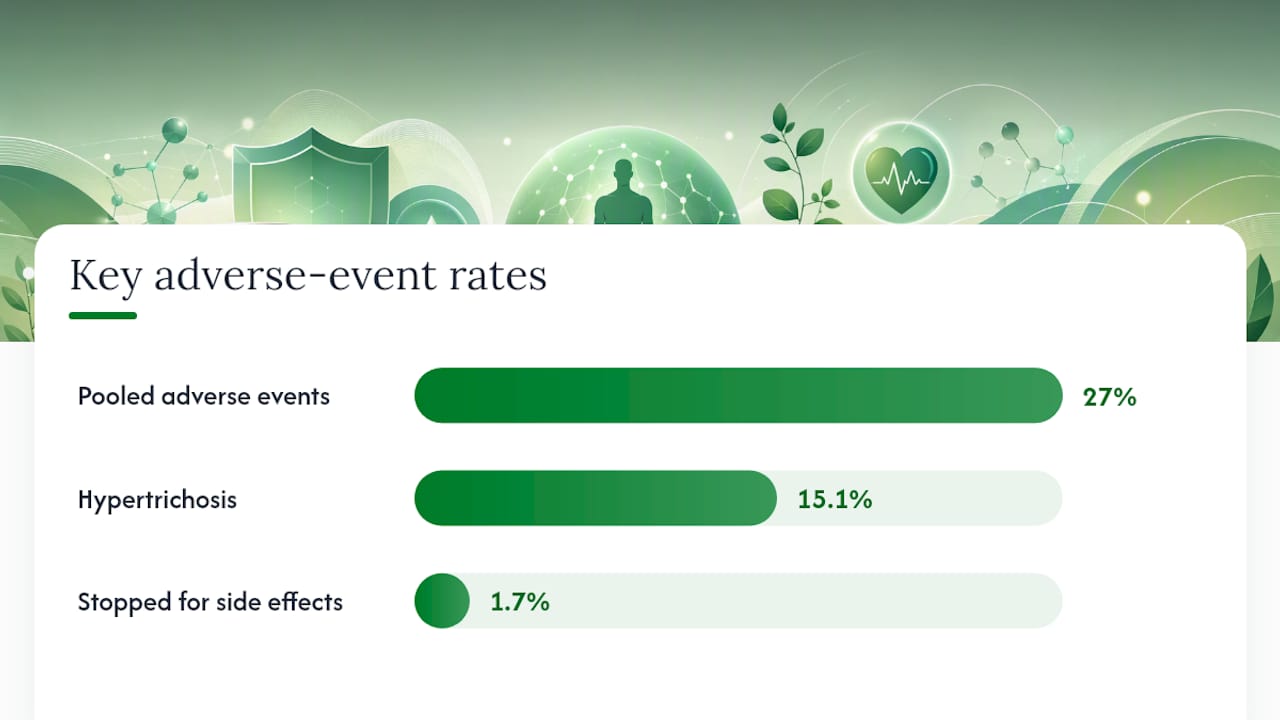
Low-dose oral minoxidil (LDOM) is considered safe for most healthy adults when prescribed and monitored by a clinician. The largest real-world safety evidence comes from a multicenter retrospective cohort of 1,404 patients, which found a generally good safety profile: only 1.7% of patients stopped treatment because of side effects. A 2025 systematic review and meta-analysis pooling 2,933 patients reported an overall adverse-event incidence of about 27% (95% CI: 18%–36%), with most events being mild and dose-related. The Mayo Clinic drug monograph confirms that the most common side effect, unwanted body hair growth (hypertrichosis), is often reversible after stopping treatment.
Low-dose oral minoxidil requires medical supervision: it can cause fluid retention, a faster heart rate, and lowered blood pressure, so clinicians typically monitor blood pressure and ask about heart conditions before prescribing. It is not recommended during pregnancy or breastfeeding. Discuss these risks with a physician before starting.

The bottom line: LDOM is a reasonable option for adults with pattern hair loss who have no significant cardiac history, who are not pregnant or breastfeeding, and who are not on medications that lower blood pressure. Anyone with heart disease, uncontrolled hypertension, or a history of fluid retention should speak with a clinician before considering it.
Key facts at a glance:
- Hypertrichosis (unwanted hair growth) is the most frequently reported side effect, occurring in 15.1% of patients in the multicenter cohort
- Systemic adverse events such as fluid retention and tachycardia are uncommon at low doses
- Only a small percentage of patients in the largest cohort discontinued treatment due to side effects
- Serious events like pericardial effusion are rare but have been reported, making baseline screening important
- Pregnancy and breastfeeding are absolute contraindications
Key Takeaways
Low-dose oral minoxidil has a well-documented safety profile at hair-loss doses, with most adverse events being mild, dose-related, and reversible, but baseline screening and follow-up monitoring are non-negotiable.
| Point | Details |
|---|---|
| Overall safety at low doses | Only 1.7% of patients in the 1,404-patient cohort stopped treatment due to side effects. |
| Most common side effect | Hypertrichosis occurred in 15.1% of the cohort; it is often reversible after stopping treatment. |
| Pooled adverse-event rate | A 2025 meta-analysis of 2,933 patients found an overall adverse-event incidence of about 27% (95% CI: 18%–36%). |
| Monitoring is required | Baseline blood pressure, heart rate, and medication review are needed before starting; follow up at 2–4 weeks after initiation. |
| Zealthy’s role | Zealthy’s licensed clinicians evaluate your history, prescribe when appropriate, and provide structured follow-up for hair loss treatment. |
What low-dose oral minoxidil is and why clinicians use it for hair loss
Oral minoxidil is a systemic vasodilator, meaning it relaxes and widens blood vessels. It was originally developed and FDA-approved under the brand name Loniten as an antihypertensive medication, used at doses of 10–40 mg per day for patients with severe, treatment-resistant high blood pressure. At those doses, the cardiovascular and fluid-retention risks are significant, and clinicians historically co-prescribed diuretics and beta-blockers to manage them.
Hair loss treatment uses a fraction of that dose. “Low-dose” for alopecia typically means 0.25–5 mg per day, which is why the risk profile looks so different from the antihypertensive context. The comprehensive PMC review of LDOM describes two categories of adverse effects: type A events, which are dose-dependent and predictable (hypertrichosis, edema, tachycardia), and type B events, which are idiosyncratic and unpredictable regardless of dose (pericardial effusion). Understanding that distinction helps set realistic expectations.
Clinicians choose oral over topical minoxidil for several practical reasons:
- Prior topical intolerance: Scalp irritation, contact dermatitis, or propylene glycol sensitivity can make topical formulations uncomfortable or unusable
- Adherence challenges: Twice-daily scalp application is inconvenient for some patients; a once-daily pill is simpler
- Diffuse or widespread hair loss: Oral delivery reaches the entire scalp uniformly, which can be an advantage when hair thinning is not localized
- Topical treatment failure: Some patients see limited results with topical minoxidil and benefit from switching to the oral route
Pro Tip: If you have tried topical minoxidil for at least six months without meaningful results, oral minoxidil is worth discussing with your clinician as a next step, not a last resort.
Which side effects happen most often with oral minoxidil and how frequently
The side-effect picture for LDOM is well-characterized at this point, thanks to large cohort data and the 2025 meta-analysis. Most events are predictable, mild, and manageable.
Common side effects and approximate incidence
The multicenter 1,404-patient cohort reported the following rates:
The 2025 meta-analysis pooled a broader dataset and found a hypertrichosis rate of approximately 35% across studies, with lower-limb edema around 4%. The difference between cohort and pooled rates reflects variation in study populations, dose ranges, and how side effects were defined and reported.
Dose matters. The meta-analysis stratified patients into very low dose (VLDOM, ≤1 mg), low dose (LDOM, 1–2 mg), and higher dose (HDOM, >2 mg) groups and found dose-related increases in both hypertrichosis and cardiovascular symptoms across those strata. Women tend to report hypertrichosis more frequently than men, likely because facial hair growth is more noticeable and distressing for female patients.
A few practical notes on severity and reversibility:
- Hypertrichosis is cosmetically bothersome but not medically dangerous; it typically improves after stopping treatment
- Lightheadedness is usually positional (standing up quickly) and often resolves within the first few weeks as the body adjusts
- Persistent or worsening edema warrants a clinical review, not just reassurance
- Tachycardia that persists beyond the initial adjustment period should be evaluated
Serious risks, rare adverse events, and who should avoid oral minoxidil
The reassuring news is that serious adverse events are uncommon at hair-loss doses. The concerning news is that they are not zero, and some patients face meaningfully higher risk than others.
Absolute contraindications
These conditions represent situations where oral minoxidil should not be used:
- Pheochromocytoma: A rare adrenal tumor that can cause dangerous blood pressure swings; minoxidil is contraindicated
- Pregnancy and breastfeeding: The Mayo Clinic monograph explicitly advises against use during pregnancy and breastfeeding due to potential harm to the fetus or infant
- Known hypersensitivity to minoxidil or any component of the formulation
Relative cautions and higher-risk groups
- Heart failure or reduced cardiac function: minoxidil’s vasodilatory effect can worsen fluid overload
- Uncontrolled hypertension: paradoxically, the drug may interact unpredictably with antihypertensive regimens
- Significant renal impairment: reduced clearance can amplify systemic exposure
- Current use of medications that lower blood pressure: additive hypotension risk
Rare but serious events
Pericardial effusion (fluid around the heart) is the most cited serious idiosyncratic event associated with minoxidil. It is rare at hair-loss doses, but the comprehensive LDOM review notes it has been reported and classifies it as a type B adverse event, meaning it cannot be predicted from dose alone. Severe hypotension is another rare but serious risk, particularly in patients who are also taking antihypertensive medications or who are volume-depleted.
Pro Tip: Tell your clinician about every medication you take, including over-the-counter blood pressure supplements, diuretics, and herbal products. Additive hypotension is the most preventable serious interaction.
Seek urgent care if you experience chest pain, shortness of breath, rapid or irregular heartbeat, or sudden severe dizziness after starting oral minoxidil.
Recommended baseline checks and follow-up monitoring while on oral minoxidil
Monitoring is not optional with LDOM. Even at doses well below antihypertensive ranges, the drug has real cardiovascular activity, and a structured check-in schedule protects patients and helps clinicians catch problems early.
Baseline assessments before starting
- Complete medication review: Identify antihypertensives, diuretics, or any drug that lowers blood pressure
- Blood pressure and resting heart rate: Establish a baseline so changes after starting treatment are meaningful
- Cardiovascular history: Screen for heart failure, arrhythmias, recent cardiac events, or structural heart disease
- Pregnancy test: Required for women of childbearing potential before prescribing
- Renal function: Consider in patients with known kidney disease or risk factors
Follow-up schedule
- 2–4 weeks after starting or after a dose increase: Blood pressure and heart rate check; ask about dizziness, edema, or palpitations
- 3 months: Clinical review of side effects, treatment response, and any new symptoms
- Every 6–12 months thereafter: Ongoing monitoring for patients on stable doses
The multicenter safety cohort supports this approach: the low discontinuation rate of 1.7% in that study reflects a population that was screened and followed appropriately.
Stop treatment and seek care if you experience:
- Persistent or worsening dizziness, especially when standing
- Chest pain or pressure
- Shortness of breath at rest or with minimal exertion
- Unexplained swelling in the legs, ankles, or feet that does not resolve
- Rapid or irregular heartbeat that does not settle within the first few weeks
Pro Tip: Keep a simple log of your resting heart rate and blood pressure for the first month. Many pharmacies offer free BP checks, and several consumer devices (validated cuffs, not wrist monitors) give reliable readings at home.
For patients managing hair health remotely, telehealth follow-up visits make it straightforward to report vitals and discuss any new symptoms without an in-person appointment.
What “low dose” means in practice and how clinicians individualize dosing
The term “low-dose oral minoxidil” covers a range, and where a patient starts within that range depends on their sex, hair-loss pattern, cardiovascular baseline, and tolerance.
Typical dose ranges for hair loss
- Very low dose (VLDOM): ≤1 mg per day. Often the starting point for women, older patients, or anyone with a borderline cardiovascular history. The 2025 meta-analysis examined this stratum separately and found lower rates of cardiovascular side effects compared to higher dose groups.
- Standard low dose (LDOM): 1–2.5 mg per day. The most commonly used range in published cohorts and the dose range studied in the multicenter 1,404-patient safety cohort.
- Upper low dose (HDOM): 2.5–5 mg per day. Used when lower doses produce insufficient response; associated with higher rates of hypertrichosis and cardiovascular symptoms.
How clinicians individualize dosing
- Women with female-pattern hair loss are typically started at 0.25–1 mg per day, with slow titration based on response and tolerance
- Men with androgenetic alopecia often start at 1–2.5 mg per day
- Dose increases are made gradually, usually after a follow-up visit confirms tolerability
- If side effects emerge, the clinician may reduce the dose rather than stop treatment entirely, since many patients tolerate a lower dose well
The dose-response relationship cuts both ways: higher doses tend to produce better hair growth but also more side effects. That trade-off is exactly the conversation to have with your prescriber.
For women specifically, Zealthy’s female hair loss evaluation covers the full range of treatment options, including how LDOM fits into a personalized care plan.
How do oral and topical minoxidil compare on safety?
The safety comparison between oral and topical minoxidil is not simply “one is safer than the other.” Each route has a distinct side-effect profile, and the right choice depends on the individual patient.
Route-specific differences
Topical minoxidil carries local side effects that oral does not: scalp irritation, contact dermatitis, and dryness are common complaints, particularly with the solution formulation containing propylene glycol. Oral minoxidil avoids all of these but introduces systemic exposure that topical largely does not.
Systemic absorption from topical minoxidil is low but not zero. Oral minoxidil, even at 1 mg, delivers more consistent and predictable systemic levels, which is why cardiovascular monitoring matters more with the oral route.
What the clinical evidence shows
A randomized trial published in JAMA Dermatology comparing 1 mg oral minoxidil to 5% topical minoxidil found both produced significant improvements in hair diameter and density at six months, with no statistically significant difference in primary efficacy measures. Safety profiles differed by route: the oral group had more systemic effects; the topical group had more scalp-related complaints. A separate small randomized study of 65 patients comparing 5% topical to 1 mg oral reported similar patient satisfaction and no significant safety differences at six months.
When clinicians prefer oral therapy
- Topical treatment has failed after an adequate trial (typically six months or more)
- The patient has scalp sensitivity, contact dermatitis, or propylene glycol allergy
- Application adherence is poor due to lifestyle, hair type, or preference
- Diffuse hair loss makes targeted topical application impractical
For patients who cannot tolerate medication at all, non-pharmacologic options such as scalp micropigmentation offer an alternative worth discussing with a specialist.
Topical minoxidil remains a reasonable first-line choice for many patients, particularly those with cardiovascular risk factors where systemic exposure is a concern. Oral minoxidil is not a replacement for topical; it is an alternative with a different risk-benefit profile.
What we know about long-term use and reversibility of side effects
Long-term data on LDOM for hair loss is still accumulating, but the existing evidence is reassuring for most patients.
Real-world cohort data, including the multicenter 1,404-patient study, show that the majority of patients who tolerate the initial weeks of treatment continue without significant problems. Side-effect rates do not appear to increase dramatically with prolonged use in published cohorts, though longer randomized controlled trial data beyond 12 months remain limited.
Which effects are typically reversible
- Hypertrichosis: The Mayo Clinic monograph confirms this is often reversible after stopping treatment. Most patients see unwanted hair growth diminish within weeks to months of discontinuation.
- Lightheadedness and tachycardia: These cardiovascular symptoms generally resolve after stopping or reducing the dose, particularly when they are type A (dose-dependent) events.
- Edema: Lower-limb fluid retention typically resolves after discontinuation, though persistent or severe edema warrants clinical evaluation before assuming it will self-resolve.
What requires evaluation rather than watchful waiting
Cardiac symptoms, including persistent tachycardia, chest discomfort, or unexplained shortness of breath, should be evaluated by a clinician rather than attributed to minoxidil and ignored. Pericardial effusion, while rare, does not resolve on its own and requires medical management.
The 2025 meta-analysis reported an overall adverse-event incidence of about 27%, but the vast majority of those events were mild and did not lead to treatment discontinuation. The gap between “experienced a side effect” and “stopped treatment” is wide, which reflects both the mild nature of most events and the value of dose adjustment as a management tool.
Evidence gaps
Randomized controlled trial data beyond 12 months are sparse. Most long-term evidence comes from observational cohorts, which are subject to selection bias (patients who tolerate the drug stay on it; those who do not are lost to follow-up). Longer, prospective studies are needed before definitive statements about decade-long safety can be made.
Interpreting the evidence: what the studies actually show about safety
Understanding what the research actually demonstrates, and where its limits lie, helps patients and clinicians make better decisions.
The multicenter cohort and the 2025 meta-analysis
The Vañó-Galván et al. multicenter retrospective cohort enrolled 1,404 patients across multiple centers, making it the largest real-world safety dataset for LDOM at the time of publication. Its strengths are its size and clinical diversity; its limitation is the retrospective, observational design, which means patients were not randomly assigned and follow-up was not standardized. Selection bias is a real concern: patients who were deemed poor candidates were likely not prescribed LDOM in the first place, which could make the safety profile look better than it would in an unselected population.
The 2025 single-arm meta-analysis pooled 27 studies and 2,933 patients, providing the most comprehensive pooled estimate of adverse-event incidence to date. Single-arm meta-analyses cannot compare oral minoxidil to a control group, but they are useful for estimating event rates across diverse populations and dose ranges.
What randomized data add
The JAMA Dermatology randomized trial provides the most rigorous head-to-head comparison of oral and topical minoxidil available. Randomized allocation controls for confounding, but the trial’s six-month duration limits conclusions about long-term safety.
“Because oral minoxidil is used at a fraction of historical antihypertensive doses when prescribed for alopecia, the systemic risk profile is substantially reduced — but monitoring remains important because serious, idiosyncratic events have been reported.” This framing, drawn from the comprehensive LDOM review, captures the clinical consensus accurately: reduced risk is not zero risk.
The FDA-labeled product information for Loniten documents the serious cardiovascular and fluid-retention risks seen at antihypertensive doses (10–40 mg/day), providing important context for why the low-dose hair-loss range carries a fundamentally different risk profile. The contrast between those labeled risks and the LDOM cohort data is one of the strongest arguments for why careful dose selection matters.
What an experienced prescriber considers before recommending oral minoxidil
Patient selection is where oral minoxidil safety is really determined. The drug itself is well-characterized; the variable is the individual sitting across from the prescriber.
A thoughtful clinician will weigh cardiovascular baseline, current medications, lifestyle factors (activity level, tendency toward low blood pressure), and the patient’s own priorities. Someone who is already on two antihypertensive agents and reports frequent dizziness is a different candidate than a healthy 35-year-old with no cardiac history. Neither is automatically a yes or a no, but the conversation looks very different.
Shared decision-making matters here. For some patients, that is an acceptable trade-off for meaningful hair regrowth. For others, it is a dealbreaker. Knowing that upfront, before starting treatment, prevents the frustration of stopping a medication that was otherwise working.
Questions to ask your prescriber before starting LDOM:
- What dose would you start me on, and why?
- How will we monitor my blood pressure and heart rate?
- What side effects should I watch for in the first month?
- At what point would you reduce the dose versus stop treatment entirely?
- How long before I should expect to see results?
- What happens to my hair if I stop taking it?
Discussing oral minoxidil with a licensed clinician at Zealthy
Getting a prescription for oral minoxidil starts with a proper clinical evaluation, and that is exactly what Zealthy’s telehealth platform is built for. Licensed providers with an average of over ten years of clinical experience review your health history, current medications, and baseline vitals before recommending any treatment. For hair loss specifically, the evaluation covers the factors that matter most for LDOM safety: cardiovascular history, blood pressure, and any medications that could interact.

If a clinician determines LDOM is appropriate for you, the prescription is fulfilled and delivered directly to your door. Follow-up visits are built into the process so your provider can check in on blood pressure, heart rate, and any side effects at the right intervals. You do not need to track down a specialist or wait weeks for an appointment. For men exploring hair loss solutions or women seeking a personalized hair loss evaluation, Zealthy connects you with a licensed provider the same day. Visit Getzealthy to get started with a hair loss consultation.
Sources
The evidence base for LDOM safety draws on several study types, each with different strengths. Retrospective cohorts like the Vañó-Galván study provide large real-world sample sizes but cannot control for confounding. Randomized controlled trials offer the strongest causal evidence but are typically shorter and smaller. Systematic reviews and meta-analyses pool data across studies to estimate rates more precisely, though they inherit the limitations of their included studies.
Key sources used in this article:
- Safety of low-dose oral minoxidil for hair loss: A multicenter study of 1404 patients
- Efficacy and safety of oral minoxidil in the treatment of alopecia: a single-arm rate meta-analysis and systematic review
- Low-dose oral minoxidil for alopecia: A comprehensive review - PMC
- Minoxidil - StatPearls - NCBI Bookshelf
- Minoxidil (oral route) - Side effects & dosage
This article is general information, not a substitute for advice from a qualified doctor. Consult a qualified healthcare professional about your own circumstances before acting on anything here.
FAQ
How risky is taking oral minoxidil for hair loss?
At hair-loss doses (typically 0.25–5 mg/day), the risk is low for most healthy adults.
Is it safe to take oral minoxidil long-term?
Real-world cohort data suggest most patients tolerate LDOM well over time, but randomized controlled trial data beyond 12 months are limited. Ongoing monitoring of blood pressure and heart rate is recommended for anyone on long-term treatment.
Is minoxidil safe to take in pill form?
Yes, for appropriately screened patients without significant cardiac disease, pregnancy, or interacting medications. Oral minoxidil at hair-loss doses is used at a fraction of the antihypertensive doses that carry serious cardiovascular risks, which substantially reduces the systemic risk profile.
Why do some people avoid using minoxidil?
Some patients also stop because hair loss resumes after discontinuation, since minoxidil does not address the underlying cause of androgenetic alopecia.

.png)
%20(1).png)

.svg)
.svg)
.svg)
.svg)

