

Fertility awareness methods (FAMs), also called fertility awareness-based methods (FABMs), let people identify their likely fertile days using observable body signs or biomarkers so they can either avoid pregnancy, time intercourse to conceive, or generate clinical data for reproductive health monitoring. Organizations including ACOG, Planned Parenthood, and the Merck Manual recognize these methods as legitimate family-planning options when used correctly and consistently.
What FAMs can do for you:
- Avoid pregnancy: Abstain from intercourse or use barrier methods during identified fertile days
- Achieve pregnancy: Time intercourse to coincide with the fertile window
- Monitor reproductive health: Provide charts that clinicians use to detect ovulatory disorders, time hormone tests, and guide treatment
Key limits to know upfront:
- Effectiveness depends heavily on user training and daily consistency
- FAMs offer no STI protection; condoms remain necessary when STI risk is present
- Typical-use failure rates are meaningfully higher than perfect-use rates across all methods
What are fertility awareness methods, exactly?
Fertility awareness methods are structured approaches that use daily observations of physiologic signs, such as cervical mucus, basal body temperature (BBT), or urinary hormone levels, combined with a prescribed algorithm, to identify which days of the menstrual cycle carry a meaningful risk of pregnancy.
“Fertility awareness-based methods involve identifying the fertile days of the menstrual cycle, either by observing fertility signs such as cervical secretions and basal body temperature or monitoring cycle days. FABMs can be used in combination with abstinence or barrier methods during the fertile time.” — NCBI StatPearls, Natural Family Planning
You will encounter several overlapping labels in clinical and consumer settings: FAMs, FABMs, natural family planning (NFP), and the older term “rhythm method.” The rhythm method refers specifically to calendar-only estimation and is considered less accurate than modern FABMs. NFP is often used in religious contexts but refers to the same underlying methods. For clinical accuracy, FAM or FABM is the preferred terminology.
Not every cycle-tracking app qualifies as a FAM. A method earns that designation when it uses a defined biomarker protocol and a validated algorithm to classify days as fertile or infertile. Many popular apps lack published validation for contraceptive claims and should not be treated as equivalent to instructor-led FAM training. Some apps do implement rigorous FAM logic, but the distinction matters when pregnancy prevention is the goal.
How your body signals fertility: the biology behind the methods
Understanding why FAMs work starts with the fertile window. Ovulation typically occurs around 14 days before the next menstrual period, though this varies considerably between individuals and across cycles. Once released, the egg is viable for roughly 12 hours. Sperm, however, can survive in the female reproductive tract for up to five days, which means intercourse several days before ovulation can still result in pregnancy.
Hormonal changes create the observable signs that FAMs rely on:
- Estrogen rise (pre-ovulatory): As a follicle matures, rising estrogen stimulates the cervix to produce fertile-type mucus, which is clear, slippery, and stretchy, similar to raw egg whites. This mucus signals that ovulation is approaching.
- LH surge: A sharp rise in luteinizing hormone triggers ovulation within 24–36 hours. Urinary hormone monitors detect this surge directly.
- Progesterone rise (post-ovulatory): After ovulation, the corpus luteum releases progesterone, which raises BBT by roughly 0.2–0.5°C (0.4–1.0°F). This sustained temperature shift confirms that ovulation has occurred.
These three signals map to different phases of the cycle and serve different purposes. Mucus and hormone monitoring help identify the approach of ovulation; BBT confirms it has passed. Relying on a single sign increases the chance of misclassifying a day. Combining signs, as the symptothermal method does, reduces that risk and gives a clearer picture of the full fertile window.

A guide to the main types of fertility awareness methods
Each FAM tracks different signs, carries a different daily burden, and suits different goals. The table below summarizes the key dimensions.

| Method | Sign(s) tracked | Daily burden | Best use | Training needed | Effectiveness direction |
|---|---|---|---|---|---|
| Standard Days / Calendar | Cycle days (days 8–18) | Low | Contraception (regular cycles only) | Minimal | Lower perfect-use; poor with irregular cycles |
| TwoDay (mucus) | Mucus presence/absence | Low–medium | Contraception, conception | Moderate | ~3.5% perfect use; 22–24% typical use |
| Billings / Creighton (mucus) | Cervical secretion quality | Medium–high | Contraception, clinical monitoring | High (multiple sessions) | Higher with trained instruction |
| Basal Body Temperature | Morning BBT | Medium | Conception timing, cycle monitoring | Moderate | Confirms ovulation only; limited alone for contraception |
| Symptothermal | Mucus + BBT (+ cervix optional) | High | Contraception, conception, clinical | High | ~2/100 correct use; higher rate/100 typical use |
| Marquette Model | Mucus + urinary estrogen/LH | Medium–high | Contraception, conception | High | Higher with device + instruction |
| LAM | Breastfeeding criteria | Low (postpartum only) | Contraception (postpartum) | Moderate | 92–100% with strict criteria |
| App-supported FAMs | Varies by app | Low–medium | Conception tracking; contraception only if validated | Low–moderate | Highly variable; most apps lack contraceptive validation |
A few points worth highlighting:
- The Standard Days Method is suitable only for people with cycles consistently between 26 and 32 days long. Outside that range, its calendar-based rules break down.
- LAM requires exclusive breastfeeding, feeding at least every four hours during the day and every six hours at night, and no return of menstruation. All three criteria must be met simultaneously.
- The Marquette Model adds a handheld urinary hormone monitor to mucus observation, which can be particularly useful for people who find mucus interpretation difficult.
Pro Tip: Combining signs, as in the symptothermal method, generally reduces the risk of misclassifying a fertile day compared with single-sign methods. If pregnancy prevention is the primary goal, seek certified instruction rather than relying on a general-purpose app.
How effective are fertility awareness methods? What the evidence shows
Effectiveness in FAMs splits sharply between perfect use and typical use, and that gap is larger here than with most other contraceptive methods. Clinical trials and cohort studies consistently show that trained, adherent users achieve meaningfully better outcomes than those who learn informally or skip charting on difficult days.
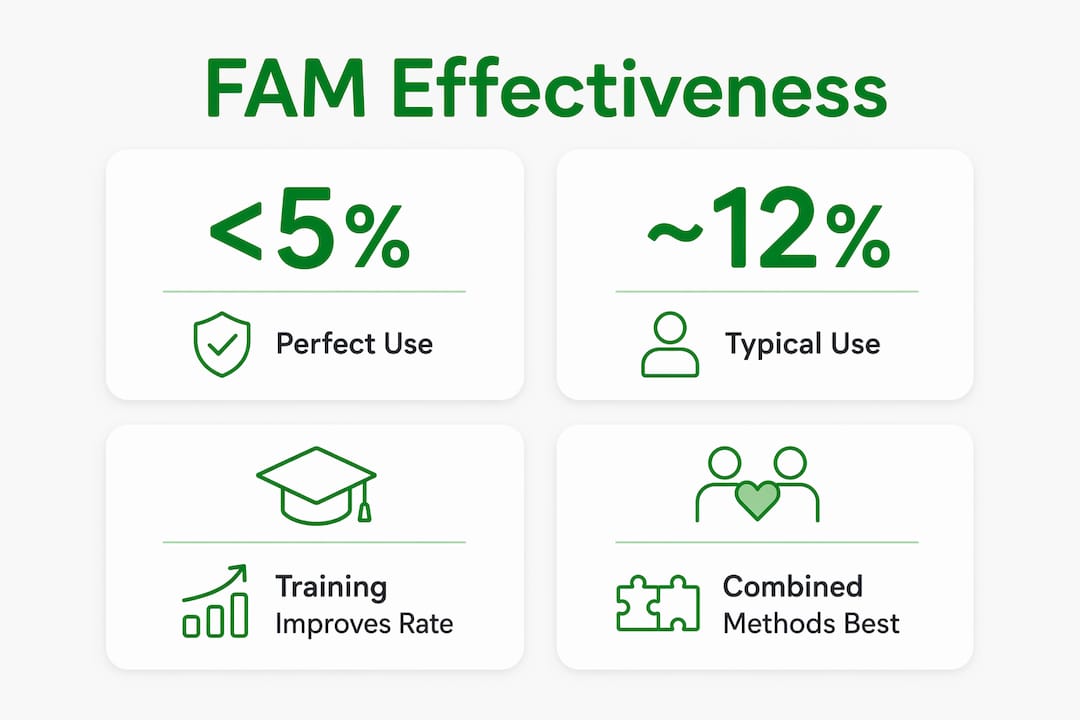
The StatPearls review published through NCBI summarizes the clinical picture clearly: as a contraceptive category, natural family planning carries a typical failure rate of 22–24% across all methods combined. That figure reflects real-world use, not laboratory conditions. Broken down by method, the picture is more nuanced.
| Method | Typical-use failure | Perfect-use failure |
|---|---|---|
| Standard Days | ~12% | <5% |
| TwoDay | ~14% | ~3.5% |
| Symptothermal | higher typical rate | ~2% |
| LAM (strict criteria) | Up to 8% | <2% |
| Calendar / rhythm (general) | Higher; not well-defined for modern use | Not applicable |
Sources: NCBI StatPearls; Merck Manual; PMC peer-reviewed review
The main drivers of typical-use failure are consistent across studies:
- Inconsistent charting: Skipping days, especially around weekends or travel, creates gaps that make fertile-window identification unreliable
- Mucus misreading: Distinguishing fertile-type from infertile mucus takes practice; early users frequently misclassify
- Missed or invalid BBT readings: A single morning of sleeping in, a fever, or alcohol the night before can invalidate that day’s temperature data
- Underestimating the abstinence window: Because sperm survive up to five days, users must begin abstaining or using barriers several days before ovulation, not just on the day itself. Many users underestimate this window.
- App reliance without validation: Most cycle apps are not validated for contraceptive use, and their algorithms may not adapt to unusual cycle patterns
Training by a certified instructor substantially narrows the gap between typical and perfect use. When trained instructors teach FABMs, effectiveness improves and users gain health literacy that supports better clinical care over time.
How to choose and use a fertility awareness method correctly
Getting started with a FAM involves more than downloading an app or reading a pamphlet. A structured approach reduces user error and builds the consistency that makes these methods work.
Step 1: Assess your situation
- Check cycle regularity. If your cycles vary by more than a few days month to month, calendar-only methods are not appropriate. Mucus-based or symptothermal methods are more adaptable.
- Clarify your goal: avoiding pregnancy, achieving pregnancy, or monitoring reproductive health. Each goal may favor a different method.
- Evaluate your daily routine. BBT requires measuring temperature immediately on waking, before any activity, every single morning. If your schedule makes that difficult, a mucus-only or hormone-monitor method may fit better.
- Consider STI risk. FAMs provide no protection against sexually transmitted infections. If STI protection is needed, plan to use barrier methods alongside any FAM.
- Decide on your tolerance for abstinence or barrier use during fertile days. The fertile window can span 8–10 days per cycle.
Step 2: Learn the method properly
- Seek a certified FAM instructor, especially for the symptothermal, Billings, or Creighton methods. Multiple instruction sessions are standard.
- Treat the first 1–3 cycles as a learning period. Do not rely on your chart for contraception during this time without backup methods.
- Use a dedicated paper chart or a validated app to record observations daily. Consistency of recording is as important as accuracy of observation.
Step 3: Daily practice
- BBT: Use the same thermometer every morning, immediately after waking and before getting out of bed, speaking, or drinking anything. Record the reading before you forget it. Illness, travel, or alcohol can invalidate a reading; mark those days as indeterminate rather than guessing.
- Mucus: Check several times a day, before urination, using fingers or tissue. Note the most fertile-type observation of the day, not the least.
- Hormone monitors (Marquette): Follow the device’s testing schedule, which typically increases testing frequency around the expected fertile window.
Pro Tip: During the learning phase, use a barrier method on all days you are uncertain about, not just on days you believe are fertile. Uncertainty itself is a signal to protect.
Real benefits and real limitations: what to weigh before you decide
FAMs offer genuine advantages that no hormonal method can match, but they also carry trade-offs that matter in practice.
“Patients benefit from fertility education and gain body awareness, which is helpful throughout their lives. Facilitating autonomy requires clinicians to equip patients with adequate knowledge for decision-making.” — NCBI StatPearls, Natural Family Planning
Benefits worth knowing:
- Hormone-free: No systemic hormonal exposure, which matters for people who cannot use or prefer to avoid hormonal contraception
- Dual-use: The same charting practice works for both avoiding and achieving pregnancy, often without switching methods
- Low recurring cost: After initial training, most methods require only a thermometer and a chart or low-cost app
- Clinical value: Charts can serve as a reproductive vital sign, giving clinicians data they cannot get from a single office visit
- Body awareness: Many users report a meaningful increase in understanding of their own cycle patterns and hormonal health
Limitations that deserve equal weight:
- User dependence is high. A method that requires daily measurement and recording will fail if that commitment wavers.
- Typical-use effectiveness is lower than with IUDs, implants, or combined hormonal methods.
- FAMs do not protect against STIs. This is not a minor footnote; it is a clinical fact that affects method suitability for many people.
- Reliability drops with irregular cycles, recent postpartum return to fertility, illness, significant stress, or medications that affect cycle patterns.
- The learning curve is real. Most methods require weeks to months before a user can interpret their chart with confidence.
Quick self-screen questions:
- Are your cycles generally regular (26–35 days, consistent)?
- Can you commit to daily observations and recording without frequent interruptions?
- Are you and your partner willing to abstain or use barriers for up to 10 days per cycle?
- Is STI protection a concern? If yes, plan to use condoms regardless of which FAM you choose.
The clinical role of FAM charts in diagnosis and reproductive care
One of the most underappreciated aspects of fertility awareness is what charts can tell a clinician. A well-kept chart is not just a contraceptive tool; it is a reproducible record of hormonal and ovulatory function that supports diagnosis and targeted treatment.
Frontiers in Medicine research on FABMs in clinical evaluation highlights several specific diagnostic applications:
- Timing serum progesterone: Mid-luteal progesterone testing is most informative when drawn 7 days after confirmed ovulation. A chart showing the BBT shift allows a clinician to schedule that draw accurately, rather than guessing based on cycle day alone.
- Detecting anovulatory cycles: A chart with no sustained temperature rise and no mucus peak suggests the cycle may have been anovulatory, prompting further endocrine evaluation.
- Identifying abnormal uterine bleeding patterns: Charting distinguishes true menstrual bleeding from mid-cycle spotting or breakthrough bleeding, which carry different clinical implications.
- Supporting restorative reproductive medicine (RRM): RRM practitioners use charts as a primary diagnostic tool to guide targeted hormonal support, timing of interventions, and monitoring of treatment response.
Adding FABMs to a clinical practice expands contraceptive choice without raising unintended pregnancy rates, and the charts themselves generate health data that benefits both patient and provider. Despite this, a U.S. survey cited in StatPearls found that one-third of clinicians did not mention natural family planning to their patients, and 40% discussed it only with selected women.
When to refer or escalate:
- Persistent anovulatory patterns on chart: refer for endocrine workup (thyroid, prolactin, androgens)
- Luteal phase shorter than 10 days: discuss with a reproductive endocrinologist or RRM-trained clinician
- Irregular cycles that make FAM use unreliable: consider hormonal evaluation before committing to a FAM for contraception
- Patient wants to use FAMs but has a complex history (recent miscarriage, fertility treatment, perimenopause): coordinate with a clinician before starting
Who is a good candidate for fertility awareness methods?
FAMs are not one-size-fits-all, and being honest about suitability upfront prevents frustration and unintended pregnancy.
“Effectiveness may be misrepresented as it is directly related to patient education, personal commitment to the method, menstrual cycle regularity, and the ability to abstain from intercourse during peak fertility.” — NCBI StatPearls, Natural Family Planning
Strong candidates:
- People with regular cycles (26–35 days) who can commit to daily tracking
- Couples motivated to learn together, since partner participation improves adherence
- Those seeking hormone-free contraception or a method compatible with religious or personal values
- People actively trying to conceive who want to optimize timing
- Patients whose clinicians want cycle data for diagnostic purposes
Caution flags and contraindications:
- Irregular cycles: Polycystic ovary syndrome (PCOS), thyroid disorders, and other conditions that disrupt cycle regularity make most FAMs significantly less reliable
- Recent postpartum: Cycles are unpredictable as they return after delivery. LAM applies only under strict breastfeeding criteria in the first six months; after that, a different method is needed
- Recent miscarriage or abortion: Cycles may be irregular for several months; charting during this period requires extra caution and clinician guidance
- Frequent illness, shift work, or irregular sleep: These disrupt BBT readings and can make temperature-based methods unreliable
- Medications affecting cycles: Certain antidepressants, antipsychotics, and hormonal treatments alter cycle patterns and reduce FAM reliability
Special cases:
Adolescents often have naturally irregular cycles in the years following menarche, making calendar and temperature methods less reliable without close monitoring. Perimenopausal people face increasing cycle variability that complicates fertile-window identification. People undergoing IVF or using fertility medications are not appropriate candidates for FAMs as their primary contraceptive or conception tool, since the medications override natural cycle patterns entirely.
Key Takeaways
Fertility awareness methods can be highly effective for contraception and conception when used consistently with proper training, but typical-use failure rates are substantially higher than perfect-use rates across all methods.
| Point | Details |
|---|---|
| Core role of FAMs | FAMs identify fertile days using biomarkers so users can avoid pregnancy, time conception, or generate clinical data. |
| Effectiveness depends on training | Symptothermal correct-use failure is ~2 per 100 women per year; typical-use rises to higher rate without consistent practice. |
| No STI protection | FAMs offer zero protection against sexually transmitted infections; condoms are necessary when STI risk exists. |
| Clinical diagnostic value | Charts help clinicians time progesterone tests, detect anovulation, and guide restorative reproductive medicine protocols. |
| Zealthy for clinical support | Zealthy’s primary care telehealth connects you with licensed clinicians who can review charts and guide next steps. |
Why FAMs deserve more clinical attention than they typically get
FAMs occupy an unusual position in reproductive health: they are simultaneously underused in clinical practice and misunderstood by the people who might benefit most. The gap between perfect-use and typical-use effectiveness is real, but it is also largely a training problem, not a method problem. When clinicians dismiss FAMs as unreliable without distinguishing between a calendar-only approach used without instruction and a symptothermal method taught by a certified educator, they are comparing very different things.
What gets lost in that dismissal is the diagnostic value. A three-cycle chart from a motivated patient tells a clinician more about ovulatory function than a single mid-cycle blood draw. Clinicians who work with FABMs regularly describe them as a reproductive vital sign, and that framing is accurate. The chart shows not just whether ovulation occurred, but when, how the luteal phase looks, and whether the mucus pattern suggests adequate estrogen priming.
The other underappreciated dimension is the relationship effect. When both partners learn a FAM together, the method becomes a shared responsibility rather than a burden on one person. That dynamic tends to improve adherence and, in many cases, opens conversations about reproductive health that couples had not previously had. That is not a small thing.
The honest caution is this: FAMs require genuine commitment. They are not a passive method. Someone who wants effective contraception with minimal daily effort will be better served by a long-acting reversible method. But for people who are motivated, have regular cycles, and want to understand their bodies, FAMs offer something no pill or device can: direct knowledge of their own reproductive biology.
Zealthy can connect you with clinical guidance on fertility and reproductive health
Getting started with a fertility awareness method is easier when you have a clinician in your corner, not just a chart template. Zealthy’s telehealth primary care connects you with licensed providers who can review your cycle history, help you decide which method fits your goals, and interpret early charts so you are not guessing through the learning phase alone.

Whether you are trying to avoid pregnancy without hormones, actively trying to conceive, or simply want a clinician to look at a pattern you have noticed in your cycle, Zealthy makes it straightforward to get that conversation started. Same-day appointments are available, and providers with an average of over ten years of clinical experience are ready to help you build a plan that fits your life. Visit Zealthy to schedule a consultation and take the next step with clinical support behind you.
Authoritative sources for further reading
-
NCBI StatPearls: Natural Family Planning — Comprehensive clinical overview of all major FAM types, failure rates, and counseling guidance. Best for clinicians and informed lay readers who want method-specific data.
-
Merck Manual (Professional): Fertility Awareness-Based Methods — Concise clinical reference covering biomarkers, fertile-window biology, and LAM criteria. Clinician-facing but accessible.
-
Frontiers in Medicine: FABMs for Women’s Health and Family Planning — Peer-reviewed review covering clinical applications, training evidence, and restorative reproductive medicine uses. Recommended for clinicians and researchers.
-
PMC: Fertility Awareness Methods — Distinctive Modern Contraceptives — Peer-reviewed review on effectiveness evidence, app validation gaps, and the importance of trained instruction. Useful for both clinicians and patients evaluating method choice.
-
Planned Parenthood: Are Fertility Awareness Methods Right for Me? — Patient-facing resource covering STI protection limits, method suitability, and practical guidance. Best starting point for lay readers.
-
HHS Office of Population Affairs: Understanding Fertility Basics — U.S. government resource explaining fertility awareness and FABMs in plain language. Good for readers new to the topic.
-
MSD Manuals: Practical Limitations of FAMs — Consumer-facing version of the Merck Manual content, with practical guidance on BBT accuracy, illness effects, and daily-use pitfalls.
This article is general health information, not medical advice. Confirm current guidelines and method suitability with a qualified clinician for your individual situation.



.svg)
.svg)
.svg)
.svg)

