To switch birth control without losing protection, go straight from one method to the next. Avoid gaps, or use backup protection for the recommended number of days if you can’t overlap. Pill packs can be stopped any day, and the new pack’s first active pill starts right away. If a procedure like an IUD insertion or removal is involved, a clinician should guide your timing.
TL;DR:
- Switching from one contraceptive method to another typically requires no gaps or a short backup period, depending on the methods involved.
- Clinicians recommend starting the new method immediately for no-gap switches or overlapping for about seven days when transition requires building effectiveness.
- Long-acting methods like IUDs, implants, and injections have specific timing rules that often depend on procedures, with no-gap or switch-on-removal-day protocols.
- Most common side effects, including spotting and nausea, usually ease within one to three months, but severe symptoms require immediate medical attention.
- Telehealth services can facilitate quick, same-day consultations to coordinate switching, prescribe, and ensure continuous protection during transitions.
Table of Contents
- When Should You Switch Birth Control?
- How Do You Safely Change Birth Control Pills or Methods?
- Timing Rules for IUDs, Implants, the Shot, Patch, Ring, and Pills
- What Side Effects Should You Expect, and For How Long?
- When Should You Contact a Clinician About Switching?
- A Practical Take on Switching Without Overthinking It
- How Zealthy Makes Switching Birth Control Simpler
- Sources
- FAQ
When Should You Switch Birth Control?
Most people switch for one of three reasons: side effects they can’t tolerate, a new health development that changes their risk profile, or a shift in what they actually want from contraception, whether that’s lighter periods, clearer skin, or plans to conceive sooner rather than later.
Timing matters here. Hormonal adjustment isn’t instant, and many side effects genuinely improve within one to three months as your body adapts to a new hormone dose or delivery method. If you’re two weeks into a new pill and dealing with mild nausea, that’s often worth riding out before you switch again.
Some situations don’t allow for patience. Watch for:
- Severe mood changes, migraines with visual aura, or chest pain that started after beginning a method
- A new diagnosis (like a blood clotting disorder or uncontrolled high blood pressure) that makes your current method medically risky
- Side effects intense enough to disrupt daily life, even after giving them a few weeks
- A change in reproductive goals, such as wanting to conceive within the next few months
If any of the urgent scenarios apply, don’t wait out the standard adjustment window. Contact a provider and switch sooner.
How Do You Safely Change Birth Control Pills or Methods?
There are three accepted approaches for changing contraceptive methods, and the right one depends on what you’re switching from and to.
- No-gap switching. Start the new method the same day you stop the old one. This works well for most pill-to-pill transitions and some pill-to-patch or pill-to-ring changes.
- Overlap switching. Start the new method a set number of days before stopping the old one. Clinicians commonly recommend a seven-day overlap when moving between certain hormonal methods, particularly when the new method needs time to build effectiveness.
- Backup-only switching. If you can’t overlap, use condoms or spermicide for the recommended window, generally seven days, while the new method takes effect.
Pills are more forgiving than most people assume. You don’t need to finish your current pack before switching; you can stop on any day and start the first active pill of the new pack immediately. Skipping placebo pills to avoid a gap is generally fine, but confirm the specifics with a provider first.
The table below reflects the general timing framework clinicians use, adapted from published transition guidance.
| Switching From | Switching To | Typical Approach |
|---|---|---|
| Combined pill | Progestin-only pill | Start next day, no gap needed |
| Pill, patch, or ring | IUD or implant | Overlap until procedure; keep using current method until insertion |
| Depo shot | Pill, patch, or ring | Start before next shot is due; use backup if starting late |
| IUD or implant | Pill, patch, or ring | Start method same day as removal to avoid gap |
Pro Tip: If you’re not sure whether your situation calls for overlap or a straight no-gap switch, use backup protection anyway during the first week. It costs you nothing and closes any timing gaps you didn’t account for.
Timing Rules for IUDs, Implants, the Shot, Patch, Ring, and Pills
Long-acting methods carry the most nuance, mainly because they involve procedures rather than a pack you can start today.
- IUDs (hormonal or copper): If you’re switching to an IUD, keep taking your pill, patch, or ring until the insertion appointment, then stop. If you’re switching away from an IUD, start the new method on removal day.
- Implants: Some clinicians insert the new implant on removal day; others prefer starting pills a few days ahead as a bridge. Reproductive Access guidance notes this is often decided case by case.
- Depo shot: The shot stays effective for up to roughly 15 weeks, so if you’re moving off it, start your new method before that window closes to avoid an unprotected gap.
- Patch, ring, and pill: These three switch fairly interchangeably, usually with just a one to two day adjustment window and no mandatory overlap.
What Side Effects Should You Expect, and For How Long?
Spotting, breakthrough bleeding, nausea, breast tenderness, and shifts in mood or libido are the most commonly reported effects after a switch. None of these are unusual in the first few cycles.
Most side effects ease up within one to three months as hormone levels stabilize. If symptoms are still disruptive after that window, it’s worth a follow-up rather than pushing through indefinitely.
Some symptoms are never just “part of adjusting.” Stop the method and seek immediate care for:
- Sudden leg swelling or pain (possible blood clot)
- A severe migraine with visual changes you haven’t had before
- Yellowing of the skin or eyes (possible liver involvement)
- Chest pain or shortness of breath
When Should You Contact a Clinician About Switching?
Reach out to a provider if side effects are severe, you’re worried about a pregnancy risk during the transition, you need an IUD or implant inserted or removed, or a new health condition might make your current method unsafe.
Telehealth has made this faster than it used to be. A virtual visit can confirm your timing, issue an e-prescription for a bridging method, and coordinate a referral if you need an in-person procedure like an IUD placement.
Before your appointment, have this ready:
- Your current method and start date
- Date of your last pill, shot, insertion, or patch/ring change
- Relevant medical history and any new diagnoses
- Other medications you’re taking
- What you want from a new method (lighter periods, no hormones, pregnancy planning, etc.)
Pro Tip: Write down your last dose or insertion date the moment you decide to switch. Clinicians use that single data point to calculate your entire timing plan, and guessing at it is the most common source of switching mistakes.
A Practical Take on Switching Without Overthinking It
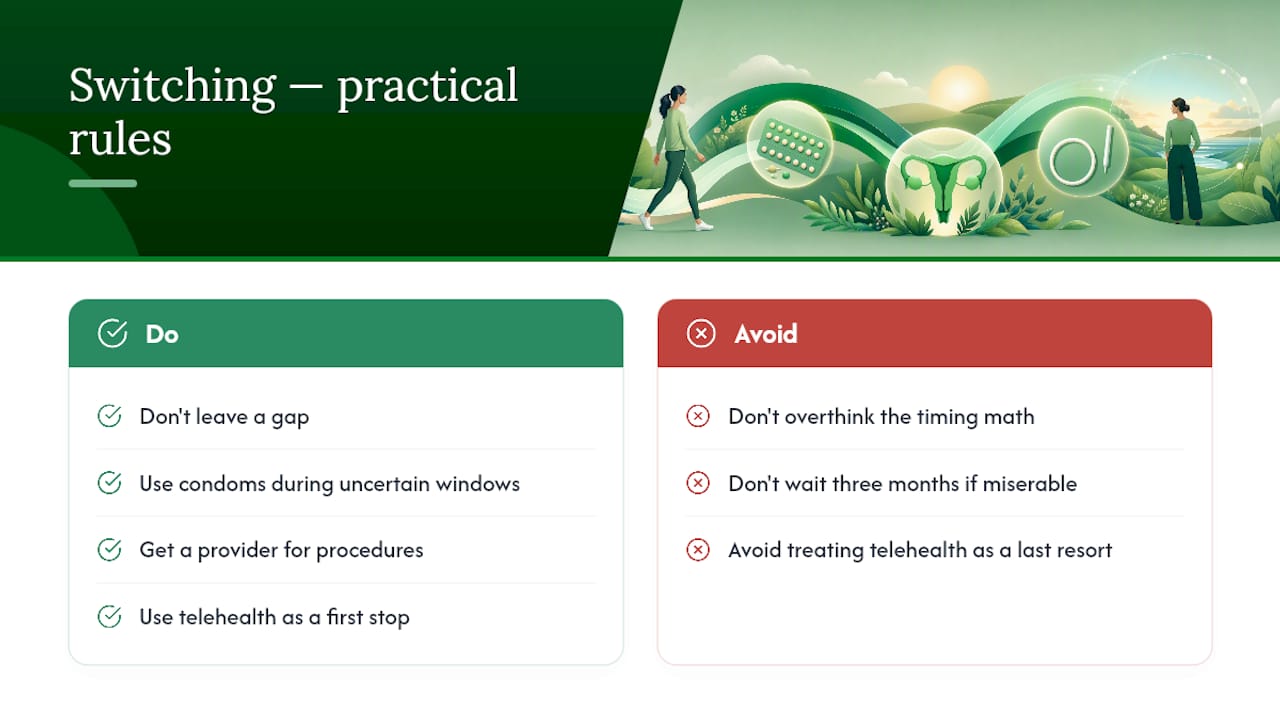
The rule that matters most is simple: don’t leave a gap. Beyond that, most of the anxiety people feel about switching is disproportionate to the actual risk, because the timing math is well established and forgiving if you use backup protection when in doubt.
If your current method is making you miserable, that’s reason enough to switch. You don’t need to wait out a full three months of side effects just because a chart says that’s typical. Use condoms during any uncertain window, get a provider involved for anything requiring a procedure, and treat telehealth as a legitimate first stop rather than a last resort. A model like Zealthy’s supports this kind of decision, where a quick, credible answer is more important than an in-person waiting room.
— Bryan
How Zealthy Makes Switching Birth Control Simpler
This service offers same-day virtual visits with licensed clinicians instead of a multi-week wait for an in-person slot, which matters most when you’re mid-switch and timing is tight.

Once your provider confirms the right approach, whether that’s a no-gap switch, a seven-day overlap, or backup protection, an e-prescription goes out and your medication ships to your door. If your plan involves an IUD or implant, telehealth can’t perform the procedure itself, but clinicians can bridge you with an interim prescription and coordinate the referral so you’re never left unprotected while you wait for the appointment. If you’re currently using birth control through insurance, most U.S. plans cover it at no cost, and that coverage typically carries over when you switch. Start a visit on the Zealthy birth control page to get your timing plan and prescription sorted today.
Sources
The timing rules in this article draw from the Reproductive Access clinical switching guide, AAFP’s clinician timing chart, and the CDC’s medical eligibility criteria for contraceptive use. Patient-facing guidance came from MedlinePlus, Healthline, and Medical News Today.
This article is general information, not a substitute for advice from a qualified doctor. Consult a qualified healthcare professional about your own circumstances before acting on anything here.
- How to Switch Birth Control Methods (Reproductive Access clinical guidance)
- How to Switch Birth Control Methods | AAFP
- Switching birth control pills: A how-to guide (Healthline)
- Switching birth control pills: Methods and side effects (Medical News Today)
FAQ
Is It Okay to Switch Birth Control?
Yes. Switching is common and safe when you follow the no-gap, overlap, or backup-protection rules, and it’s a normal response to side effects or changing needs. A Zealthy visit can confirm the right timing for your specific transition.
What Are the Side Effects of Switching Birth Control?
Spotting, nausea, breast tenderness, and mood or libido changes are the most commonly reported effects. Most resolve within one to three months as your body adjusts to the new method.
How Do You Know If You Need to Switch Birth Control?
Persistent side effects beyond a few months, a new health condition, or a change in what you want from contraception (like period control or plans to conceive) are the main signals. Severe symptoms, like signs of a blood clot or a new type of migraine, mean you should switch immediately rather than wait.
Can You Get Pregnant If You Switch Birth Control?
Pregnancy risk goes up only if there’s a gap in protection during the switch. Following the no-gap, overlap, or seven-day backup rule keeps that risk low, which is why clinical timing guidance exists for nearly every method combination.


.svg)
.svg)
.svg)
.svg)

