You may only lawfully provide telehealth where the patient is physically located unless a specific state authorization applies. Before any out-of-state visit, confirm the patient’s real-time location, check that state’s licensing board, and verify your prescribing authority there. Five distinct legal pathways can make cross-state care possible, but each carries its own documentation and renewal requirements.
TL;DR:
- Practicing telehealth in a patient’s current location requires verifying that the provider holds applicable licensure, registration, or compact privileges in that state, not where the provider is physically based.
- The patient’s real-time physical location at the time of the visit is the legal determinant for licensure, making it essential to confirm their whereabouts before and during each encounter.
- Five pathways for cross-state telehealth include full licensure, temporary practice laws, reciprocity, interstate compacts, and state-specific telehealth registration, each with different documentation and renewal requirements.
- Prescribing controlled substances across state lines depends on both federal extensions and state laws, requiring careful check of DEA status, local regulations, and pharmacy policies at the time of writing prescriptions.
- Clinicians and patients should systematically confirm and document location, licensure status, and emergency plans before, during, and after each telehealth encounter to stay compliant and reduce legal risks.
Table of Contents
- Why the patient’s location, not the provider’s, controls licensure
- The five authorization pathways for cross-state telehealth
- How compacts streamline licensure without replacing it
- Prescribing across state lines adds a second layer of rules
- Behavioral health, nursing, and allied professions each carry their own wrinkles
- A pre-visit, during-visit, and post-visit checklist for clinicians
- What patients should confirm before a telehealth visit while traveling
- Checking the current rules fast: where to look and what to ask
- Resources that help clinicians put this into practice
- Balancing access against legal risk in interstate care
- Getting compliant telehealth care through Zealthy
- Sources
- FAQ
Why the patient’s location, not the provider’s, controls licensure
The rule surprises a lot of clinicians who assume their own license governs the visit. It does not. HHS guidance on licensing across state lines confirms that telehealth practice occurs where the patient is physically located at the time of the encounter, which means a Texas-licensed physician treating a patient vacationing in Colorado is practicing medicine in Colorado, not Texas.
This trips people up because “location” gets confused with three different data points. A patient’s home address on file, the state listed in the electronic health record, and the state the patient is actually standing in during the visit are not always the same thing. Only the last one matters legally. A patient who lives in Ohio but is spending the summer in Michigan is, for licensure purposes, a Michigan patient the moment the visit starts.
The policy logic behind this is straightforward:
- State medical boards oversee the practice of medicine within their borders, and that oversight does not disappear because the visit happens by video.
- Scope-of-practice rules, from prescribing limits to what a nurse practitioner can do independently, vary by state and follow the patient.
- Patient safety protections, including malpractice recourse and board complaint processes, are tied to the state where care was delivered.
Clinicians who treat the home address as the deciding factor are the ones most likely to end up practicing without a license in the eyes of a state board. The safest habit is asking, every single visit, “where are you right now?” and documenting the answer.
The five authorization pathways for cross-state telehealth
HHS identifies five distinct pathways that can authorize a provider to see a patient in another state. None of them is automatic, and each has its own paperwork.
- Full licensure: You apply for and hold a complete, independent medical license in the patient’s state, meeting that state’s education, exam, background check, and continuing education requirements. This is the most durable option but also the slowest and most expensive to obtain.
- Temporary practice laws: Some states permit a limited number of days or encounters per year for an out-of-state licensed provider, often tied to a pre-existing patient relationship or a specific consultation.
- Reciprocity or limited exceptions: A handful of states recognize licenses from neighboring or comparable states for specific circumstances, such as episodic follow-up care after an in-person visit that occurred elsewhere.
- Interstate compacts: Multistate agreements like the Interstate Medical Licensure Compact let eligible providers obtain expedited licensure in participating states without repeating the full application process from scratch.
- Telehealth registration: Several states allow an out-of-state provider to register for telehealth-only practice, typically requiring an unrestricted home-state license, no disciplinary history, proof of malpractice insurance, no in-state office or in-person services, and annual renewal with a fee, as HHS outlines.
To find out which pathway applies, start with the destination state’s medical or nursing board website and search for “telemedicine,” “telehealth registration,” or “consultation exception.” Board guidance documents usually spell out exactly which category a given provider falls into, and calling the board directly resolves any ambiguity a website leaves unanswered.
How compacts streamline licensure without replacing it
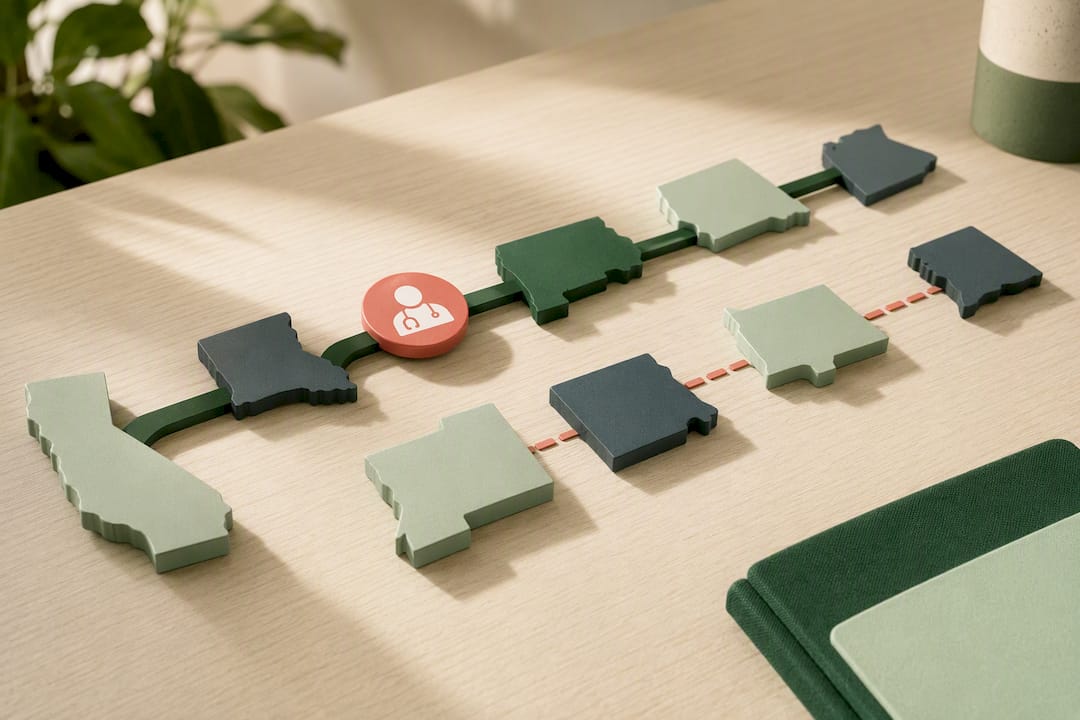
Interstate compacts get talked about as if they hand providers a universal license. They don’t. A compact speeds up the process of obtaining a license or privilege in a new state, but it still requires an active application, and the member state keeps its own disciplinary authority over your conduct there.
The major compacts cover different professions:
- The Interstate Medical Licensure Compact (IMLC) expedites full licensure for eligible physicians across member states.
- The Nurse Licensure Compact (NLC) allows registered nurses in member states to hold one multistate license valid for practice across the compact.
- PSYPACT extends similar portability to psychologists, permitting telepsychology and, in some cases, temporary in-person practice across member states.
- Compacts also exist for physical therapists, occupational therapists, and speech-language pathologists and audiologists through the ASLP-IC, each with its own membership list.
A provider must hold an unencumbered home-state license and meet the compact’s specific eligibility criteria, background checks and fees included, before gaining privileges elsewhere, as HHS notes on licensure compacts. Not every state belongs to every compact, so the first step is always checking the current membership map for the specific compact and profession in question rather than assuming coverage.
Prescribing across state lines adds a second layer of rules
Licensure answers whether you can see the patient. Prescribing, especially controlled substances, is a separate question governed by both the DEA and the destination state’s pharmacy laws.
The current federal rule to know: the DEA and HHS issued a Fourth Temporary Extension of COVID-era telemedicine flexibilities, permitting certain remote prescriptions of controlled substances without a prior in-person exam through December 31, 2026. Two separate 2025 final rules also create additional prescribing authorities with their own requirements, so a clinician relying on the extension should confirm which specific authority applies to their situation rather than treating the flexibilities as one uniform rule.
Meeting the federal extension is not enough on its own. A prescription also has to satisfy the state controlled-substance laws where the patient is located and the receiving pharmacy’s own policies, which sometimes go further than state law requires. Before writing a prescription for a patient in another state, run through this checklist:
- Confirm your DEA registration status and whether it covers the prescribing authority you intend to use.
- Check the destination state’s controlled-substance rules, since some states impose additional telehealth-specific restrictions.
- Verify the patient’s pharmacy will fill an out-of-state telehealth prescription for that drug class.
- Document the encounter, including the patient’s real-time location, at the time of prescribing.
Documentation matters more here than almost anywhere else in telehealth, because home-address data is often wrong. HHS materials on prescribing controlled substances via telehealth point to research showing address-based misidentification is a real problem, not a hypothetical one, which is why verifying real-time location at each encounter carries more legal weight than whatever address sits in the chart.
Behavioral health, nursing, and allied professions each carry their own wrinkles
The patient-location rule applies across every profession, but the extra requirements layered on top of it are not uniform. HHS guidance on behavioral health licensure flags several areas where telebehavioral health diverges from general telehealth practice.
- Informed consent processes for telebehavioral health often require more explicit disclosure about the limits of remote care than a standard primary care telehealth consent.
- Emergency planning is treated as a baseline requirement, not an optional add-on, since a mental health crisis can escalate quickly without an in-person option nearby.
- Some states restrict prescribing of certain psychiatric medications via telehealth alone, requiring at least one in-person visit before certain prescriptions can be issued.
- Nursing and allied health professionals operate under different compact structures (the NLC for nurses, ASLP-IC for speech and audiology, separate PT/OT compacts), so a psychologist’s PSYPACT privileges say nothing about a nurse practitioner’s authority in the same state.
- Episodic follow-up visits and one-time specialist consultations sometimes qualify for a narrower exception even in states that otherwise restrict out-of-state telehealth, so it is worth checking whether the encounter fits that narrower category before assuming full licensure is required.
Because these exceptions are profession-specific and state-specific at the same time, the safest approach is checking both the destination state’s board for your profession and any relevant compact membership before the visit, not after.
A pre-visit, during-visit, and post-visit checklist for clinicians
Turning all of this into a repeatable workflow keeps compliance from depending on memory. Here is a sequence clinicians can build into their scheduling and documentation systems.
- Before the visit, confirm the patient’s real-time state (not their home address on file), check whether you hold full licensure, a compact privilege, or a valid registration in that state, and verify your malpractice coverage and DEA registration extend to that jurisdiction.
- During the visit, document the patient’s stated location and obtain informed consent for telehealth specifically, referencing Zealthy’s consent to telehealth resource as an example of what that documentation should capture.
- Still during the visit, hold off on prescribing anything you are not certain is permitted in that state, especially controlled substances, until you have confirmed both DEA and state-level requirements.
- Before ending the visit, confirm the patient has an emergency plan and knows what local, in-person resource to use if something goes wrong before your next scheduled contact.
- After the visit, log the verification steps you took (license check, compact confirmation, or registration number) so the record shows compliance was confirmed, not assumed.
- On an ongoing basis, track renewal dates for any state registration or compact privilege, and report any adverse board action promptly, since most compacts and registrations require disclosure.
Pro Tip: Keep a simple internal log, even a shared spreadsheet, listing which states you’re currently authorized in and by which pathway. It turns a legal question into a thirty-second lookup before you accept a booking.
Clinicians running asynchronous or message-based care face a parallel set of operational steps, covered in more detail in Zealthy’s guide to asynchronous telemedicine operations.
What patients should confirm before a telehealth visit while traveling
Patients have less visibility into licensing rules than providers do, but a few direct questions protect against an interrupted prescription or a wasted visit.
- Tell your provider exactly where you will be, physically, at the time of the visit, and ask directly whether they are authorized to treat you there.
- If you take a controlled substance or expect a new prescription, ask in advance whether it can be sent to a pharmacy in your current location, since state and federal rules on this vary.
- Ask what happens if your provider is not authorized in your current state: many practices can reschedule once you return home or connect you with a locally licensed clinician instead.
- If you’re managing an ongoing mental health condition, ask what the practice’s emergency plan looks like if you’re not near your usual local support system.
- Save a copy of any telehealth consent form or visit summary in case a pharmacy or another provider needs proof of the encounter later.
A little upfront clarity here avoids the frustrating scenario of a completed visit followed by a pharmacy refusing to fill the prescription.
Checking the current rules fast: where to look and what to ask
Rules shift often enough that a two-year-old article referencing “which states allow this” is not reliable. Go to primary sources directly.
- Start with HHS’s licensing across state lines page for a plain-language summary of pathways and requirements.
- Check HHS’s licensure compacts page for which compacts exist and what they generally require.
- Look up the specific compact’s membership map (IMLC, NLC, PSYPACT, or the relevant allied health compact) to confirm the destination state actually participates.
- Read the destination state’s own statute or board advisory. Minnesota’s telehealth registration statute, §147.032, is a useful example of how specific these state-level requirements can get, down to fees and disciplinary history disclosures.
- When a board advisory mentions “telemedicine registration,” “consultation exception,” or “episodic care,” read that section closely since it usually defines the exact boundary of what’s permitted.
- If anything is ambiguous, call the board directly and ask a specific question: “Can a physician licensed in [state] see a patient physically located in [this state] for a single follow-up visit?”
Headline counts of “how many states allow out-of-state telehealth” vary by source because definitions differ, so treat the destination state’s own statute as the final word rather than a summary article.
Resources that help clinicians put this into practice
Turning these rules into daily habits is easier with the right supporting materials on hand. Zealthy’s clinician-facing resources are built around the same operational logic covered above: verify, document, and plan ahead.
Zealthy’s consent to telehealth page lays out what a telehealth-specific consent process should cover, which matters given that behavioral health and general telehealth carry different disclosure expectations. A patient-facing checklist on telehealth privacy walks through the security and documentation questions patients should be able to answer about any platform they use, which doubles as a useful lens for clinicians auditing their own workflows. For practices running message-based or asynchronous care, the operational steps guide breaks down what a compliant remote workflow looks like in practice. And because Medicare’s telehealth coverage rules intersect with a lot of these licensure questions, Zealthy’s explainer on Medicare telehealth coverage through 2027 is a useful companion for practices serving Medicare patients across state lines.
Together, these resources support the same checklist habits outlined earlier: confirm location, document consent, plan for emergencies, and keep records that would hold up if a board ever asked.
Balancing access against legal risk in interstate care
The honest tension in this field is that patients often need care faster than licensure paperwork moves. A clinician’s job is deciding, visit by visit, whether to proceed or to pause and route the patient toward in-person or locally licensed care instead. My view is that access should win when the pathway is clearly established, a compact privilege, a valid registration, or full licensure, and documentation is solid. It should lose the moment any of those pieces is missing, no matter how minor the visit seems.
Documentation and emergency planning are not paperwork for paperwork’s sake. They’re the difference between a defensible clinical decision and an exposed one if a board or malpractice carrier ever looks closely. Compacts and registrations exist to make lawful access easier, not to be treated as a formality. Clinicians who use them as intended, rather than as a loophole to avoid full licensure, are the ones building a practice that can scale across state lines without building legal risk alongside it.
— Bryan
Getting compliant telehealth care through Zealthy
Zealthy is built around the same principle this article keeps returning to: care should be fast, but it has to be authorized and documented correctly. Patients can access appointments, prescription delivery, and care plans from licensed providers, supported by consent and privacy processes designed to meet required standards.

For patients who travel or split time between states, Zealthy’s model is worth considering because the same compliance steps this article recommends, verifying location and authorization before the visit, are already built into how the platform operates. This applies whether you’re looking for primary care, weight loss support, birth control, mental health care, or erectile dysfunction treatment.
- Appointments are arranged promptly to minimize wait times for compliant, documented visits.
- Prescription delivery is coordinated with the pharmacy rules relevant to where you actually are.
- Consent and privacy documentation are handled upfront, not as an afterthought.
If you want telehealth that treats these legal details as part of the service rather than a footnote, explore Zealthy’s services and see what fits your situation.
This article is general information, not a substitute for advice from a qualified doctor. Consult a qualified healthcare professional about your own circumstances before acting on anything here.
Sources
FAQ
Can I do telehealth if I am out of state?
Yes, but only if you have a legal pathway authorizing you in the patient’s actual state at the time of the visit, such as full licensure, an interstate compact privilege, or a valid telehealth registration. Without one of these, practicing where the patient is physically located without authorization is not permitted.
What states allow telehealth across state lines?
There is no single national rule since each state sets its own requirements through licensure, registration, or compact participation. The safest approach is checking the specific destination state’s medical or nursing board and relevant compact membership rather than relying on general counts.
Did Congress extend telehealth for 2026?
The DEA and HHS issued a Fourth Temporary Extension of telemedicine flexibilities permitting certain remote prescriptions of controlled substances through December 31, 2026. Two separate 2025 final rules also introduce additional prescribing authorities with their own conditions.
Does telehealth know what state you’re in?
Not automatically. Platforms and providers typically rely on the patient stating their real-time location, since home addresses and EHR entries can be inaccurate, which is why confirming and documenting your actual location at each visit matters for legal compliance.
Do I need a full medical license in every state where my patients live?
Not necessarily. Full licensure is one of five pathways, alongside temporary-practice laws, reciprocity, interstate compacts, and telehealth registration, and which one applies depends on your profession and the destination state’s specific rules.


.svg)
.svg)
.svg)
.svg)

