

Asynchronous telemedicine, often called store-and-forward care or an e-visit, is clinical care where a patient submits information such as photos, questionnaires, or lab results, and a clinician reviews and responds later rather than in a live video or phone call. It fits best for teledermatology, chronic-disease follow-up, and provider-to-provider consults, per HHS guidance. It’s not a substitute for an exam when a condition needs hands-on assessment or immediate triage.
TL;DR:
- Asynchronous telemedicine is most effective for chronic disease follow-up, dermatology, medication refills, and provider-to-provider e-consults, with response times typically within days.
- Poor image quality, incomplete data, and unstandardized intake procedures can create diagnostic blind spots, especially in infection management and cases requiring physical examination.
- Clinicians must set clear standards for photos and documentation, implement triage thresholds for urgent cases, and ensure workflow integration into existing systems to prevent delays and errors.
- Reimbursement remains fragmented and limited under Medicare and varies by state and payer, so programs should verify coverage and document the asynchronous nature of visits.
- Combining asynchronous review with synchronous visits and remote monitoring creates more effective hybrid models, reducing risks and improving patient access and satisfaction.
What Does Asynchronous Telemedicine Look Like in Practice?
Asynchronous telemedicine covers several distinct workflows, and clinicians who understand the differences design better programs. The Health and Human Services best-practice guide groups common use cases into teledermatology, chronic condition management for diabetes and hypertension, and medication refills. Each relies on the same core mechanic: information collected now, reviewed later, with a response that arrives within a defined window rather than instantly.
Store-and-forward is the original model. A patient uploads a photo, an intake form, or a scanned document, and a clinician opens it during a review session, sometimes hours later, sometimes the next business day. Dermatology built its reputation on this format because a clear image of a rash or mole often carries as much diagnostic value as an in-person look, provided the lighting and resolution are good.
E-visits extend the concept into structured questionnaires. A patient answers a branching set of clinical questions about symptoms, duration, and history, and the responses populate a note a clinician can review without ever speaking to the patient live. This is the backbone of most virtual primary care platforms for straightforward complaints like sinus infections, urinary tract symptoms, or medication renewals.
Secure messaging functions as the connective tissue between visits. A patient with a treatment plan already in place can message a question about a side effect, and a care team member responds within a service window. It’s asynchronous by design, but it depends heavily on the platform’s texting terms and security protocols to keep protected health information contained.
Provider-to-provider e-consults let a primary care clinician send a case summary to a specialist for an opinion, without the patient ever booking a separate appointment. This model expands specialist reach into areas with long wait times, and it’s one of the fastest-growing asynchronous applications inside health systems.
A typical asynchronous encounter follows a predictable arc:
- A patient completes an adaptive intake questionnaire, often triggering follow-up questions based on earlier answers.
- The patient uploads supporting material: a photo of a skin lesion, a screenshot of a home blood pressure log, or an uploaded lab report.
- A clinician reviews the packet during a scheduled review block, not necessarily in real time.
- The clinician responds with a diagnosis, a prescription, a request for more information, or an escalation to a live visit.
- The interaction closes with documentation in the patient’s chart and, if needed, a scheduled follow-up.
Remote patient monitoring intersects with this model in an important way, supported by platforms that help families coordinate care and share a parent’s care plan like KinCarer. RPM devices, such as blood pressure cuffs or glucose monitors, generate continuous data streams, but not every reading needs a live response. A clinician can review a week of RPM data asynchronously, flagging trends rather than reacting to every data point. That said, systematic-review evidence on RPM found that practitioners also report added workload and data-accuracy concerns when monitoring volume grows without added staffing. Asynchronous review works well for trend analysis; it works poorly when a single alarming reading needs immediate action and nobody is watching in real time.
Does the Evidence Support Asynchronous Care?
The evidence is genuinely encouraging in some areas and genuinely thin in others, and clinicians proposing asynchronous programs should be precise about which claim they’re making. A JMIR systematic review found that e-visits and other asynchronous communication-based visits often produce clinical outcomes comparable to in-person care for chronic disease management and several dermatology applications, and that costs came in lower in some settings. That same review flagged mixed quality specifically around infection management and antibiotic prescribing, where a lack of physical examination limits diagnostic certainty.
What the research actually shows: Comparable outcomes for chronic disease follow-up and dermatology, lower costs in some settings, and mixed evidence for conditions requiring exam-based diagnosis like suspected infections, according to the JMIR review.
A separate systematic literature review of asynchronous telemedicine research reached a more cautious conclusion about the state of the science itself. It found that most published work focuses on care quality and patient satisfaction, but that many individual studies carry methodological weaknesses, small samples, or inconsistent outcome measures. That doesn’t mean asynchronous care fails to work. It means the research base, while growing, hasn’t yet produced the volume of high-quality randomized evidence that would let anyone claim a settled verdict across every specialty.
Access and satisfaction data tell a more consistent story. The American Telemedicine Association frames asynchronous telehealth as a tool for improving access and reducing stigma, particularly for patients who would otherwise delay care oversensitive topics or scheduling friction. That framing matches what shows up across the literature in a few consistent patterns:
- Convenience wins first. Patients don’t need to take time off work or arrange childcare for a five-minute question about a rash.
- Wait times shrink for routine issues. A same-day e-visit for a medication refill often beats the next available in-person slot by days.
- Utilization effects vary. Some programs report lower per-encounter costs; others see utilization rise simply because access got easier, which isn’t necessarily a bad outcome, but it changes the cost calculation.
- Satisfaction scores tend to track convenience more than clinical complexity, meaning patients rate asynchronous visits highly for simple issues and less enthusiastically for anything that felt like it needed a closer look.
The honest summary: asynchronous telemedicine holds up well for chronic follow-up, dermatology, and administrative tasks like refills. It holds up less well, and needs tighter guardrails, for anything resembling an acute infection or a diagnosis that depends on physical findings a photo can’t capture.
What Goes Wrong With Asynchronous Care?
The failure modes in asynchronous telemedicine are specific, and most of them trace back to one root problem: the clinician is working with whatever the patient submitted, and patients aren’t trained photographers or historians.
Poor patient-submitted data creates real diagnostic blind spots. A blurry photo of a mole taken under yellow kitchen light can obscure the exact features a dermatologist needs to rule out melanoma. A rushed symptom questionnaire, answered on a phone while distracted, can omit the detail that would have changed the clinical picture entirely. Unlike a live visit, there’s no chance to ask a clarifying question in the moment, only after the fact, which adds a delay cycle.
Antibiotic prescribing is a recognized weak point. The JMIR review specifically flagged infection management as an area with mixed evidence quality, largely because sinus infections, urinary tract symptoms, and skin infections are hard to distinguish from viral or non-bacterial mimics without an exam. A clinician working from a questionnaire alone faces real pressure to prescribe defensively rather than confirm a bacterial cause, which is exactly how overprescribing creeps into asynchronous programs that lack decision support.
Operational strain builds quietly. Message volume in a growing asynchronous program tends to outpace staffing plans, and clinicians end up doing chart review in fragments between other duties rather than in dedicated blocks. Patients, meanwhile, experience anxiety when a response takes longer than expected, especially if the platform never set a clear expectation for turnaround time in the first place.
Mitigating these problems is less about technology and more about design discipline:
- Use structured, adaptive questionnaires that branch based on prior answers, reducing the odds a patient skips a critical detail.
- Set explicit photo standards, including lighting, distance, and multiple angles, before a submission is accepted for review.
- Build triage rules that automatically flag certain symptom combinations for a synchronous visit instead of an asynchronous one.
- Establish escalation protocols so a clinician reviewing a case can move a patient to a live visit or urgent care referral without friction.
- Publish a clear service-level expectation, such as a same-business-day response window, so patients aren’t left guessing.
Pro Tip: Build your intake form to ask “when did this start” and “has this happened before” before it asks about current symptoms. Sequencing history questions first gives the clinician context that makes the symptom answers much easier to interpret correctly.
None of this means asynchronous care is inherently riskier than a live visit. It means the risk profile is different, and a program that doesn’t design around photo quality, prescribing discipline, and escalation pathways will eventually run into a case that exposes the gap.
How Do HIPAA and Reimbursement Rules Apply?
Every asynchronous platform handling patient photos, questionnaires, or messages is transmitting and storing protected health information, and HIPAA’s security and privacy requirements apply exactly as they would to any other form of care documentation. That means encrypted transmission, access controls limiting who can view a submitted case, and audit trails showing who reviewed what and when. A platform’s texting terms of use should spell out exactly how messages are secured and retained, and patients deserve a clear answer before they upload anything sensitive.
Consent carries particular weight in asynchronous care because the patient often never speaks with a clinician directly. A well-designed telehealth consent process should explain, in plain language, that the encounter is asynchronous, what response time to expect, and what happens if the clinician determines a live visit is needed instead.
Reimbursement is where asynchronous telemedicine gets genuinely complicated, and clinicians proposing a program should walk in with realistic expectations. Medicare coverage for store-and-forward services is limited and applies mainly to a defined set of demonstration projects and specific state arrangements, not a uniform national policy, according to the Center for Connected Health Policy. State Medicaid programs and commercial payers vary even more widely. Some states reimburse asynchronous dermatology consults at parity with in-person visits; others exclude store-and-forward entirely from covered telehealth services.
That fragmentation isn’t accidental neglect. Advocacy groups including the American Telemedicine Association have pushed for model policy language at the state and federal level specifically because current rules lag behind clinical practice. Programs launching today should expect the payer landscape to keep shifting over the next few years rather than settling into a stable national standard soon.
Practical steps for clinicians navigating this terrain:
- Verify state-specific telehealth statutes before assuming a store-and-forward encounter is reimbursable in that jurisdiction.
- Document the asynchronous nature of the visit clearly in the chart, including submission time and review time, since payers increasingly ask for this distinction.
- Use CPT codes specific to online digital evaluation services where applicable, rather than defaulting to in-person visit codes.
- Confirm consent language covers asynchronous review explicitly, not just “telehealth” broadly, since some state boards require this distinction by name.
Reimbursement uncertainty is real, but it hasn’t stopped growth. Cash-pay and subscription-based virtual care models have expanded specifically because they don’t depend on resolving every payer’s coverage gap first.
How Do You Build an Asynchronous Program That Works?
A functioning asynchronous program comes down to five operational decisions, and skipping any one of them is usually where programs run into trouble later.
- Design the intake questionnaire to adapt, not just collect. A static form that asks every patient the same twelve questions regardless of complaint generates noisy, incomplete data. An adaptive questionnaire that branches based on the chief complaint, following the approach JMIR’s review associates with better-quality visits, catches the details that matter for that specific condition and skips the ones that don’t.
- Set photo and document standards before submission, not after. Require a stated minimum resolution, ask for multiple angles on skin complaints, and reject blurry uploads at the point of submission rather than during clinical review. This single design choice eliminates a large share of the back-and-forth follow-up that slows programs down.
- Integrate the workflow directly into the EHR. Programs that route asynchronous submissions into the same inbox clinicians already use for other messaging tend to perform better than ones running a separate, disconnected tool, a pattern HHS’s best-practice guidance highlights repeatedly. Fragmented systems create the exact blind spots where a message sits unreviewed longer than intended.
- Staff to a defined service-level agreement, and measure against it. Decide upfront whether your response window is two hours, four hours, or by end of business day, and staff clinician review blocks accordingly. Track response time, follow-up visit rates, and safety events as your core quality metrics, and review them monthly rather than only when a complaint surfaces.
- Build the escalation path into the workflow itself, not into clinician judgment alone. A reviewing clinician should have a one-click option to convert an asynchronous case into a same-day synchronous visit when the submitted information doesn’t add up, rather than needing to improvise a workaround.
Staffing models vary by program size. Smaller practices often route asynchronous review through the same clinicians handling live visits, fitting review sessions between appointments. Larger platforms tend to build dedicated asynchronous review shifts, staffed by clinicians who specialize in high-volume triage and documentation. Either model can work, but the review workload needs to be explicitly scheduled, not treated as something clinicians squeeze in during downtime that rarely exists.
Training deserves more attention than most programs give it. Clinicians new to asynchronous review need practice interpreting incomplete information and recognizing when a case doesn’t have enough data to act on safely. Patients need clear instructions, ideally embedded directly in the intake flow, on how to take a usable photo and how to describe symptom timelines in a way that’s actually useful. Accessibility matters here too: intake forms should work for patients with limited digital literacy, vision impairment, or a primary language other than English, since asynchronous care can otherwise widen the very access gaps it’s meant to close.
Pro Tip: Run a monthly audit of ten random asynchronous cases and ask a second clinician to review whether the submitted information was sufficient to support the decision made. This single habit surfaces intake-design flaws faster than any patient complaint will.
How Do Specialties Use Asynchronous Care Differently?
Dermatology remains the clearest asynchronous success story, largely because a clear photograph carries so much diagnostic weight. Effective teledermatology programs require specific photo guidance: good lighting, a ruler or reference object for scale on lesions, and multiple angles for anything raised or textured. Triage thresholds matter here too. A rapidly changing mole, a lesion with irregular borders, or any finding suggestive of melanoma should trigger an immediate referral to an in-person dermatologist rather than continued asynchronous management.

Primary care leans on asynchronous e-visits mainly for medication refills and chronic disease check-ins. A patient managing well-controlled hypertension doesn’t need a live visit every time a prescription needs renewing; a structured e-visit confirming blood pressure logs and symptom status covers the same clinical ground in a fraction of the time. Zealthy’s primary care model reflects this pattern, pairing asynchronous check-ins with same-day access when a patient’s situation calls for more.
Behavioral health uses asynchronous touchpoints more cautiously, usually for medication check-ins and symptom tracking between live therapy or psychiatry sessions rather than as a replacement for the therapeutic relationship itself. Privacy considerations run higher here: a patient messaging about a mental health concern deserves the same secure handling as any other sensitive health data, and platforms should be explicit about who reads those messages and when.
Provider-to-provider e-consults extend specialist reach without adding a patient visit at all. A primary care clinician can send a rheumatology or endocrinology case summary to a specialist, get a written opinion back within days, and adjust the treatment plan without the patient ever sitting in a specialist’s waiting room. This model doesn’t get as much attention in consumer health coverage, but it’s one of the most efficient uses of asynchronous infrastructure in health systems today.
- Dermatology: photo-based, high diagnostic value, clear referral triggers for concerning findings.
- Primary care: refills and chronic follow-up, well suited to structured e-visits.
- Behavioral health: supplementary touchpoints, not a replacement for ongoing therapeutic care.
- Specialist e-consults: expands access without adding a patient-facing appointment.
Where Does Asynchronous Care Fit in Hybrid Models?
The strongest telehealth programs rarely rely on asynchronous care alone. They combine it with synchronous visits and remote patient monitoring, using each modality where it performs best. A patient with diabetes might submit glucose logs asynchronously each week, join a synchronous video visit quarterly for a fuller review, and rely on RPM data to flag anything that needs faster attention in between. That layered structure lets clinicians reserve live appointment time for the cases that genuinely need it.
Regulatory and reimbursement trends will likely keep shaping how far this model spreads. As more states clarify coverage for store-and-forward services and as advocacy efforts push for consistent policy language, expect more health systems to formalize asynchronous options rather than treating them as an informal add-on to existing telehealth infrastructure.
Technology is moving in a direction that should ease some of the current friction. Adaptive intake forms that branch intelligently based on symptom answers are becoming more common, reducing the incomplete-data problem that plagues static questionnaires. Clinical decision support tools built directly into review workflows can flag likely bacterial versus viral presentations, addressing the antibiotic-prescribing concern head-on rather than leaving it to individual clinician judgment. And EHR vendors are increasingly building asynchronous review natively into existing inboxes rather than forcing clinicians to juggle a separate platform, which should reduce the fragmentation that currently slows many programs down.
What Clinicians Should Actually Take Away From This
Most coverage of asynchronous telemedicine either oversells it as a frictionless replacement for in-person care or dismisses it as a lesser substitute. Both framings miss the point. Asynchronous care is a specific tool with a specific job: handling the large share of clinical encounters that don’t need real-time interaction to reach a good outcome. Treat it that way, and it performs well. Treat it as a universal replacement for exam-based medicine, and it will eventually produce a missed diagnosis that becomes the case everyone points to when arguing telehealth doesn’t work.
Six things matter more than anything else for clinicians or program leads building this out. First, invest in adaptive intake design before you invest in anything else, since bad data in produces bad decisions out. Second, set explicit photo and documentation standards and enforce them at submission. Third, build automatic escalation triggers for symptom patterns that shouldn’t stay asynchronous. Fourth, staff review time as a dedicated block, not a gap-filler between other duties. Fifth, treat antibiotic prescribing in asynchronous visits as a flagged decision requiring extra scrutiny, not a default. Sixth, measure response time and follow-up rates monthly, because problems in asynchronous programs tend to surface in the data long before they surface in a complaint.

Zealthy’s model reflects several of these principles directly: same-day access when a case needs to move beyond asynchronous review, a primary care structure built around structured follow-up, and a consent process that sets expectations before a patient submits anything.
— Bryan
Get Same-Day Access to Asynchronous and Live Care With a telehealth provider
Certain telehealth providers address the gap most asynchronous programs struggle to close: what happens when a case needs more than a photo and a questionnaire. Patients can get secure messaging with their care team, structured e-visits for chronic follow-up and refills, and same-day appointments when a clinician decides a live visit is necessary, with prescriptions delivered when treatment is needed.
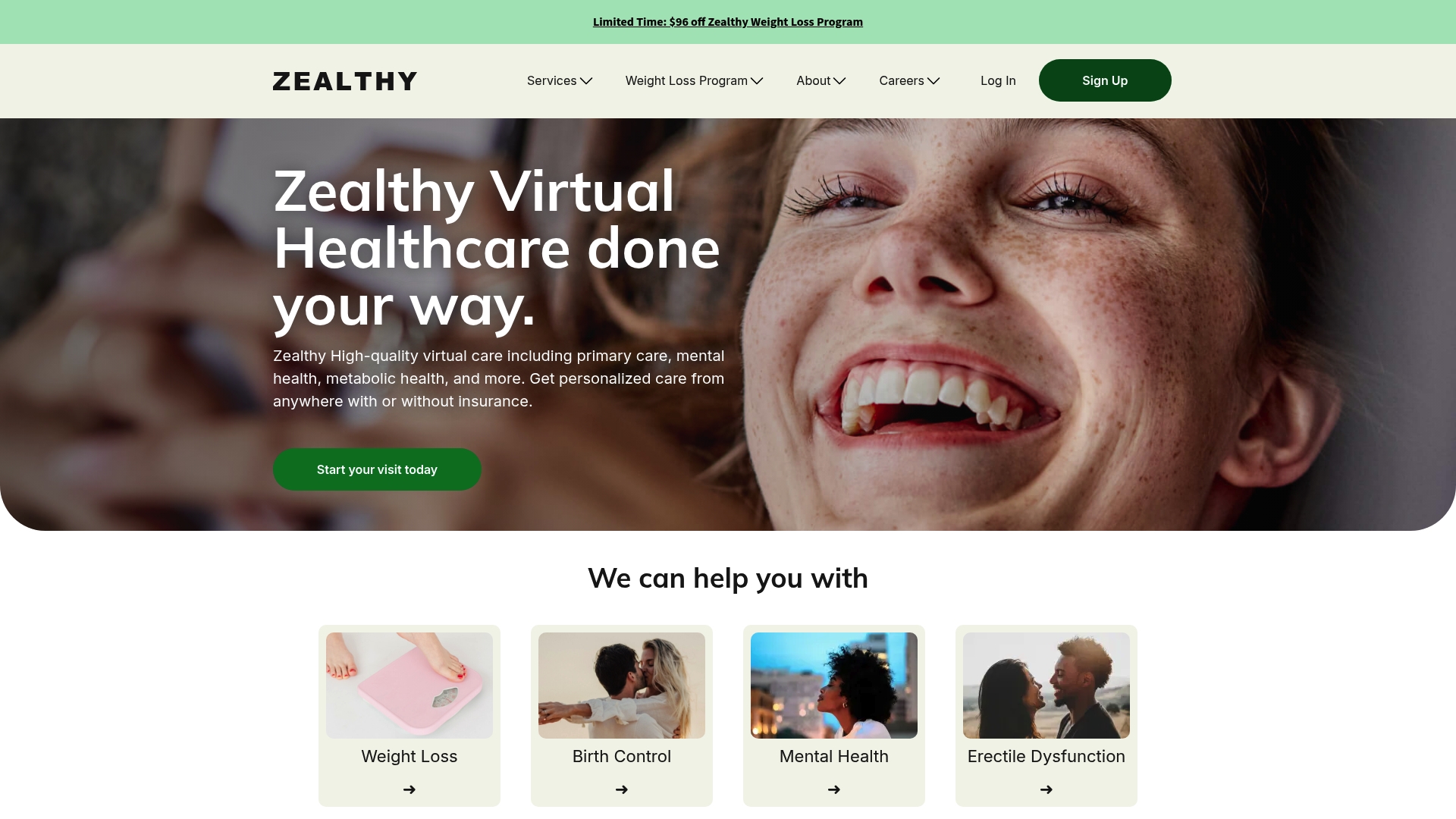
That combination matters because the biggest risk in asynchronous care isn’t the modality itself. It’s getting stuck in it when a situation calls for something more immediate. Zealthy’s model moves patients between asynchronous and same-day live care without forcing them to restart the process with a new provider or a new intake form. If you’re managing a chronic condition, exploring weight loss, skin, or sexual health treatment, or simply want a care relationship that doesn’t require guessing which appointment type to book, start with Zealthy’s primary care page and see what a same-day slot looks like on your schedule this week.
Sources
Clinicians and program leads building or refining an asynchronous service should keep a short list of primary sources on hand rather than relying on secondary summaries.
- Telehealth for direct-to-consumer care — Asynchronous direct-to-consumer telehealth
- Impact of Asynchronous Electronic Communication–Based Visits on Clinical Outcomes and Health Care Delivery: Systematic Review
- Benefits and Challenges of Remote Patient Monitoring as Perceived by Health Care Practitioners: A Systematic Review
- Store-and-Forward (CCHP)
FAQ
What is an example of asynchronous telehealth?
A patient photographing a skin rash and submitting it through a secure form, then receiving a diagnosis and treatment plan from a dermatologist hours later, is a classic example of store-and-forward asynchronous telehealth.
What is the difference between synchronous and asynchronous telemedicine?
Synchronous telemedicine happens in real time, through video or phone, while asynchronous telemedicine involves a patient submitting information that a clinician reviews and responds to later, without both parties present at the same moment.
What are the four main types of telemedicine?
The commonly recognized categories are store-and-forward (asynchronous), live video (synchronous), remote patient monitoring, and mobile health tools, though many programs, including Zealthy’s, blend several of these into one hybrid model.
What is the main issue with asynchronous communication in telehealth?
The core limitation is data quality: a clinician can only act on what the patient submits, so a poor-quality photo, an incomplete questionnaire, or a missed detail can create diagnostic blind spots that a live exam would have caught.
Is asynchronous telemedicine covered by insurance?
Coverage varies significantly by state and payer, and Medicare currently reimburses store-and-forward services only in limited circumstances, according to the Center for Connected Health Policy, so patients should confirm coverage before relying on it for a specific condition.




.svg)
.svg)
.svg)
.svg)

