There is no single federal law that governs telehealth in the United States. Instead, you deal with three layers: state licensing and prescribing law, federal rules for Medicare and controlled substances, and your own insurance plan. As of October 2026, Medicare’s main telehealth flexibilities run through December 31, 2027, while federal flexibilities for prescribing controlled medications by video run through December 31, 2026. Online prescriptions are legal when a licensed clinician in your state evaluates you and decides treatment is appropriate.
This guide explains what that means when you book a visit, ask for a prescription, or check what your plan will pay.
TL;DR
- Telehealth is regulated mostly by states. The clinician must be licensed where you are physically located during the visit, not where the clinician sits.
- Medicare’s telehealth flexibilities, including care from your home, are extended through December 31, 2027 for non-behavioral care.
- Online prescribing is lawful when a real clinical evaluation takes place. Controlled substances carry stricter federal rules, with current flexibilities set to run through December 31, 2026.
- Insurance coverage varies by state, by plan and by Medicare type, so check your own plan before assuming a visit is covered.
- A legitimate telehealth service will ask for your location, collect consent and explain what it can and cannot prescribe.
Table of Contents
- The three layers of telehealth law
- Licensure: the rule tied to where you are
- Medicare: what is in place through 2027
- Private insurance and Medicaid: a state patchwork
- Online prescribing: what the law actually says
- What lawful telehealth looks like from your side
- Our perspective
- Where Zealthy fits
- Questions people ask
- Sources
The three layers of telehealth law
It helps to separate the rules by who writes them.

States decide who can practice medicine on their residents, what a valid patient relationship looks like, what consent is required, and what private insurers and Medicaid must cover.
The federal government controls Medicare payment rules, the Drug Enforcement Administration (DEA) rules on controlled substances, and federal privacy law.
Your health plan decides what it pays for in practice, within whatever your state and federal law require.
Most confusion comes from assuming one layer applies everywhere. A rule that is true for Medicare in one state may not describe your Medicaid plan or your employer plan at all.
Licensure: the rule tied to where you are
The most important concept is also the most misunderstood. Telehealth is generally considered to take place where the patient is located, so states typically require clinicians treating patients inside their borders to hold a license from that state or some form of in-state authorization.
The National Consortium of Telehealth Resource Centers describes the common misconception as the idea that telehealth has no borders. In practice, the clinician has to confirm that their license, or a compact privilege, is valid in the state where you are at the time of the visit (Telehealth Resource Centers, 2025 summary).
For you, this has a few practical effects:
- Your location matters, not your home address. If you are traveling in another state, the clinician may not be authorized to treat you there for that visit.
- Expect to be asked where you are. A provider that never asks is skipping a basic compliance step.
- Clinicians often hold several licenses. Many telehealth organizations credential their clinicians state by state, and some use interstate compacts to speed that up.
If you want a deeper look at how clinicians become lawfully able to treat patients across state lines, we wrote about it in 5 authorization paths for lawful out-of-state telehealth.
Medicare: what is in place through 2027
Medicare rules changed repeatedly after the pandemic, and the picture is now clearer. Telehealth.HHS.gov reports that recent legislation extended many Medicare telehealth flexibilities through December 31, 2027. Under that extension, Medicare non-behavioral telehealth services have no geographic restriction on where the patient is, and patients can receive them at home.
A few points are worth knowing:
- Mental health care has its own conditions. Medicare’s rules for behavioral and mental telehealth differ from those for other care, including in-person visit requirements in some situations. If you are on Medicare and use telehealth for mental health, confirm the current requirements with your plan or Medicare.
- Pending bills would make extensions longer-term. Bills such as S. 2709 and H.R. 5081 address payment for telehealth services at certain clinics. Introduced bills are not law, so treat them as signals, not guarantees.
- Provider billing is technical. For 2026, for example, CMS lists an originating site facility fee of $31.85 in its mental health coverage guidance. This is a provider-side payment detail, not something you pay as a patient.
We explain what patients pay under Medicare in Medicare Telehealth Insurance Coverage: What You Pay Through 2027.
Original Medicare is not the whole story
Coverage often depends on whether you have Original Medicare, a Medicare Advantage plan, an accountable care organization arrangement, or Medicaid. Medicare.gov is the place to confirm the basics, and your plan documents are the place to confirm the details. Networks can be more or less flexible than Original Medicare.
Families who manage coverage across several programs, for example a child with autism covered through a military or state plan, often need program-specific guidance. This Spanish-language guide to TRICARE autism coverage shows how much a single program’s rules can differ from general telehealth rules.
Private insurance and Medicaid: a state patchwork
If you have employer or marketplace coverage, state law is the main driver. According to the Telehealth Resource Centers’ 2025 summary, as of late 2025, 44 states, the District of Columbia, Puerto Rico and the Virgin Islands had laws addressing private payer telehealth reimbursement. Only 24 states and Puerto Rico required payment parity, meaning insurers pay for telehealth at the same rate as comparable in-person care.
Here is what that means for a patient:
| Question | What decides the answer |
|---|---|
| Will my plan cover a video visit? | Your state’s coverage law, your plan type, your network |
| Is my copay the same as an in-person visit? | Your plan design, not just state law |
| Does my Medicaid program cover audio-only? | Your state Medicaid policy |
| Does self-funded employer coverage follow state mandates? | Often not, because federal law can exempt these plans from state insurance mandates |
The last row is a general feature of how employer plans work, so ask your benefits administrator whether your plan is self-funded.
Many telehealth services offer a cash-pay route alongside insurance. That can be simpler for a focused need such as birth control or a specific prescription, though you should compare it with what your plan would charge. Our guide to what monthly telehealth membership fees leave out covers the costs to look for.
Online prescribing: what the law actually says
People often search for online prescription laws expecting a yes or no. The accurate answer is that a clinician licensed in your state can prescribe after a legitimate evaluation, and the rules get tighter for certain drug classes.
For most medications, a few standards generally apply:
- A valid clinician-patient relationship. States set the details. Many accept video, and some accept other methods of evaluation.
- A clinical assessment. The clinician reviews your history, symptoms, current medications and allergies.
- Informed consent. Many states have specific consent guidelines, and most require consent to be documented in your record. You can read ours on the Zealthy consent to telehealth page.
- Appropriate follow-up. Ongoing prescriptions should have monitoring, by messaging or visits.
A prescription is a medical decision, not a product you are entitled to. A clinician may decline to prescribe, ask for lab work, or recommend an in-person visit. That is the system working as designed.
Controlled substances
Controlled medications, such as certain ADHD stimulants, some sleep medications and opioids, face stricter federal rules. The DEA and HHS say telehealth expands access but is not a free-for-all for these drugs, and the framework keeps tougher requirements for clinicians who have never seen a patient in person, while easing them for established relationships (DEA, January 2025).
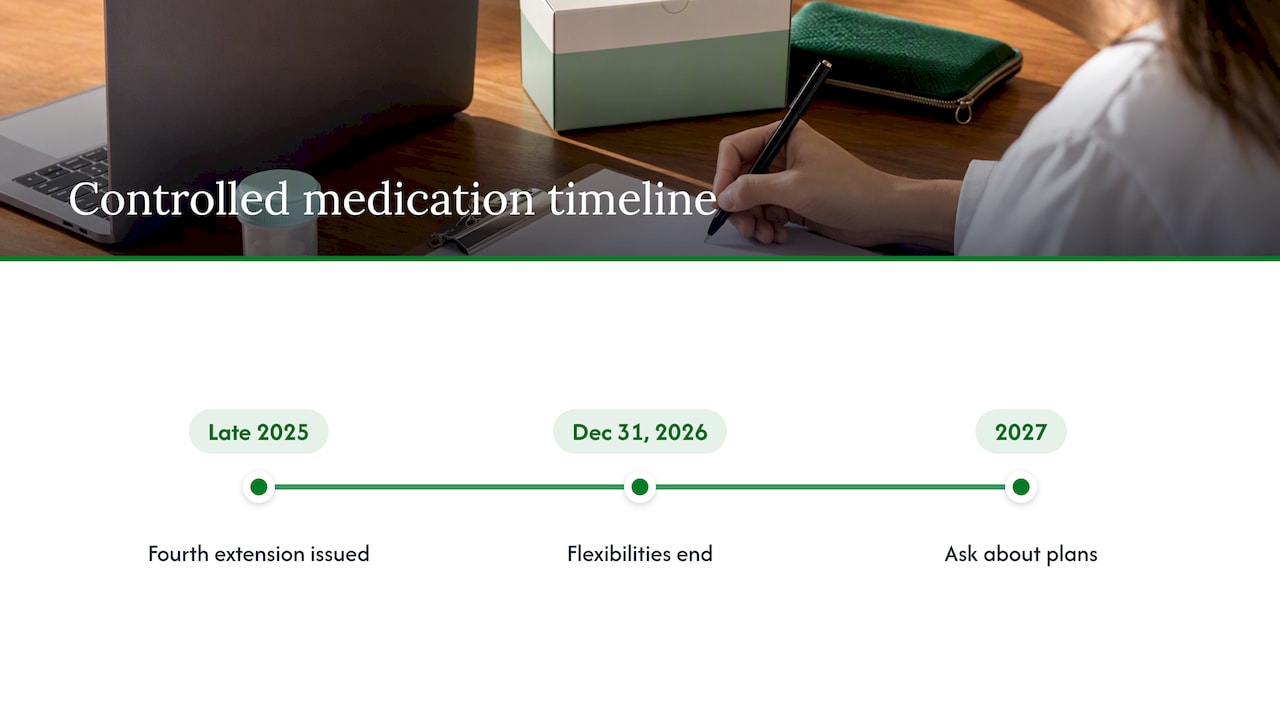
The timeline matters right now. In late December 2025, the DEA and HHS issued a fourth temporary extension of the telemedicine flexibilities for prescribing controlled medications, running through December 31, 2026. Under it, DEA-registered practitioners can prescribe Schedule II to V controlled medications through audio-video telemedicine visits. HHS’s guidance explains that once a provider has done a legitimate in-person evaluation, they may prescribe via telemedicine going forward.
With that date close, anyone who relies on a controlled medication through telehealth should ask their prescriber how they are planning for 2027 and check the DEA and HHS pages for updates. Do not stop or change a controlled medication on your own. Talk to your prescriber first.
What lawful telehealth looks like from your side
Use this checklist when you pick a service:
- It confirms your state and physical location before the visit.
- A licensed clinician makes the prescribing decision, not an algorithm and not a sales form.
- Consent is collected and documented.
- It is clear about what it will not prescribe, especially controlled substances.
- Pricing is explicit, including whether insurance is accepted and what happens with refills.
- You can reach someone about side effects, and it explains when to seek urgent or in-person care.
- Privacy practices are stated. Telehealth providers that handle health information are generally subject to HIPAA.
Prior authorization is another area where patients get surprised. Our prior authorization checklist for telehealth patients walks through what to gather before you start.
Our perspective
We built Zealthy around a simple idea: care should be easier to reach without being less careful. The regulations above are what make that possible, not obstacles to it. State licensure, documented consent and clinical evaluation exist to protect patients, and a telehealth platform that treats them as the foundation will be more trustworthy than one that treats them as paperwork.
What we see as the most useful thing patients can do is ask questions before they pay. Where will my clinician be licensed? What happens if my insurance does not cover this? What will you not prescribe? A good provider answers these directly.
We also think patients deserve choice between using insurance and paying out of pocket, because the right answer depends on your plan, your deductible and what you need. Our clinicians are licensed professionals, and we describe the experience they bring in plain terms on our site. Regulations will keep changing, and we will keep our guides current so you do not have to track every update yourself.
— Bryan
Where Zealthy fits
If you want to see how this works in practice, we offer online visits, messaging and home delivery of prescriptions from licensed providers. Our services include primary care, weight loss, birth control, hair loss, skincare and erectile dysfunction care, plus support for anxiety, depression and sleep. You can start from the Zealthy home page and see which services are available in your state. Whether a treatment is appropriate is always the decision of your clinician after your visit.
Questions people ask
Will Congress extend telehealth beyond 2027?
No one can say yet. Medicare’s current flexibilities for non-behavioral care run through December 31, 2027, and bills such as S. 2709 and H.R. 5081 are under consideration. Until a bill becomes law, treat the 2027 date as the one that counts.
Which states do not allow telehealth?
No state bans telehealth outright. States differ in licensure rules, consent requirements, prescribing standards and insurance coverage. That is why a service may offer a treatment in one state and not another, so check availability for your state before you book.
Is it legal to get a prescription online?
Yes, when a clinician licensed in your state evaluates you and decides the medication is appropriate. Controlled substances have extra federal rules, and a clinician can decline to prescribe. Be cautious about sites that offer any prescription drug without a real evaluation.
Is telehealth still covered by insurance?
In most cases, yes, but the details depend on your plan. Medicare covers many telehealth services, including from home, through December 31, 2027, for non-behavioral care. For private insurance and Medicaid, state law and plan terms control, so call your insurer or check your plan documents.
Sources
- Telehealth Laws and Medicaid, 2025 summary (Telehealth Resource Centers)
- Out-of-State Telehealth Provider Policies (Telehealth Resource Centers)
- Telehealth policy updates (Telehealth.HHS.gov)
- Prescribing controlled substances via telehealth (Telehealth.HHS.gov)
- DEA announces three new telemedicine rules (January 2025)
- DEA extends telemedicine flexibilities (December 2025)
- Medicare.gov telehealth coverage
- CMS: Medicare mental health coverage
- S. 2709 (Congress.gov)
- H.R. 5081 (Congress.gov)


