

TL;DR
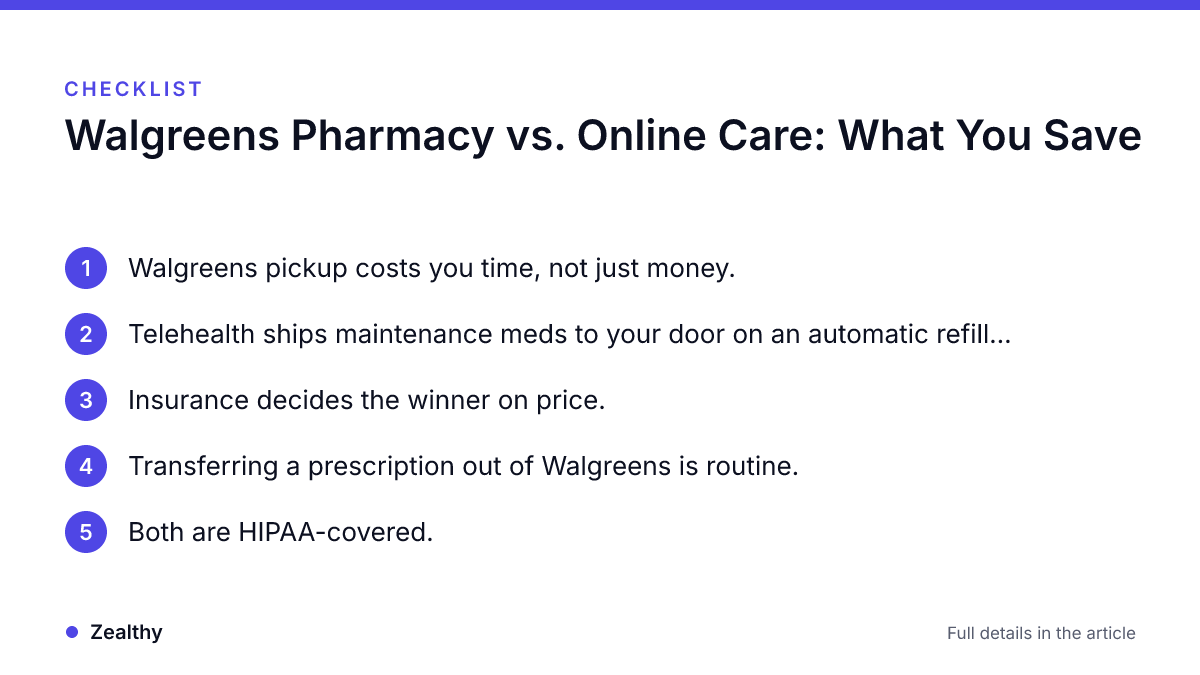
- Walgreens pickup costs you time, not just money. Driving, parking, waiting behind six people at 5 p.m., and finding out your medication isn't in stock all happen before you pay a cent.
- Telehealth ships maintenance meds to your door on an automatic refill schedule, so pharmacy hours, phone trees, and counter lines stop being part of your month.
- Insurance decides the winner on price. Good coverage on a generic usually beats anything online. No coverage, or a drug your plan won't touch, and a flat bundled telehealth plan often costs less per year.
- Transferring a prescription out of Walgreens is routine. Have your Rx number and store location ready. Most transfers we see land within a business day or two, but Schedule II medications generally need a fresh prescription instead.
- Both are HIPAA-covered. The difference is that nobody at your kitchen table says your medication name out loud in front of a stranger.
Maria refilled her birth control at the same Walgreens on Dickson Street in Fayetteville, AR, for three years. Same drive, same fifteen minutes if the pharmacist was buried, same small cringe when the tech called her name and half the store glanced over. Then one month her insurance flagged for re-verification, the pharmacist was out sick, and a "quick refill" turned into three days and two phone calls.
That's when she started looking. And she found out how much friction she'd been filing under normal.
How does Walgreens pickup compare to online prescription delivery?
Walgreens requires you to show up during open hours. Telehealth ships the medication to you after a virtual visit. Obvious enough, but the interesting part is everything hiding behind that sentence.
At a retail counter, your refill depends on variables you don't control. Does the store have stock? Is the pharmacist physically there to verify it? Did your insurance re-authorization clear? Is the drive-thru four cars deep because everyone else is also picking up after work? High-demand categories like GLP-1s and ADHD medications have made all of that worse. Store hours didn't change. The number of people competing for the same shelf did. We broke down how those delays compound in why CVS pharmacy waits cost you refill days, and the same math applies at Walgreens.
With telehealth, the visit takes minutes, the provider sends the prescription electronically, and the fulfilling pharmacy ships to your address with the next refill already queued. There's no version of "they closed at 9, so now it's tomorrow."
Pro tip: If you're on a maintenance medication like birth control, an SSRI, or a hair loss treatment, ask whether automatic refills are included and when the refill ships relative to your run-out date. Good programs ship about a week early. That one feature kills most "I ran out on a Saturday" stories.

What does it actually cost, Walgreens with insurance vs. online without it?
Your insurance status decides this, and most comparisons dodge that. Solid prescription coverage on a common generic? Your Walgreens copay is probably the cheapest thing available to you. No coverage, or a medication sitting on a bad formulary tier, and retail cash pricing gets rough fast.
Here's an illustrative scenario, using round numbers you should replace with your own.
Say you're uninsured and need a 30-day ED medication. Retail cash price on a brand-name option often runs somewhere north of $60 a month in the quotes patients bring us, and it resets every single refill with zero care attached. A telehealth plan that bundles the medication and the provider visit into one flat monthly charge might land in the $30 to $50 range depending on the medication and dose. The consultation is already inside that number.
Run it like this:
(monthly medication cost + annual visit or consult fees) × 12 months = your real yearly total.
- Retail path: $65/month × 12 = $780, plus a $25 consult once a year = $805/year
- Bundled telehealth: $40/month × 12 = $480/year
- Difference: $325/year, before you count gas, parking, and roughly twelve hours of your life spent in a pharmacy queue
The threshold worth remembering: if your out-of-pocket retail price is more than about $15 above a bundled online plan, the online option almost always wins over twelve months. Under that, stay where you are.
| Factor | Walgreens/CVS pickup | Zealthy online care |
|---|---|---|
| Getting the first prescription | In-person visit or existing script required | Virtual visit, often within days |
| Refill process | You reorder and pick up each cycle | Automatic refills shipped to your address |
| Cost with insurance | Usually lowest if the drug is covered | Comparable on many generics |
| Cost without insurance | Full cash price, varies store to store | Flat bundled rate, shown before you pay |
| Hours you're bound to | That store's posted pharmacy hours | Order or message any time |
| Specialty medications | May route to a specialty pharmacy transfer | Handled through a partner pharmacy network |
Pro tip: Before you assume insurance makes retail cheaper, call and ask for your copay on the exact medication, dose, and quantity. Not the drug name alone. A 90-day supply frequently prices out well below three 30-day fills, and formularies shift at the start of the plan year without much warning.
How do prescription transfers and refills work between pharmacies?
Moving a prescription from Walgreens to a telehealth-affiliated pharmacy is routine. Pharmacies pass prescriptions back and forth all day. You are not asking anyone for a favor.
You'll need three things:
- Your prescription number, printed on the bottle label or sitting in your pharmacy's app under refill history.
- The exact store, meaning the Walgreens or CVS street address, because "the one by the highway" isn't enough when a chain has four locations in your zip code.
- The receiving pharmacy's name, which your telehealth provider hands you during onboarding.
Most transfers we see clear within a business day or two. Controlled substances are the exception, and the rules tighten as you move up the schedule. If you're on a Schedule II stimulant, plan on getting a new prescription from your prescriber rather than a transfer. Ask about it before you cancel anything at your current pharmacy. Walgreens documents its own transfer and refill process on its pharmacy page, and the mechanics look similar across chains.
The real difference is who does the chasing. The standard experience is you calling the old pharmacy, then the new one, then calling back because nothing moved. With a telehealth care team, that back-and-forth is their job. You answer a few questions and they follow the paperwork.
Is my information more private with online care than at a pharmacy counter?
Both are HIPAA-covered, so the legal floor is identical. What differs is how exposed you feel standing there.
At a counter, your last name and your medication get spoken aloud, sometimes twice, sometimes loud enough for the person behind you in line holding a bag of chips. The consultation window is a partial wall, not a room. For PrEP, mental health medications, or ED treatment, that thirty seconds is exactly the part people dread, and it's the reason plenty of prescriptions never get filled at all.
Online, the same conversation happens in your living room. Messaging your provider, reviewing your plan, and requesting refills all sit inside a private account. If you're managing hair loss, acne or rosacea, or anxiety and depression, that shift from storefront to screen is frequently the actual reason people switch. Price is the excuse. Privacy is the motive.
Pro tip: Ask any telehealth service how the package arrives before you order. What you want to hear: plain outer packaging, a fulfillment pharmacy name on the label rather than a medication name, and no signature requirement so a box isn't sitting on your porch announcing itself. Most reputable services do all three. Confirm anyway.
What about Walgreens pharmacy hours and getting someone on the phone?
Walgreens pharmacy hours vary by location, and that inconsistency is the whole problem if your schedule isn't predictable. One store closes at 9 p.m. on weekdays and 6 p.m. on Sunday. Another five miles away runs 24 hours. Searching "Walgreens pharmacy Appleton" or "Walgreens pharmacy Fayetteville AR" to find something open right now is its own small chore.
Then there's the detail nobody warns you about: many chain pharmacy counters close for a pharmacist lunch break in the early afternoon, even though the front of the store stays wide open. You walk in at 1:45 p.m., the gate is down, and you wait thirty minutes or come back. Check the counter's posted hours, not the store's.
CVS runs the same store-by-store inconsistency, so switching chains doesn't fix it. And staffing, not policy, is usually why the phone rings for ten minutes before anyone picks up.
Online care deletes the question. You order or message at 11 p.m. once the kids are down, or during a lunch break, and nothing depends on who called out sick at that specific store today. For most people comparing the two honestly, that's a bigger quality-of-life change than the money.
Which option should you actually use?
Use Walgreens or CVS when you need something filled within the hour, when you're on a controlled substance that can't be managed remotely, or when your copay clearly undercuts everything else. Use telehealth for the medications you take every month: birth control, GLP-1 weight loss medication, ED treatment, anxiety or depression medication, or enclomiphene.
Most people end up splitting it. Local pharmacy for the occasional acute prescription, online provider for the recurring ones. Maria kept her Walgreens for antibiotics when her kid gets strep and moved her birth control online. That's a sensible split, and it doesn't require overhauling anything. If you're weighing it, Zealthy's FAQ page walks through what the first visit and first refill look like.
Frequently asked questions
Can I keep my Walgreens pharmacy as a backup after switching to telehealth?
Yes. Moving your maintenance medications online doesn't close your Walgreens profile or wipe your history there. Plenty of patients keep a local pharmacy active for one-off prescriptions and route the monthly stuff through delivery.
Does insurance work with telehealth prescriptions the same way it does at Walgreens?
Depends on the medication and the provider. Some telehealth services bill insurance much like a retail pharmacy. Others run flat self-pay pricing, especially for treatments insurance rarely covers, like most weight loss and hair loss medications. Ask before you sign up rather than after.
What happens if my telehealth medication is out of stock, the way it sometimes is at Walgreens?
Most telehealth providers work with a network of pharmacies instead of one storefront, so a shortage at one fulfillment site can route to another without you making a single call. That's a genuine advantage over being tied to whatever one store happened to receive that week.
Pull your last three pharmacy receipts, add up what you actually paid per month, and compare it against a bundled plan using the formula above. If the gap clears $15 a month, the switch pays for itself in a year. Zealthy's reviews will tell you what the first month looks like from patients who've already run the numbers.




.svg)
.svg)
.svg)
.svg)

