Low testosterone and erectile dysfunction (ED) are two different conditions that sometimes show up together. Low testosterone is a hormone problem that mostly affects sex drive, energy and muscle. ED is a problem getting or keeping an erection, and it is usually a blood flow problem. The American Urological Association (AUA) says low testosterone may affect sexual desire but rarely causes ED. That is why the right first step is working out which one you have, or whether you have both.
If you are here because something has changed in the bedroom and you are not sure why, you are in good company. It is a common worry, and it has clear answers. This guide covers symptoms, causes, testing and treatment, so you can walk into an appointment knowing what to ask.
TL;DR
- Low testosterone is a hormone deficiency with symptoms. ED is trouble getting or keeping an erection firm enough for sex.
- Low testosterone mainly lowers sex drive. ED is almost always caused by reduced blood flow to the penis.
- Studies find low testosterone in a minority of men with ED, with estimates ranging widely from 7% to 47% depending on how it is measured.
- Testing means a medical history, a physical exam and early-morning blood tests. Treatment depends on which condition is confirmed.
- Testosterone therapy does not fix ED in men with normal testosterone, so an accurate diagnosis matters.
Table of Contents
- What each condition actually is
- How the symptoms differ
- What causes each one
- How often do they occur together?
- Why the distinction changes treatment
- How clinicians work out which one you have
- Treatment options
- Perspective: what we see at Zealthy
- Getting started with care
- When to see a clinician sooner
- FAQ
- Sources
What each condition actually is
Low testosterone
Testosterone is a male sex hormone. It supports sex drive, muscle, bone, mood and energy. The AUA defines testosterone deficiency as a low total testosterone level together with symptoms or signs, and it uses a threshold of below 300 ng/dL on at least two separate early-morning tests. The words “together with symptoms” matter. A single low number with no symptoms is not, on its own, the diagnosis.
Erectile dysfunction
ED is difficulty getting or keeping an erection firm enough for sexual intercourse. It is a symptom with many possible causes, not a disease in itself. Hormones are only one of them, and often a minor one.
Why people confuse them
Both can lower your confidence in bed, both become more common with age, and both can come from the same background problems, such as obesity, diabetes and poor sleep. Most online lists of low testosterone symptoms include ED, so it is easy to assume one explains the other. The evidence says that is true less often than people think.
How the symptoms differ
The AUA’s guidance lists the symptoms that can point to low testosterone. Some overlap with ED, but most do not.
| Symptom | More typical of low testosterone | More typical of ED |
|---|---|---|
| Reduced sex drive | Yes | Not directly, though stress about ED can lower desire |
| Trouble getting or keeping an erection | Sometimes | Yes, this is the defining symptom |
| Fatigue, low energy or endurance | Yes | No |
| Reduced muscle size or strength | Yes | No |
| Depression, poor concentration, impaired memory | Yes | Can be a result of ED, or a cause |
| Loss of body hair, needing to shave less, breast growth | Yes | No |
| Bones that break more easily, infertility | Yes | No |
The AUA lists reduced energy, fatigue, diminished work or physical performance, depression, poor concentration, impaired memory, infertility, reduced sex drive and changes in erectile function among the symptoms of testosterone deficiency. On examination, a clinician may also look at body-hair patterns, breast tissue and testicular size.
A quick way to sort your own pattern
These are not diagnostic, but they help you describe what is happening:
- Desire is low and you feel tired and flat overall. This pattern fits low testosterone better.
- You want sex, but erections are unreliable. This pattern fits ED better, usually a circulation or nerve issue.
- Morning erections have faded, desire is down and energy is poor. Worth testing for both.
- ED started suddenly after a stressful period, with normal erections when alone. Psychological factors may play a larger role.
If you are under 40 and have ED, read our guide on ED in young men and when it signals heart or hormone risk.
What causes each one
Causes of ED
The AUA’s patient guidance says ED is almost always caused by low blood flow to the penis, often related to hardening of the arteries, high blood pressure or high cholesterol. That is why ED can be an early warning sign of cardiovascular trouble, and why it deserves a proper check rather than a shrug.
The NIDDK gives a wider list of possible causes, including diabetes, obesity, kidney disease, high blood pressure, nerve disorders, medicines, anxiety, depression, stress, smoking, excess alcohol and inactivity. Low testosterone and thyroid imbalance are on that list too, which is one reason hormones get checked. Our articles on how a sedentary lifestyle contributes to ED and thyroid disorders and ED go deeper on two of them.

Causes of low testosterone
The AUA notes that pituitary problems can cause low testosterone. Other causes include problems with the testicles themselves, and in older or overweight men a form sometimes called functional hypogonadism, where the hormone drops alongside weight gain, poor sleep or other health conditions. Doctors Mathis Grossmann and Alvin Matsumoto note that this functional form in older, obese men is often potentially reversible through lifestyle changes. Our overview of how hormones affect ED covers the endocrine side in more detail.
How often do they occur together?
Less often than the internet suggests, but often enough that testing is reasonable. A review of the research found that the share of men with low testosterone among those seeking ED evaluation ranged from 7% to 47%, depending on the testosterone threshold used. A wide range like that tells you the answer depends heavily on how “low” is defined, and on the age and health of the men studied.
The practical takeaway: a man with ED has a real chance of also having low testosterone, but most men with ED will have normal levels. That is why a blood test is more useful than guessing.
Why the distinction changes treatment
This is the most important part. The AUA states that testosterone treatment does not improve erections in men with normal testosterone, and does not help men with low testosterone when ED is their only symptom. Taking testosterone for ED without confirmed deficiency means spending money and taking on risks without a likely benefit.
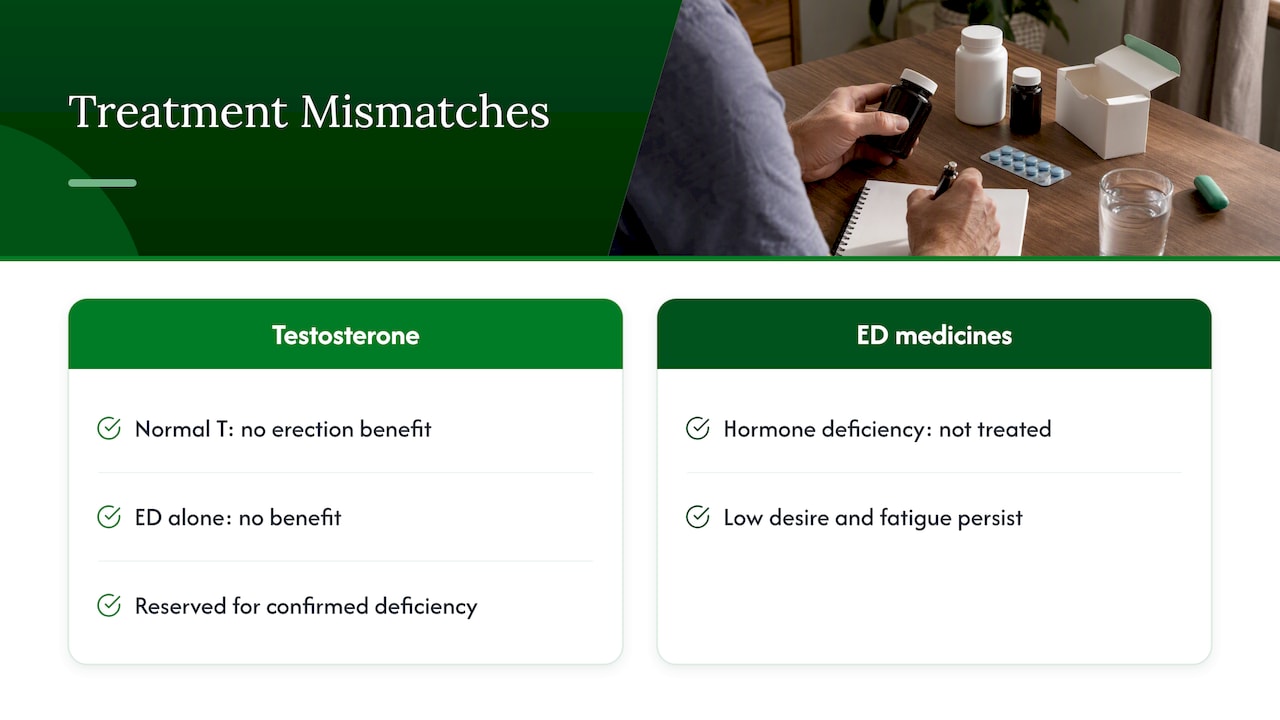
The Endocrine Society likewise says testosterone therapy should be reserved for well-documented cases of hypogonadism. On the other side, ED medicines do nothing for a hormone deficiency that is causing low desire and fatigue. Each condition needs the matching treatment.
How clinicians work out which one you have
Diagnosing low testosterone involves a medical history, a physical exam and blood tests for testosterone and other hormones. A good evaluation for ED covers similar ground, plus your blood pressure, medicines and mental health.
Here is what to expect:
- A conversation about your symptoms. When did it start? Is it every time or only sometimes? Do you wake with erections? How is your desire, sleep, mood and energy?
- A review of your health and medicines. Blood pressure drugs, antidepressants and other prescriptions can affect erections. Smoking, alcohol and activity level matter too.
- A physical exam. This can include blood pressure, weight, body-hair pattern, breast tissue and testicular size.
- Blood tests. Because levels vary through the day, the AUA’s approach uses early-morning samples on at least two separate days. Your clinician may add other hormones, blood sugar and cholesterol.
Treatment options
For ED
Treatment often begins with lifestyle factors like diet, weight and physical activity, followed by medical management with PDE5 inhibitors such as sildenafil and tadalafil. Systematic reviews suggest that lifestyle changes can have effect sizes for ED similar to medication and are good for long-term health, so they are not a consolation prize.
PDE5 inhibitors work with arousal, not instead of it. They help only when there is adequate sexual stimulation. That same review notes that a poor response can be linked to performance anxiety or unrealistic expectations, not only to the drug.
If you want to compare the common options, we have plain-language guides to sildenafil, tadalafil and vardenafil.
For low testosterone
Testosterone therapy is recommended for men with testosterone deficiency, including blood testosterone below 300 ng/dL with symptoms. If a lifestyle-related cause is likely, such as excess weight, inactivity or poor sleep, working on those can be an initial or added step, as Grossmann and Matsumoto describe. Treatment decisions should be made with a clinician who has seen your lab results, because therapy has its own risks and monitoring needs.
What about foods that raise testosterone?
People search for this a lot. We would be careful here. There is no food that has been shown to treat a diagnosed deficiency. What the research does support is the broader picture: a healthy weight, regular activity and a balanced diet can improve functional low testosterone and ED alike. Treat food as one part of the plan, not a replacement for testing.
Perspective: what we see at Zealthy
Men often come to us after reading a list of low testosterone symptoms and deciding that is the problem. Sometimes it is. More often, the picture is simpler: erections have become less reliable, stress and worry have piled on, and nobody has checked blood pressure, blood sugar or sleep in a while.
Our view is that ED deserves to be treated as a health signal, not only a bedroom problem. That is why we pair ED care with primary care in one place, so the same team can look at the whole person. We also think testing should come before hormone treatment. If your symptoms point to low testosterone, the right move is confirming it with proper blood work, not guessing.
We also want you to feel no embarrassment. ED is common and treatable, and starting online means you can have the conversation privately, at a time that suits your schedule, with licensed providers.
— Bryan
Getting started with care
If erections are your main concern, our online ED treatment lets you complete a visit with a licensed provider, get a personalized plan and have prescriptions delivered if treatment is appropriate. If you also have fatigue, low mood or other whole-body symptoms, a primary care visit is a sensible starting point, since we offer same-day primary care appointments. Your provider can talk through which tests make sense. We accept insurance where applicable, and you can also pay out of pocket.
When to see a clinician sooner
Book a visit rather than waiting if any of these apply:
- ED came on suddenly, especially with chest pain, shortness of breath or dizziness. These can point to heart trouble, so seek urgent care if they are happening now.
- You have diabetes, high blood pressure or high cholesterol and are noticing erection changes.
- You have breast growth, loss of body hair, shrinking testicles or unexplained bone fractures.
- You are trying to have a child. Testosterone therapy can affect fertility, so raise this before any treatment starts.
- Low mood, hopelessness or anxiety are part of the picture. These are treatable, and they can also feed ED.
If ED is also straining your relationship, you might find our piece on ED and relationship strain useful, since the emotional side often needs attention alongside the physical one.
FAQ
Can low testosterone cause erectile dysfunction?
It can contribute, but it rarely is the sole cause. The AUA says low testosterone may affect sexual desire but rarely causes ED. Blood flow problems are the far more common cause. If your only symptom is ED, testosterone therapy is unlikely to help.
What are the first signs of low testosterone?
Common early signs include lower sex drive, fatigue, reduced muscle strength, low mood and trouble concentrating. These can have other causes, such as poor sleep or depression. A diagnosis needs symptoms plus repeated early-morning blood tests showing low levels.
Should I get my testosterone tested if I have ED?
It is reasonable to discuss it with a clinician, particularly if you also have low desire, fatigue or other symptoms. Your provider will weigh your history and exam first. If testing is warranted, expect morning blood draws, often repeated.
What are the most common causes of ED?
Reduced blood flow to the penis is the leading cause, often tied to hardening of the arteries, high blood pressure or high cholesterol. Diabetes, obesity, medicines, stress, anxiety, depression, smoking and heavy alcohol use can also play a part.
Is testosterone replacement therapy available in the US?
Yes, for men with a confirmed deficiency. Guidelines recommend it for men with blood testosterone below 300 ng/dL and symptoms. It is prescribed after evaluation and monitored by a clinician, and it is not intended for men with normal levels.
Sources
- Treatment for erection problems (AUA)
- Evaluation and Management of Testosterone Deficiency: AUA Guideline
- Symptoms & Causes of Erectile Dysfunction (NIDDK)
- Management of Erectile Dysfunction in the Hypogonadal Man
- A Perspective on Middle-Aged and Older Men With Functional Hypogonadism
- Testosterone Therapy Patient Guide (Urology Care Foundation)
- Erectile Dysfunction Patient Guide (Urology Care Foundation)
- Interventions to Treat Erectile Dysfunction and Premature Ejaculation
- Erectile dysfunction: causes, assessment and management
- Experts issue recommendations to improve testosterone prescribing practices (Endocrine Society)


