Telehealth can produce meaningful weight loss, and in the best-studied programs the results come close to those of in-person care. The size of the result depends on three things: how long the program runs, how much human contact it includes, and whether medication is paired with lifestyle support. This guide covers the numbers behind those findings, the limits of the research, and how to judge a virtual program before you enroll.
TL;DR
- Reviews of telehealth and eHealth weight programs find average losses of roughly 4.3 kg compared with no care, and programs with human contact do better than self-guided ones.
- Longer programs tend to work better: a 2024 meta-analysis of US adults linked 6 to 12 month interventions with larger weight loss.
- A 2026 real-world study of a national telehealth platform found patients who stayed on semaglutide lost about 16.6% of body weight on average over 68 weeks.
- Results vary widely from person to person. Medication works best alongside nutrition, activity and regular check-ins with a clinician.
Table of Contents
- What “telehealth outcomes” actually measure
- What the research says about telehealth weight loss
- What separates strong programs from weak ones
- A quick checklist for judging any telehealth weight program
- Side effects and realistic expectations
- Cost and coverage: what is changing in 2026
- Our perspective: outcomes come from the care model
- Start with a clinician who can look at your whole picture
- Limits of the evidence
- FAQ
- Sources
What “telehealth outcomes” actually measure
When researchers report outcomes for a virtual weight program, they usually track a few things:
- Weight change, in kilograms or as a percentage of starting body weight.
- BMI change, which moves with weight but says little about body composition.
- Behaviors, such as diet quality, physical activity and self-monitoring.
- Persistence, meaning how many people are still in the program after 3, 6 or 12 months.
- Safety, including side effects and discontinuations.
Percentage of body weight is the most useful single number. A 5% loss is generally considered clinically meaningful, and the figure lets you compare people who start at very different weights. Be careful with averages, though. Many studies report only people who completed the program, which can make results look better than they are for everyone who starts.
What the research says about telehealth weight loss
Telehealth works better than no care
A systematic review of systematic reviews looked at eHealth weight loss interventions in adults with overweight or obesity. Digital programs, especially those involving human contact, were generally more effective than no-care or control conditions, and they compared reasonably with traditional face-to-face clinical programs. The mean difference against no-care groups was about 4.32 kg.
That is a modest, real effect. It is not a promise that every participant loses that much.
Duration matters
A 2024 systematic review and meta-analysis of telemedicine for obesity among US adults reported statistically significant improvements in weight and BMI. Interventions lasting 6 to 12 months were associated with more substantial weight loss. A separate 2024 meta-analysis of telemedicine interventions also supports telemedicine as a promising route to weight loss support.
The practical lesson: a four-week plan will not tell you much. Look for a program built for months, not weeks.
Real-world telehealth results with GLP-1 medication
Clinical trials are tightly controlled, so people reasonably ask whether results hold up in everyday virtual care. A large retrospective cohort study published in Obesity in 2026 examined 655 patients treated with semaglutide through a nationwide telehealth platform. Mean body weight fell by 16.6% at 68 weeks, and the authors reported no major safety concerns. The paper notes that participants in the STEP 1 trial lost an average of 14.9% over the same period.
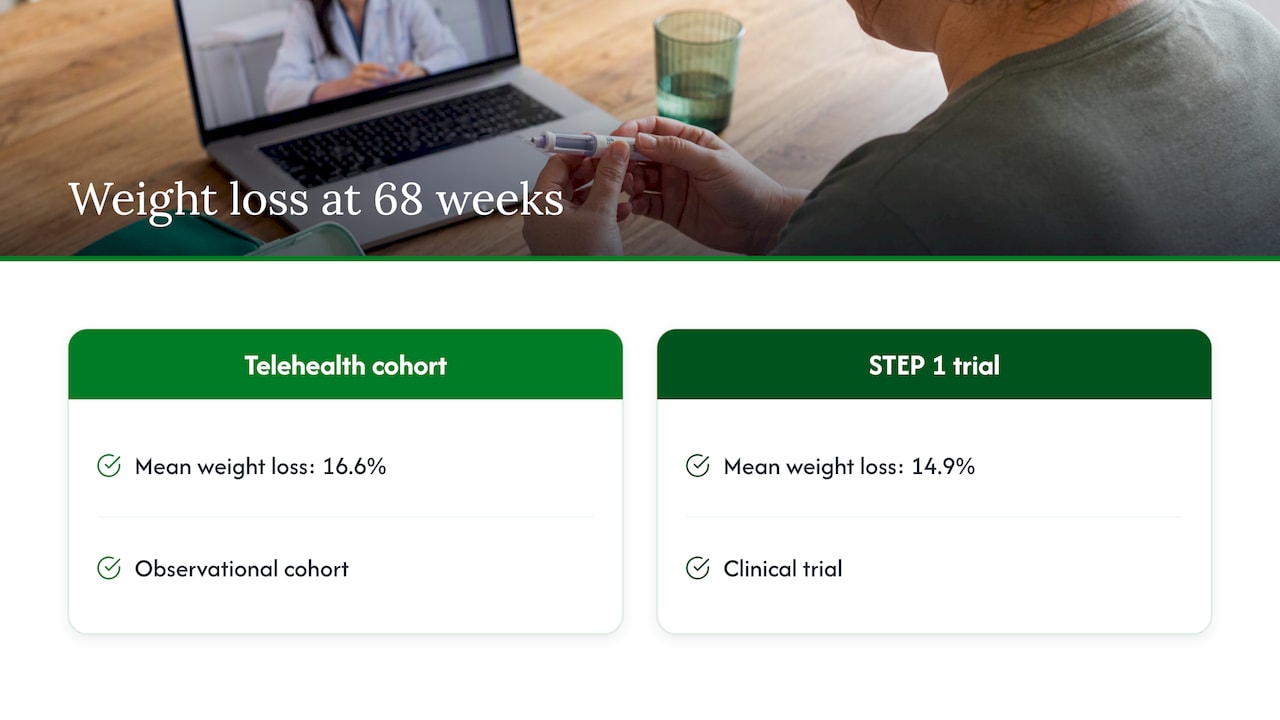
Two cautions apply. The study looked at patients who persisted with treatment, so it describes people who stayed on the medication, not everyone who started. It is also an observational study, which cannot prove cause and effect the way a randomized trial can.
For context on the drug itself, AGA’s clinical practice guideline summarizes trial data on semaglutide 2.4 mg, with weight loss of 9.7 to 16.8 kg in treatment groups versus 1.5 to 6.2 kg with placebo. The guideline recommends pharmacotherapy in addition to lifestyle intervention for adults with overweight or obesity and weight-related complications who have an inadequate response to lifestyle changes alone.
What separates strong programs from weak ones
The studies do not say “telehealth works” or “telehealth fails” as a blanket statement. They say that design matters. Here is what shows up again and again.
Frequent, human contact
Virtual visits and messaging make it easy to check in more often than a clinic calendar usually allows. More frequent contact with a care team is consistently linked with more weight loss. The eHealth review above found human contact to be a key feature of the more effective interventions.
Medication plus lifestyle, not medication alone
A retrospective study of a hybrid approach combined GLP-1 agonists with lifestyle guidance for obesity and pre-diabetes. Successful programs increasingly pair medication with dietitians, coaching and physician oversight instead of simply shipping a prescription. Researchers writing in a 2023 review describe digital tools as most valuable as adjuncts to established treatments such as behavioral counseling, not replacements for them.
Structured clinical care
The Obesity Medicine Association’s clinical practice statement on telehealth describes the ADAPT model: Assessment, Diagnosis, Advice, Prognosis and Treatment. The point is that obesity is a chronic condition. Good virtual care evaluates the whole person, explains what to expect, and follows up. It does not stop at filling a prescription.
Monitoring and maintenance
Keeping weight off is often harder than losing it. The AGA guideline describes the value of ongoing monitoring and regular touchpoints so the care team can adjust treatment and manage side effects as they appear. Connected tools such as Bluetooth scales can help, and so can a simple habit of logging your weight weekly.
A quick checklist for judging any telehealth weight program
| Question to ask | Why it matters |
|---|---|
| Who prescribes and follows up? | Licensed clinicians should review your history and monitor you over time. |
| How often will you talk with the care team? | More frequent contact is linked with better results. |
| Is there lifestyle support? | Nutrition and activity guidance make medication more effective and easier to tolerate. |
| How long does the plan run? | Evidence favors 6 to 12 months or more. |
| What happens when you reach goal weight? | Maintenance is the hard part and needs a plan. |
| What does it cost, and is insurance accepted? | You need to know your total monthly cost before starting. |
Side effects and realistic expectations
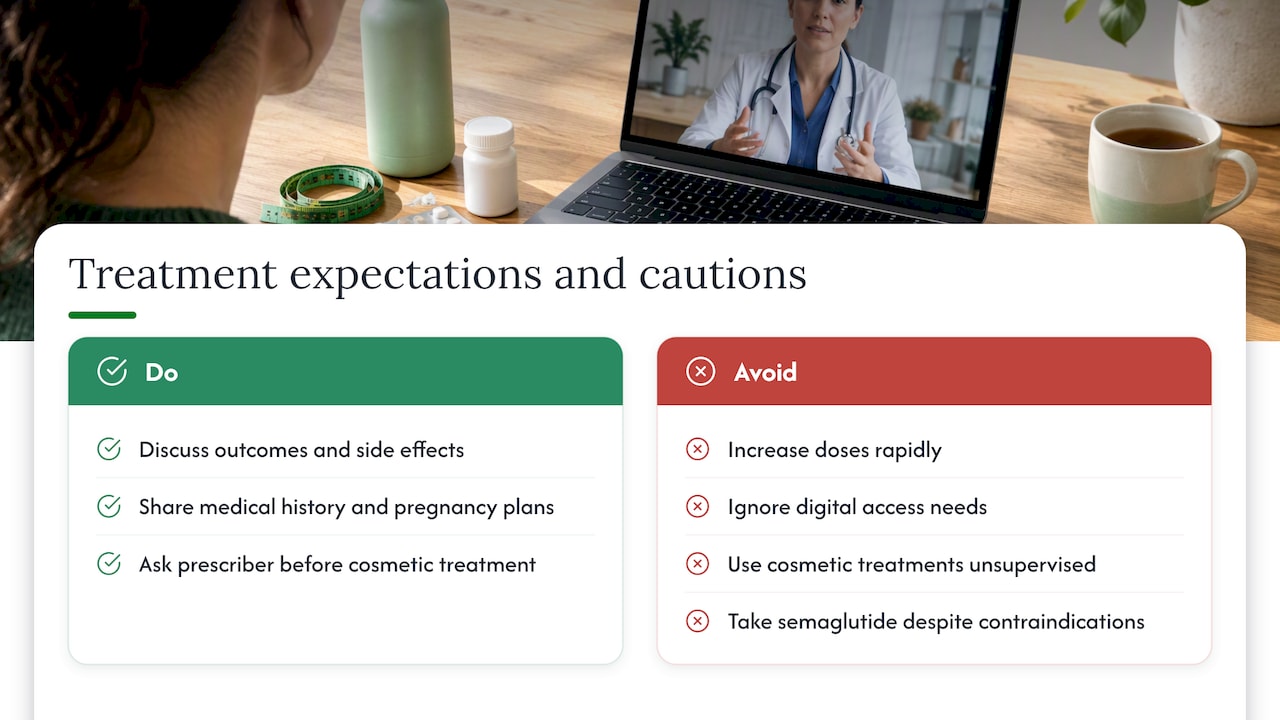
GLP-1 medications can cause nausea and other gastrointestinal symptoms, which is why doses are increased gradually. Expert guidance stresses that response is highly individual, and clinicians should discuss likely outcomes and side effects honestly before treatment begins (AGA guideline).
Food choices can help. We have written a clinician-aligned guide to 20 to 30 gram protein meals on GLP-1 therapy aimed at easing nausea. A joint advisory from four leading obesity and nutrition organizations also covers nutrition priorities during GLP-1 treatment. It adds that telehealth can improve access and equity, but must be implemented carefully so older or underserved patients with limited digital skills are not left behind.
Rapid weight loss can also change how skin looks and feels. If that concerns you, this guide to non-invasive skin tightening after GLP-1 treatment explains options offered at a Portland clinic. Talk to your prescriber first about any cosmetic treatment while your weight is still changing.
Some people should not take semaglutide at all. Read our overview of semaglutide contraindications patients must report and tell your clinician about your full medical history, including pregnancy plans and any history of thyroid or pancreatic conditions.
Cost and coverage: what is changing in 2026
Access is part of outcomes. A program that people cannot afford to continue will not deliver 12 months of results. Medicare now has a temporary route: according to Medicare.gov, starting July 1, 2026, the GLP-1 Bridge program covers certain GLP-1 drugs, including Wegovy and Zepbound KwikPen, for eligible people with Part D drug coverage. If you are on Medicare and trying to work out whether you qualify, this explainer from a Medicare insurance agent walks through the Part D side. Eligibility rules are specific, so check your plan details.
For a broader look at how virtual obesity care fits with these changes, see our article on telehealth obesity care and Medicare’s 2026 drug bridge.
Our perspective: outcomes come from the care model
We see telehealth as a way to remove the friction that stops people from starting and staying in treatment. Traveling to a clinic, waiting weeks for an appointment and juggling work are all reasons people drop out before a plan has time to work. Same-day appointments, messaging with a clinician, and medication delivered to your door address those barriers directly.
But convenience alone does not produce outcomes, and the research says so clearly. What matters is what happens after the first visit. At Zealthy, primary care, mental health and weight loss live on one platform, because weight rarely changes in isolation. Sleep, stress, anxiety and other conditions all affect appetite and routine. Our providers are licensed, and on average have more than ten years of clinical experience, so care plans can be tailored to the person instead of following a script. You can use insurance where it applies or pay out of pocket.
We also think honesty is part of good care. Results vary. Some people lose a lot, some lose less, and some find a medication is not right for them. The studies above describe averages, and we do not present them as a guarantee of what you will achieve. We encourage patients to think in terms of 6 to 12 months and beyond, to plan for maintenance from day one, and to keep in touch with their care team when something feels off.
— Bryan
Start with a clinician who can look at your whole picture
If you want to see whether a medically supervised plan fits your health history and goals, our Zealthy weight loss program is a place to start. You complete an online visit, a licensed provider reviews your information, and if treatment is appropriate, medication is delivered to your home. Our weight loss FAQ covers common questions about the process. If you would like more background first, read about how GLP-1 weight loss medications work or how to start a GLP-1 plan from home.
Limits of the evidence
Be cautious with any single headline number. Studies differ in population, program length and what counts as success. Many are observational, many lose participants over time, and some of the strongest data come from trials with unusually high contact. The reviews also report high variability, which is why researchers call for more personalized approaches. Treat the findings as a reasonable guide to what is possible, not a forecast for any one person.
FAQ
Is telehealth weight loss as effective as in-person care?
Reviews find that digital and telehealth weight management with human contact is generally comparable to traditional face-to-face programs (systematic review). The quality of the program matters more than the setting. Frequent follow-up, clinical oversight and lifestyle support are the common ingredients.
How much weight can you lose with telehealth?
It depends on the program and the person. In a 2026 cohort of patients on semaglutide via telehealth who stayed on treatment, the average loss was 16.6% of body weight at 68 weeks. Programs without medication typically show smaller average losses.
How long should I stay in a telehealth weight loss program?
Meta-analytic evidence links 6 to 12 month programs with larger weight loss (2024 meta-analysis). Because obesity is a chronic condition, your clinician may recommend a longer plan or a maintenance phase. Do not stop or change medication without talking to your prescriber.
Can I use insurance for telehealth weight loss?
It depends on your plan and the medication. Medicare began covering certain GLP-1 drugs for eligible Part D enrollees through its GLP-1 Bridge program on July 1, 2026. Zealthy accepts insurance where applicable, and you can also pay out of pocket.
Sources
- Telemedicine for obesity management among US adults: systematic review and meta-analysis (2024)
- Effect of telemedicine interventions on weight loss: systematic review and meta-analysis (2024)
- The effectiveness of eHealth interventions for weight loss and maintenance: systematic review of systematic reviews
- Real-world evidence on semaglutide in obesity telehealth: retrospective cohort study (Obesity, 2026)
- AGA clinical practice guideline on pharmacological interventions for adults with obesity
- Effectiveness of a hybrid approach integrating GLP-1 agonists and lifestyle guidance
- OMA clinical practice statement on obesity and telehealth
- Review of digital interventions as adjuncts to evidence-based treatment
- Joint advisory on nutritional priorities to support GLP-1 therapy
- Medicare.gov: weight loss drugs


