The right telehealth provider is licensed in the state where you are sitting during the visit, protects your health data, is clear about what care costs and whether your insurance applies, and prescribes only after a real clinical visit. Everything else, from app design to appointment speed, matters less than those basics.
This guide walks through eight checks you can finish in about fifteen minutes, explains what to look for in each, and shows where we at Zealthy fit. Whether you want primary care, mental health support, weight loss, birth control or another treatment, the same checks apply.
TL;DR
- Confirm the clinician is licensed in the state where you will be during the visit, not just where you live.
- Look for clear privacy policies, encrypted visits and HIPAA-compliant handling of your health information.
- Ask up front what you pay, whether your insurance applies, and how cancellation works.
- Be wary of any site that offers prescription medication without a real visit with a clinician.
- Pick a provider whose services match your need, and make sure there is a path to in-person care if you need it.
Table of Contents
- Why the choice matters more than it used to
- Check 1: Know what kind of care you need
- Check 2: Confirm licensing in your state
- Check 3: Look at who actually treats you
- Check 4: Verify privacy and security
- Check 5: Sort out insurance and cost before the first visit
- Check 6: Understand how prescribing works
- Check 7: Test the cancellation and billing experience
- Check 8: Look at the follow-up and the way out
- How the main types of provider compare
- Our perspective: what we think matters most
- Get ready for your first visit
- Start with a provider that fits your needs
- A quick decision checklist
- FAQ
- Sources
Why the choice matters more than it used to
Most people who try telehealth like it. One survey cited in an American Medical Association issue brief found that 79% of respondents were satisfied with their virtual visits and 73% intended to keep using telehealth. Convenience and less travel time were the usual reasons.
But “telehealth” covers a wide range. It includes your own doctor’s office offering video visits, a health plan’s virtual urgent care, a specialist service, and subscription companies that handle a single condition. These are not the same product. They differ in who treats you, what they can prescribe, what you pay, and what happens to your data.

That is why a short, structured check is worth your time. The sections below follow the order in which problems tend to show up.
Check 1: Know what kind of care you need
Start with your goal, not with a brand. Telehealth works especially well for:
- Routine and follow-up care, such as medication reviews and check-ins
- Mental health support, including anxiety and depression
- Common, well-defined concerns like birth control, hair loss, skincare or sleep
- Ongoing conditions where you mostly need monitoring and refills
It works less well when a clinician needs to touch, measure or test you, or when symptoms point to an emergency. Research published in the Journal of the American Geriatrics Society and summarized by the AMA found that many patients prefer a hybrid model: telemedicine for follow-ups and straightforward issues, in-person visits for initial exams or complex conditions.
If you are unsure which side your symptoms fall on, our guide to telehealth vs. urgent care lists symptoms that call for a virtual visit, symptoms that call for urgent care, and signs that mean you should call 911. Our comparison of telehealth and office visits covers when the trip is worth it.
Check 2: Confirm licensing in your state
This is the check people skip most often, and it is the most important. Clinicians generally need to be licensed in the state where the patient is located at the time of the visit. If you travel for work or spend part of the year somewhere else, the state that counts is the one you are physically in when the call happens.
Federal guidance reflects this. The Centers for Medicare & Medicaid Services advises patients who plan to travel to confirm whether their provider is licensed to practice in the state where they will be.
What to look for:
- A clear list of the states where the service operates
- Clinician credentials you can verify, such as a license type and state
- A plain explanation of what happens if you are traveling
The AMA has also argued that rigid state-line rules can threaten continuity of care for established patients who are temporarily elsewhere. Rules are still evolving, so ask rather than assume. We explain the legal routes in 5 authorization paths for lawful out-of-state telehealth.
Check 3: Look at who actually treats you
A good provider tells you who will be on the other side of the screen. Look for licensed physicians, nurse practitioners, physician assistants or licensed therapists, depending on the service, and for experience that is stated plainly rather than implied.
At Zealthy, care is delivered by licensed providers, and our clinicians average over ten years of clinical experience. You build a care plan with them for your own situation, whether that is weight loss, anxiety, erectile dysfunction or something else. Whatever provider you pick, ask whether you will see the same clinician for follow-ups or whether you will be matched with whoever is available.
Check 4: Verify privacy and security
You are sharing medical history, medications and sometimes very sensitive details. The privacy bar should be high.
The U.S. Department of Health and Human Services explains that HIPAA requires covered entities to put reasonable safeguards in place to protect health information. In practice, look for:
- A privacy policy written in plain language, easy to find on the site
- Encrypted video and messaging
- A clear statement of who can see your information and why
- No suggestion that your health data is used for advertising
That fourth point is not theoretical. In 2024 the Federal Trade Commission announced a proposed order against a telehealth company that would prohibit it from using or disclosing sensitive data for advertising and require it to pay $7 million. The lesson for patients is that HIPAA is not the only layer: the FTC also polices how health apps handle your data.
You can do your part too. Telehealth resource centers recommend taking calls from home rather than a public place, closing doors and using headphones. For a deeper walk-through, see our telehealth privacy risks and patient checklist and our guide on whether telehealth is secure.
Check 5: Sort out insurance and cost before the first visit
“Does insurance still pay for telehealth?” is one of the most common questions, and the answer depends on your plan.
Medicare. Medicare.gov states that through December 31, 2027, Medicare covers telehealth services you can get from anywhere in the U.S., including your home. CMS notes that after that date, restrictions return for most non-behavioral health services. Our article on what you pay for Medicare telehealth through 2027 goes into the details.
Private insurance. Coverage is not universal. Call your plan or check its member portal and ask whether the specific provider, service and condition are covered, and what your copay or deductible would be.
Paying out of pocket. Many people choose this route for privacy, speed or because their plan does not cover a service. If so, you want a provider that tells you the full cost before you commit.
Questions to ask any provider:
- What is the visit fee, and is it separate from medication costs?
- Is there a membership or subscription, and what does it include?
- Do you accept insurance for this service, and which plans?
- Are labs, shipping or follow-up messaging billed separately?
Zealthy accepts insurance where applicable and also lets you pay out of pocket. Our published pricing includes Zealthy Hardies, available from $20 per month. For our other services, we do not publish a single price on this page, so check the service page for current details before you start.
Check 6: Understand how prescribing works
A legitimate telehealth provider prescribes after a clinical evaluation. That might be a video visit, or for some conditions a detailed medical questionnaire reviewed by a licensed clinician, depending on the condition and state law. What should worry you is the absence of any real evaluation.
The FDA’s warning letters point to common red flags. In one September 2025 warning letter, the agency took issue with marketing that promised brand-name drugs at unusually low prices and with claims that compounded products were identical to FDA-approved ones. Treat these as warning signs:
- Medication offered with no visit or review by a clinician
- Brand-name drugs at prices that look too good to be true
- Claims that a compounded product is the same as an FDA-approved drug
- Pressure to buy before you have talked to anyone
A trustworthy provider will also tell you when a medication is not right for you, and will explain side effects and what to watch for. If a provider never says no, that is a reason to keep looking.
Also ask how medication reaches you. Home delivery is convenient, but you should know which pharmacy fills the order, how long shipping takes and who to contact if something is wrong.
Check 7: Test the cancellation and billing experience
Many telehealth services run on subscriptions. That can be good value for ongoing care, but only if you can leave easily.
The FTC has warned that a “cancel anytime” promise can mask slow, multi-step processes that lead to unwanted recurring charges. Before signing up:
- Read the cancellation terms before entering a card number.
- Look for independent user feedback about cancelling, not just about the first visit.
- Check whether you can pause or cancel from your account without calling.
- Find out what happens to your records and any remaining medication.
Also read the consent form. Every legitimate platform asks you to agree to receive care by telehealth, and it should explain the limits. You can read ours at Consent to Telehealth.
Check 8: Look at the follow-up and the way out
Good care does not end when the video call does. Ask how you can reach your care team between visits, how quickly they reply and what happens if your treatment needs adjusting.
Also ask what the provider does when a problem is outside what telehealth can handle. It should refer you to in-person care, labs or emergency services, and it should say so plainly. Healthcare leaders quoted by the AMA note that technology cannot replace the human touch of physical presence, though care delivered in a patient’s own comfort zone can lower stress. A provider that is honest about that limit is easier to trust.
We built follow-up into how we work. Our article on same-day online follow-up care explains how timely check-ins can reduce repeat visits.
How the main types of provider compare
You do not need brand names to decide. Think in categories:
| Type of provider | Best for | Watch for |
|---|---|---|
| Your own doctor’s virtual visits | Follow-ups, existing conditions | Limited hours, waitlists for new patients |
| Health plan virtual care | Quick, low-cost minor issues | Different clinician each time |
| On-demand urgent virtual care | Short-term problems, off-hours | Narrow scope, little continuity |
| Single-condition subscription services | One focused need, such as hair loss | Recurring charges, limited scope |
| Integrated virtual care platform | Several needs in one place, ongoing care | Confirm services and state availability |
None of these is right for everyone. Many people use two: a virtual platform for ongoing, routine needs and a local clinic or urgent care for things that need hands-on care.
Our perspective: what we think matters most
We built Zealthy around a simple idea: getting care should not mean taking half a day off. Most of the people we serve are busy. They are juggling work, family and their own health, and they put off care because the process is slow.
That is why we focus on same-day appointments, a single place for primary care, mental health and specialized treatments, and prescription delivery to your door. Seeing everything in one record also means your clinician can look at the whole picture. A person managing anxiety who also wants help with sleep or weight loss should not need three separate apps.
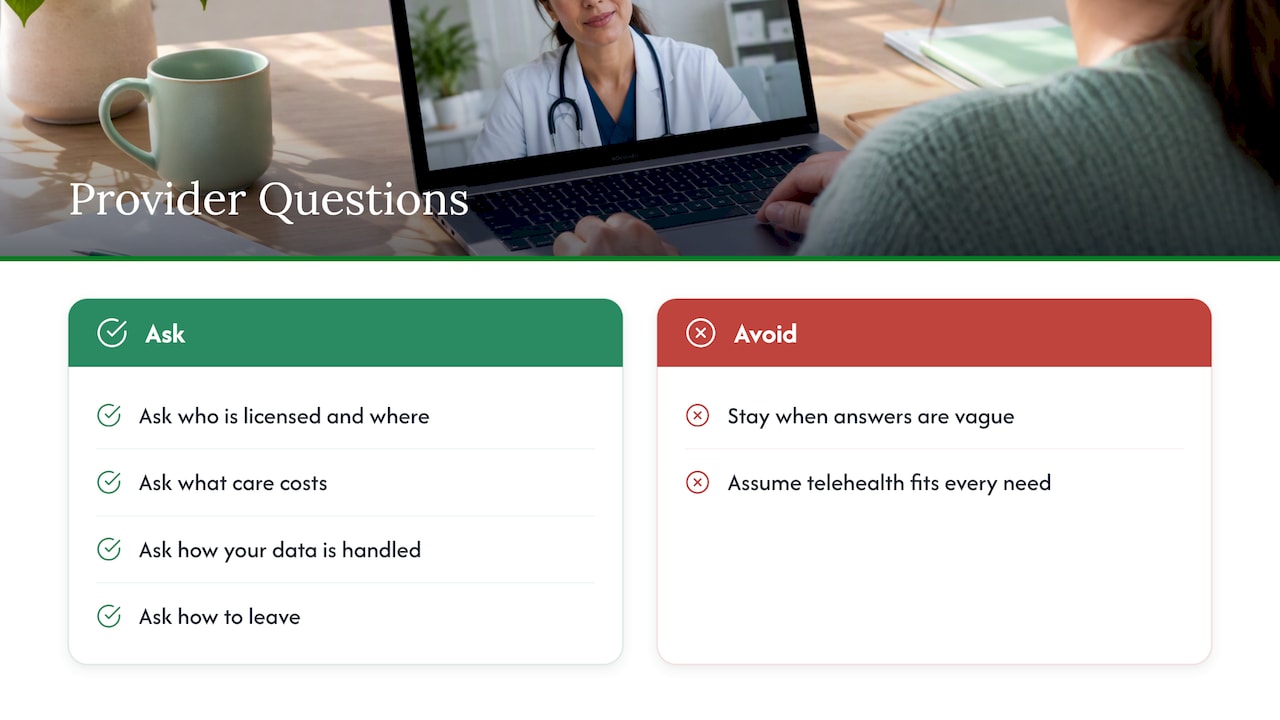
But convenience is only worth something when it comes with substance. In our view, the first questions you should ask any provider, including us, are the unglamorous ones: who is licensed, where, what does it cost, how is my data handled, and how do I leave. If the answers are clear and written down, you can trust the rest. If they are vague, move on.
We also think telehealth should be honest about its limits. It is a strong option for many needs, and when it is not the right fit, a good provider says so and points you somewhere else.
— Bryan
Get ready for your first visit
A little preparation makes the first appointment far more useful. The National Telehealth Resource Centers’ visit checklist recommends charging your device, testing your internet connection, and checking your camera, microphone and speakers before the call. It also suggests setting up a private, well-lit space.
Have these ready:
- A list of your current medications and doses
- Recent test results, if you have them
- A short list of symptoms, with when they started
- Your insurance card, if you plan to use coverage
- Your questions, written down
Providers appreciate this because it cuts time spent on history-taking and leaves more time for the decisions that matter.
Start with a provider that fits your needs
If you want a single place for several kinds of care, we can help. Zealthy offers primary care, weight loss, birth control, hair loss, skincare and erectile dysfunction treatment, along with mental health, sleep and other specialty prescriptions. Visits happen online, you can message your care team, and medication is delivered to your home when it is prescribed. You can start from our home page and see what fits your situation.
For a broader view of the field, our comparison of telehealth providers in the United States looks at how the options differ by condition, insurance and speed.
A quick decision checklist
Before you commit, you should be able to answer yes to each of these:
- I know which state’s license the clinician holds, and it matches where I will be.
- I can find a privacy policy and consent form written in plain language.
- I know the total cost, and whether my insurance applies.
- Prescriptions follow a real clinical review.
- I can cancel without a phone marathon.
- I know how to reach my care team and what happens if I need in-person care.
If any answer is no, ask the provider. A good one will answer directly.
FAQ
Who is the best telehealth provider?
There is no single best provider. The best one for you is licensed in your state, treats the condition you have, fits your insurance or budget, and handles your data responsibly. Use the eight checks above to compare your options, and keep a local in-person option for anything that needs an exam.
Does insurance still pay for telehealth?
Often, but it depends on your plan. Medicare covers telehealth from anywhere in the U.S., including your home, through December 31, 2027. Private plans vary, so call your insurer and ask about your specific provider and service before booking.
Is telehealth safe and private?
It can be, when the provider follows HIPAA and uses encrypted visits and messaging. Check for a clear privacy policy and a consent form. You can add protection by taking calls from a private room at home and using headphones.
Can I use telehealth when I am traveling?
Sometimes. The clinician generally needs to be licensed in the state where you are during the visit, so confirm this with the provider before you travel. If they cannot treat you in that state, ask about options for an in-person or local visit.
How can I tell a legitimate telehealth provider from a risky one?
A legitimate provider evaluates you before prescribing, names its clinicians and states of operation, and explains pricing and cancellation clearly. Be cautious if a site sells prescription drugs with no visit, advertises brand-name drugs at implausible prices, or claims compounded products match FDA-approved drugs.
Sources
- CMS telehealth FAQ, updated February 2026
- Medicare.gov: Telehealth coverage
- HHS: Privacy laws and policy guidance for telehealth
- AMA: State telehealth policies issue brief
- AMA: Senior patients happy with telehealth
- AMA: Virtual acute care program
- FTC: Proposed order on sensitive health data and a $7 million payment
- FDA warning letter, September 9, 2025
- Telehealth Resource Centers: Your telemedicine appointment
- Telehealth Resource Centers: Telehealth visit checklist for adults
Recommended
- 3 Telehealth Privacy Risks and a Patient Checklist to Verify Protection
- Telehealth vs Urgent Care: Choose by Symptoms, Know When to Call 911
- Telehealth vs. Office Visits: Skip the Trip Unless You Need Tests
- The best telehealth provider depends on your condition, insurance, and speed needs. Compare Zealthy, Found, Ro, Medvi, Amble, and AltRx here.


